Rug Sizes & Pads
Felt vs Rubber Rug Pads
These are not two versions of the same product. They solve different problems, and buying the wrong one is why most people think rug pads do not work.
Heads up: we earn a commission when you buy through links on this page, at no extra cost to you. It never changes which rug we put first — see how we choose and our affiliate disclosure.
Quick picks
The whole answer, before the detail. Tap any row to jump to that rug's full write-up further down the page.
| # | Rug | Best for | Construction | Price |
|---|---|---|---|---|
| 1 | 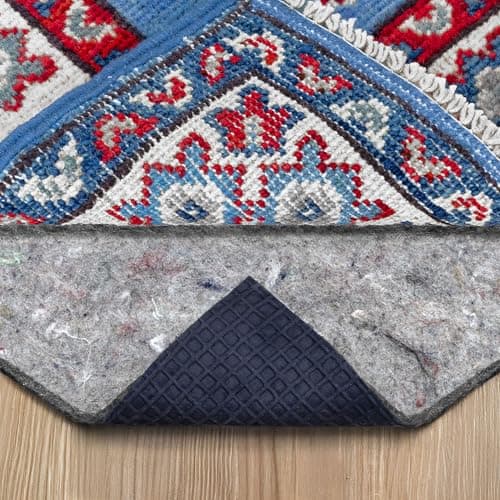 RUGPADUSA Superior-Lock Rug PadThe combined construction done properly: heat-pressed felt bonded to natural rubber, so you get the cushioning of one and the grip of the other in a single pad. Natural rubber rather than synthetic is the detail that matters on a finished wood floor - it is the formulation least likely to react with a polyurethane finish over years of contact. | Hardwood, both jobs at once | Heat-pressed felt bonded to natural rubber | $133.41$156.95View on Amazon #ad We earn a commission · Price as of October 11, 2026 |
| 2 | 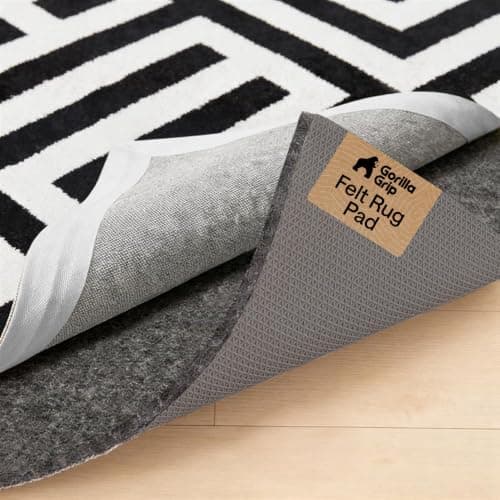 Gorilla Grip Felt and Rubber Rug PadThe same felt-over-rubber idea at a much lower price, with a textured rather than solid rubber layer. It grips well and cushions adequately. The trade is thickness consistency and long-term resilience - the felt compresses sooner than a heat-pressed pad does, so expect to replace it rather than keep it through two rugs. | Both jobs, on a budget | Felt top layer over a textured rubber grip layer | $48.99$51.99View on Amazon #ad We earn a commission · Price as of October 11, 2026 |
| 3 | 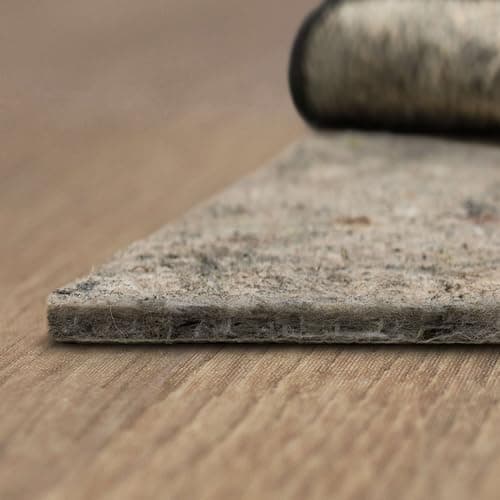 Mohawk Home Felt Rug PadFelt only, no rubber layer at all, which sounds like a lesser product and is the correct choice in one specific situation: a rug laid over wall-to-wall carpet. There, grip comes from the carpet pile itself and a rubber layer adds nothing but a sealed surface. Dense recycled felt is exactly what that job wants. | Rugs over carpet | Dense recycled felt, no rubber layer | $71.00View on Amazon #ad We earn a commission · Price as of October 11, 2026 |
| 4 | No image nuLOOM Non-Slip Outdoor Rug PadNeither felt nor solid rubber - an open-weave mesh built to drain and breathe. Included because the felt-versus-rubber question has a third answer outdoors and on any surface that gets wet, where both of the indoor options trap water and cause more trouble than the sliding they fix. | Outdoors and damp surfaces | Open-weave mesh designed to drain and breathe |
The short answer
Buy felt if you want cushioning and the rug already stays put. Buy rubber if the rug slides and you do not care how it feels. Buy a bonded felt-and-rubber pad if you want both, which is what most people on a hard floor actually need. Over wall-to-wall carpet, buy felt only - a rubber layer does nothing useful there.
A rug pad is sold as one product category and it is really three, which is why so many people conclude pads are a waste of money. They bought a thin rubber mesh because it was cheap, expected the rug to feel better, and it did not - because grip and cushioning are different jobs done by different materials. Work out which job you need first and the choice becomes obvious.
What each material actually does
Felt is dense compressed fiber, usually recycled. It does one thing well: it puts a compressible layer between the rug and a hard floor. That makes the rug feel substantially better underfoot, protects the rug's own backing from being ground against the floor, and muffles sound in a room with hard surfaces. It grips almost nothing. A felt-only pad on sealed wood will slide along with the rug, as one unit.
Rubber does the opposite. It grips a hard floor by friction and stops both the rug moving and the pad moving under it. It adds essentially no cushioning - a rubber mesh pad is a couple of millimetres thick and compresses to nothing. What it does add is the thing rug pads are most often bought for: a rug that stays where you put it, and does not ruck up into a trip hazard in a traffic lane.
Bonded felt-and-rubber is felt laminated to a rubber sheet, rubber side down. It is the right default for a rug on a hard floor because it does both jobs and does them properly, and it is the construction every pad roundup ends up recommending. It is also the thickest and the most expensive, and in a doorway that thickness can be a problem.
| Felt only | Rubber only | Felt + rubber | |
|---|---|---|---|
| Stops sliding | No | Yes | Yes |
| Cushioning | Good to excellent | None | Good to excellent |
| Protects the rug | Yes | Barely | Yes |
| Sound deadening | Good | None | Good |
| Typical thickness | 1/4 to 1/2 inch | 1/16 to 1/8 inch | 1/4 to 1/2 inch |
| Over carpet | Correct choice | Pointless | Overkill, traps moisture |
| Price | Moderate | Low | Highest |
| Lets the floor breathe | Yes | No | Partly |
Pick by what is under the rug
- Sealed hardwood - bonded felt and natural rubber. Avoid pads that do not name their rubber type; see the warning below. Rug pads for hardwood has the finish-specific detail.
- Luxury vinyl plank or sheet vinyl - this is the floor where the wrong pad chemically stains, and it is not about felt versus rubber but about plasticizers. Rug pad for vinyl plank is the page to read before buying anything.
- Tile or stone - bonded felt and rubber. Cold hard floors are where the cushioning and the sound deadening are most noticeable.
- Wall-to-wall carpet - felt only, and a dense one. Rug pad for carpet explains why a rubber layer makes things worse there.
- Concrete, including a basement slab - open-weave or felt, never solid rubber. Concrete passes moisture upward and a rubber sheet traps it.
- A deck, patio or anywhere outdoors - open-weave mesh only. Both indoor pads hold water against the surface.
RUGPADUSA Superior-Lock Rug Pad
Hardwood, both jobs at once
Product photo and price from Amazon, refreshed daily.
#ad We earn a commission · Price as of October 11, 2026
The combined construction done properly: heat-pressed felt bonded to natural rubber, so you get the cushioning of one and the grip of the other in a single pad. Natural rubber rather than synthetic is the detail that matters on a finished wood floor - it is the formulation least likely to react with a polyurethane finish over years of contact.
What it is
- Dense heat-pressed felt over a natural rubber gripping layer
- Available in quarter-inch and half-inch thicknesses
- Cuts to size with household scissors
What it does well
- Natural rubber rather than PVC or an adhesive-backed synthetic — this is the distinction that protects a hardwood finish
- The felt layer does real sound-dampening work in a room with hard floors
- Grips on glossy finishes where thinner pads slide
Don't buy it if
- Expensive relative to the rug it protects, which stops a lot of people buying one
- The half-inch version raises the rug enough to catch a door
- Heavy and awkward to handle at large sizes
The pad to buy if the floor under the rug is worth more than the rug, which on hardwood it almost always is.
Gorilla Grip Felt and Rubber Rug Pad
Both jobs, on a budget
Product photo and price from Amazon, refreshed daily.
#ad We earn a commission · Price as of October 11, 2026
The same felt-over-rubber idea at a much lower price, with a textured rather than solid rubber layer. It grips well and cushions adequately. The trade is thickness consistency and long-term resilience - the felt compresses sooner than a heat-pressed pad does, so expect to replace it rather than keep it through two rugs.
What it is
- Felt-over-rubber construction at a lower price point
- Multiple thicknesses
- Trimmable
What it does well
- Close to the premium pad's performance for meaningfully less money
- Thick enough to make a thin flatweave feel like a real rug
- Widely available in odd sizes
Don't buy it if
- The rubber layer is less dense than the premium option and compresses sooner
- Can leave a faint residue on some sealed floors in hot rooms
- The felt sheds a little when first cut
The value pad. Right under a synthetic rug, and the wrong economy under an expensive rug on an expensive floor.
Mohawk Home Felt Rug Pad
Rugs over carpet
Product photo and price from Amazon, refreshed daily.
#ad We earn a commission · Price as of October 11, 2026
Felt only, no rubber layer at all, which sounds like a lesser product and is the correct choice in one specific situation: a rug laid over wall-to-wall carpet. There, grip comes from the carpet pile itself and a rubber layer adds nothing but a sealed surface. Dense recycled felt is exactly what that job wants.
What it is
- All-felt construction with no rubber backing
- Dense enough to stop a rug rippling over carpet
- Large sizes available
What it does well
- Felt-only is the correct construction for a rug over carpet — rubber on carpet does nothing useful
- No rubber means no risk of a reaction with a vinyl or laminate finish
- Consistent density; it does not compress unevenly
Don't buy it if
- No grip layer at all, so on a bare hard floor it will slide
- Thicker than some door clearances allow
- Plain felt sheds fibers when cut
The one pad here that is specifically right for rug-over-carpet and specifically wrong for bare hardwood.
nuLOOM Non-Slip Outdoor Rug Pad
Outdoors and damp surfaces
No licensed photo of this exact rug yet — see it on the Amazon listing.
Neither felt nor solid rubber - an open-weave mesh built to drain and breathe. Included because the felt-versus-rubber question has a third answer outdoors and on any surface that gets wet, where both of the indoor options trap water and cause more trouble than the sliding they fix.
What it is
- Open mesh rather than solid felt, so water passes through
- Designed for deck and patio use
- Trimmable
What it does well
- The open weave is the whole point outdoors: it lets a deck dry instead of trapping water against it
- Stops a lightweight outdoor rug creeping in wind
- Rinses clean along with the rug
Don't buy it if
- Provides almost no cushioning — this is a grip and airflow product
- The mesh can print a faint grid onto a soft deck stain over a long summer
- Needs lifting and rinsing periodically or grit collects in the weave
The answer to the question that ruins decks: an outdoor rug needs a pad that breathes, not one that seals.
Thickness, and when it is a mistake
A quarter inch is the usual sweet spot and a half inch is luxurious. But thickness has three real costs. It raises the rug, which can stop a door clearing it - interior doors often have half an inch or less of clearance. It makes the rug edge a more pronounced trip step, which matters at the top of stairs and in a hallway. And under a thin rug it can feel unstable rather than cushioned, because the rug has no structure of its own to spread the load.
So go thick under a substantial rug in the middle of a room, and go thin under a flatweave, in a doorway, or anywhere near a step. Under a runner specifically, thin and grippy beats thick and soft every time - a runner has more unweighted length to move than a large rug does, and a thick pad gives it something to roll on.
Sizing the pad
- Cut it one inch smaller than the rug on every side. That means a pad roughly two inches smaller in each dimension - an 8x10 rug takes a pad trimmed to about 7 feet 10 by 9 feet 10.
- Never let the pad show. A pad reaching the rug's edge is visible, collects dirt, and curls up where feet catch it.
- Cut it with scissors or a utility knife on the floor, rug on top. Felt cuts cleanly; bonded pads cut from the felt side. Mark it rather than eyeballing it.
- Join two pieces for a very large rug rather than buying oversize. Butt the edges together under the middle of the rug - the seam is invisible and does not move.
- Keep the offcuts. The trimmed strips are exactly what you want under a small accent rug or a bath mat.
The short version
On a hard floor, buy the bonded felt-and-rubber pad with named natural rubber and stop thinking about it - it is the answer for the large majority of rugs. Buy felt only if the rug is going over carpet. Buy rubber only if your single problem is a rug that slides and you are not willing to pay for the rest. Buy an open-weave mesh if the surface ever gets wet. And in all four cases trim it an inch smaller than the rug all round, because that is the part everyone skips.
For the grip-first products specifically, non-slip rug pads is the roundup, and rug pads is the overview of the whole category including sizing by rug dimension.
Questions people actually ask
Are felt or rubber rug pads better?
Neither - they do different jobs. Felt cushions and protects; rubber grips. On a hard floor the right answer is usually a bonded pad with both. Over wall-to-wall carpet, felt alone is correct.
Do felt rug pads stop a rug sliding?
On a hard floor, no. A felt-only pad slides along with the rug as one unit. It only works as a non-slip layer over carpet, where the carpet pile provides the grip instead.
What rug pad is best for hardwood floors?
Felt bonded to natural rubber. The important word is natural - cheap synthetic rubber, PVC and adhesive-backed pads can react with a polyurethane finish and leave a residue that has to be sanded out.
How thick should a rug pad be?
A quarter inch suits most rugs. Go thinner under a flatweave, under a runner, in a doorway or near stairs, where height becomes a trip hazard or stops a door clearing the rug.
What size rug pad do I need for an 8x10 rug?
About 7 feet 10 by 9 feet 10 - one inch smaller than the rug on every side. Buy the nearest larger size and trim it with scissors or a utility knife.
Can you use a rubber rug pad on vinyl plank?
Only with a pad specifically rated for it. Plasticizer migration between some rubber and PVC compounds and a vinyl floor causes permanent discoloration, and it is the one pad mistake that damages the floor rather than the rug.
Do you need a rug pad under a runner?
Yes, more than under a large rug - a runner has more unweighted length to move. Use a thin grippy pad rather than a thick cushioned one, which gives the runner something to roll on.
Sources
Read next
- Rug PadsWhat a pad does, the four constructions, and how to match one to hardwood, vinyl, tile or carpet.
- Non-Slip Rug PadsWhy rugs slide, which pad constructions genuinely hold, and the thin options for tight door clearances.
- Rug Pad for Hardwood FloorsWhich pads are safe on hardwood, which damage the finish, and how to tell them apart before buying.
- Rug Pad for CarpetDense felt, not rubber. Why rubber pads fail over carpet, what stops the rug creeping, and when to use no pad at all.
- Rug Pad for Vinyl Plank FlooringWhy some backings permanently discolor LVP, which pads are safe, and how to check before laying a rug.
- Rug Sizes & PadsSize charts by room and bed, the 8x10 vs 9x12 decision, placement rules, and the right pad for hardwood, vinyl or carpet.