Rug Sizes & Pads
Rug Pad for Carpet
Putting a rug on carpet breaks the usual rule. The rubber pad that grips a wood floor does almost nothing on a pile, and it causes a problem of its own.
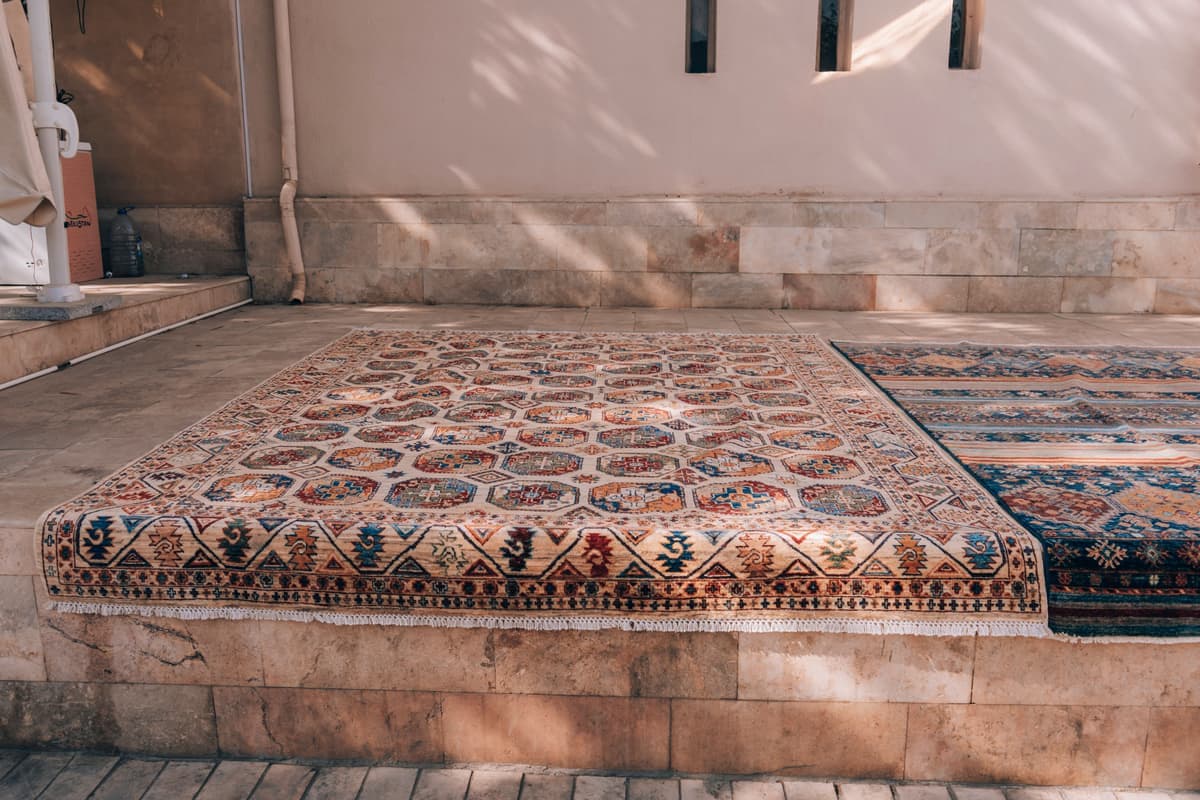
The short answer
Use a dense felt pad with no rubber layer. Rubber grips by friction against a hard surface and finds nothing to hold on a carpet pile, so it adds thickness without adding grip - and it seals the carpet underneath, which traps moisture. Felt works here because it adds mass and stiffness, which is what actually stops a rug creeping on carpet.
Layering a rug over wall-to-wall carpet is a legitimate thing to do and increasingly common - it is how renters get a rug they like onto a floor they cannot change, and how a large room gets a defined seating area without replacing the carpet. The problem is that every piece of rug pad advice you will read is written for hard floors, and on carpet the advice inverts.
Why rubber fails on carpet
A rubber pad works by friction against a smooth continuous surface. Carpet is neither: it is thousands of flexible fiber tips, and they move. The rubber sits on top of the tips, the tips bend under load, and the pad travels with the rug rather than anchoring it. On a plush or shag carpet it is close to useless.
Worse, a solid rubber sheet seals the carpet underneath it. Carpet and its own underlay hold a surprising amount of ambient moisture and need to breathe; cover a rectangle of it with an impermeable layer for a year and you get a musty patch, discoloration, and on a damp ground floor the beginnings of a mildew problem. That is a real failure, not a theoretical one, and it is the reason this page exists separately from felt versus rubber rug pads.
Why felt works
Felt does not grip the carpet; it stiffens the rug. Rug creep on carpet happens because a soft rug on a soft surface has nothing to resist shear - you step, the rug's edge bunches, and it walks forward a fraction of an inch. A dense felt pad gives the whole assembly enough rigidity that the rug moves as one plate instead of rippling, and it adds weight. That combination is what actually stops the creep.
The secondary benefits are real too. Felt stops the rug's backing abrading the carpet pile underneath, which otherwise flattens into a permanent rectangle. It keeps the rug's edges from curling. And it stays breathable, so the carpet underneath dries and does not discolor.
| Carpet underneath | Pad to use | Why |
|---|---|---|
| Plush or shag | Dense felt, no rubber | Nothing for rubber to grip |
| Medium cut pile | Dense felt, no rubber | Felt stiffens the rug instead |
| Low, dense loop | Felt and natural rubber | Behaves like a hard surface |
| Commercial-grade short pile | Felt and natural rubber | Rubber finds purchase |
| Carpet tiles | Dense felt | Avoid sealing the seams |
| Damp ground-floor carpet | Felt only, and check the damp | Never seal it |
The other half of the problem: the rug itself
No pad rescues the wrong rug on carpet. The rug choices that work are low-pile, flatwoven or tightly constructed, and reasonably heavy. The ones that fail are thick, soft or deep-pile rugs, which rock underfoot on a soft base and whose edges will not lie flat. If you have a plush carpet and you buy a shag rug for it, the combination feels unstable no matter what you put between them.
- Choose a low-pile or flatweave rug. Stiffness in the rug is worth more than thickness in the pad.
- Trim the pad an inch smaller than the rug all round. Same rule as a hard floor. A pad that reaches the edge shows and curls.
- Put the furniture legs on it. This is the most effective anti-creep measure available on carpet and it costs nothing - two sofa legs on the rug will hold it better than any pad.
- Check the door clearance. You are now stacking carpet plus pad plus rug. In a doorway this is the layering that stops a door closing.
- Lift it twice a year. Both to let the carpet breathe and to vacuum the fiber that has worked its way between the layers.
Mohawk Home Felt Rug Pad
Rugs over carpet
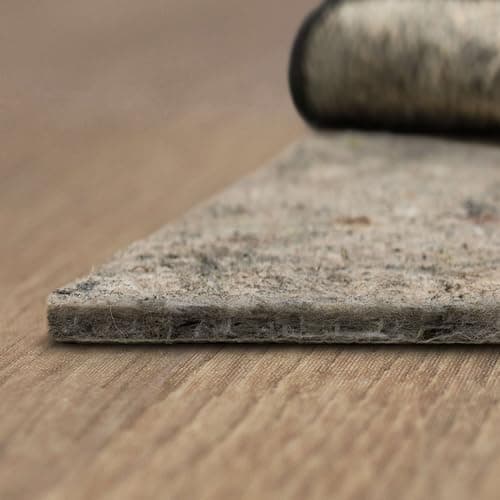
Product photo and price from Amazon, refreshed daily.
#ad We earn a commission · Price as of October 11, 2026
The correct product for this exact job, and the reason is what it leaves out: dense recycled felt with no rubber layer. Over carpet the grip has to come from mass and friction against the pile rather than from a tacky surface, and a rubber layer would only seal the carpet underneath. It is also the cheapest of the pads here, which is fair because it is doing one job.
What it is
- All-felt construction with no rubber backing
- Dense enough to stop a rug rippling over carpet
- Large sizes available
What it does well
- Felt-only is the correct construction for a rug over carpet — rubber on carpet does nothing useful
- No rubber means no risk of a reaction with a vinyl or laminate finish
- Consistent density; it does not compress unevenly
Don't buy it if
- No grip layer at all, so on a bare hard floor it will slide
- Thicker than some door clearances allow
- Plain felt sheds fibers when cut
The one pad here that is specifically right for rug-over-carpet and specifically wrong for bare hardwood.
RUGPADUSA Superior-Lock Rug Pad
Low, dense carpet
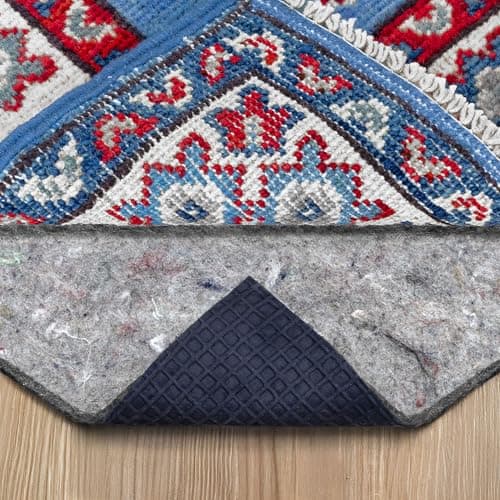
Product photo and price from Amazon, refreshed daily.
#ad We earn a commission · Price as of October 11, 2026
The upgrade if the carpet is low and dense - a commercial-grade loop, or the short tight pile in a rental - where the floor behaves more like a hard surface than a plush pile. The natural rubber layer does find purchase on that kind of carpet, and the heat-pressed felt is noticeably firmer underfoot than a budget pad.
What it is
- Dense heat-pressed felt over a natural rubber gripping layer
- Available in quarter-inch and half-inch thicknesses
- Cuts to size with household scissors
What it does well
- Natural rubber rather than PVC or an adhesive-backed synthetic — this is the distinction that protects a hardwood finish
- The felt layer does real sound-dampening work in a room with hard floors
- Grips on glossy finishes where thinner pads slide
Don't buy it if
- Expensive relative to the rug it protects, which stops a lot of people buying one
- The half-inch version raises the rug enough to catch a door
- Heavy and awkward to handle at large sizes
The pad to buy if the floor under the rug is worth more than the rug, which on hardwood it almost always is.
Gorilla Grip Felt and Rubber Rug Pad
When you are unsure
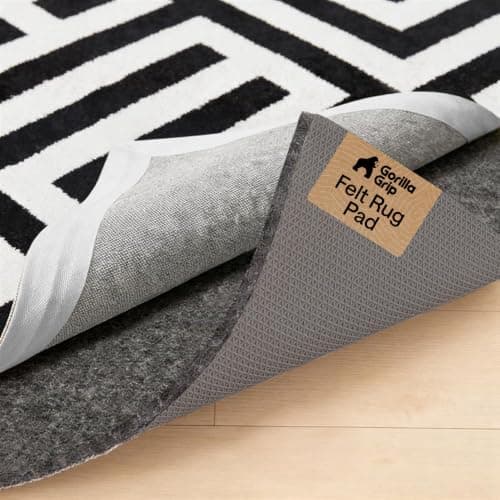
Product photo and price from Amazon, refreshed daily.
#ad We earn a commission · Price as of October 11, 2026
A reasonable middle option where you are not sure which category your carpet falls into, because the textured rather than solid rubber layer compromises in both directions. It grips a low pile adequately and seals less of the carpet than a solid sheet would. On deep plush carpet it is still the wrong tool.
What it is
- Felt-over-rubber construction at a lower price point
- Multiple thicknesses
- Trimmable
What it does well
- Close to the premium pad's performance for meaningfully less money
- Thick enough to make a thin flatweave feel like a real rug
- Widely available in odd sizes
Don't buy it if
- The rubber layer is less dense than the premium option and compresses sooner
- Can leave a faint residue on some sealed floors in hot rooms
- The felt sheds a little when first cut
The value pad. Right under a synthetic rug, and the wrong economy under an expensive rug on an expensive floor.
Rug creep, if it is already happening
If a rug on carpet is walking across the room, the cause is almost always directional traffic - a path that crosses the rug the same way every time, so each footstep nudges it a fraction. The fixes in order of effectiveness: get furniture legs onto it, add a dense felt pad, rotate the rug 180 degrees so the creep works against itself, and move the rug so the traffic path crosses it at a different angle. Carpet tape is a last resort and a bad one, because removing it takes carpet fibers with it.
What will not help is a rubber pad, for the reasons above, or a thicker pad, which makes the rocking worse. If you have tried the first three and the rug still moves, the rug is too light or too soft for the job.
The short version
Dense felt, no rubber, trimmed an inch smaller than the rug, with furniture legs on top and a low-pile rug above it. Reserve the felt-and-rubber pad for carpet so short and dense that it behaves like a hard floor. And lift the whole thing twice a year, because the one failure that is genuinely hard to undo is the musty discolored rectangle left by a sealed pad. For the rest of the pad category, rug pads is the overview and washable rugs on carpet covers the same layering question for washable rugs specifically.
Questions people actually ask
Do you need a rug pad on carpet?
Often, but not always. On a low dense carpet, under a heavy flatweave with furniture on it, you may not need one. On medium or plush carpet a dense felt pad stops the rug creeping and keeps the carpet underneath from flattening.
What kind of rug pad is best for carpet?
Dense felt with no rubber layer. Felt works by stiffening the rug and adding mass, which is what resists creep on a soft surface - rubber needs a hard surface to grip and finds nothing on a pile.
Why does my rug slide on carpet?
Directional foot traffic. A path that crosses the rug the same way every time nudges it forward a fraction each step. Furniture legs on the rug is the most effective fix, followed by a dense felt pad.
Can you use a rubber rug pad over carpet?
You can, but it does little and causes a problem. The rubber cannot grip flexible carpet tips, and a solid rubber sheet seals the carpet underneath, which traps moisture and leaves a musty discolored rectangle.
Will a rug ruin the carpet underneath it?
It will flatten the pile into a visible rectangle, and that is usually recoverable. What is not recoverable is the discoloration from a sealed, impermeable pad left down for a year or more - which is the main reason to use felt here.
What size pad for a rug over carpet?
One inch smaller than the rug on every side, the same as on a hard floor. A pad that reaches the rug's edge is visible and curls where feet catch it.
Should a rug over carpet be low pile?
Yes. A thick or deep-pile rug on a soft carpet base rocks underfoot and its edges will not lie flat, and no pad fixes that. Stiffness in the rug matters more than thickness in the pad.
Sources
Read next
- Rug PadsWhat a pad does, the four constructions, and how to match one to hardwood, vinyl, tile or carpet.
- Felt vs Rubber Rug PadsFelt for cushioning, rubber for grip, felt-and-rubber for both. Which to buy by floor type and rug size, and the pads that damage a finish.
- Non-Slip Rug PadsWhy rugs slide, which pad constructions genuinely hold, and the thin options for tight door clearances.
- Are Washable Rugs Good on Carpet?Layering a washable rug over carpet — why two-piece systems ripple, and the felt-only pad that fixes it.
- Rug Pad for Hardwood FloorsWhich pads are safe on hardwood, which damage the finish, and how to tell them apart before buying.
- Rug Sizes & PadsSize charts by room and bed, the 8x10 vs 9x12 decision, placement rules, and the right pad for hardwood, vinyl or carpet.