Rug Sizes & Pads
Rug Pile Height
The spec that decides whether a door opens, a chair rolls and a vacuum works. It is in every listing and almost nobody reads it.
The short answer
Low pile is under a quarter inch, medium is a quarter to half an inch, and high pile is anything above roughly half an inch - with shag starting around an inch. Low pile for kitchens, entries, dining rooms and offices; medium for living rooms; high for bedsides only. A standard interior door clears about three quarters of an inch.
Pile height is the distance from the backing to the tips of the yarn, and it is listed on almost every rug sold. It is also the single most predictive spec in a listing: it tells you how the rug will feel, how it will wear, how you will clean it and whether it will physically fit where you are putting it. Fiber gets all the attention and pile height decides more of the day-to-day experience.
The chart
| Band | Height | Feels | Right for | Wrong for |
|---|---|---|---|---|
| Flatweave | Under 1/8 inch | Firm, thin | Doors, layering, dining, offices | Comfort underfoot |
| Low pile | 1/8 to 1/4 inch | Firm, slight give | Kitchens, entries, hallways, high traffic | Bedrooms |
| Medium pile | 1/4 to 1/2 inch | Soft, with support | Living rooms, bedrooms | Desk chairs, under doors |
| High pile | 1/2 to 1 inch | Plush, sinking | Bedrooms, low-traffic sitting rooms | Anywhere with traffic or food |
| Shag | 1 inch and up | Deep, tousled | Bedsides | Almost everywhere else |
The bands are conventions rather than standards, so one maker's medium is another's low. The inches are what matter, and the inches are almost always in the listing. If a rug is described only as plush or low profile with no number, that is worth treating as a missing spec rather than a minor omission.
What to look for, in the order that matters
- Measure the door clearance first. Open the interior door fully and measure the gap between the bottom of the door and the floor at its tightest point. A typical gap is half to three quarters of an inch, and the rug plus its pad has to fit under it. This is the constraint that most often forces a rug to go back.
- Decide whether anything rolls on it. A desk chair, a kitchen cart, a walker or a stroller all need a flatweave or low pile. Casters do not roll on a medium pile and sink into a high one.
- Count the pile height with the pad. A half-inch felt pad under a half-inch rug is an inch of total build. People measure the rug and forget the pad, and the door catches.
- Match the pile to the traffic, not to the look you want. Pile crushes in proportion to how often it is walked on. A high pile in a hallway develops a permanent visible lane within a year; a low pile in the same spot does not.
- Think about how you will clean it. Low pile takes a beater bar and shows dirt on the surface. High pile needs suction-only vacuuming and hides grit at its base, which is where the damage happens.
Safavieh Wool Flatweave Kilim Rug
Doors, dining chairs and desk chairs
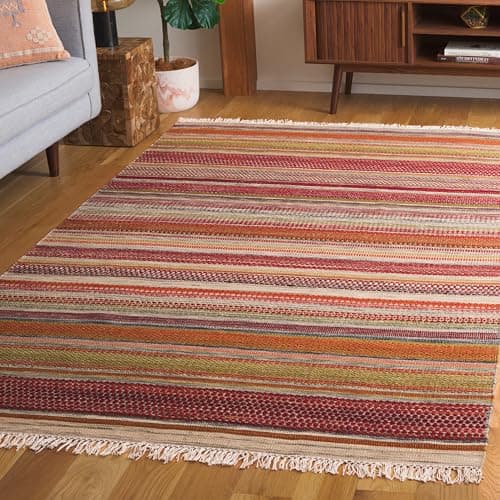
The low-pile end of the range, and effectively the zero point: a flatwoven wool kilim has no pile at all, just the weave. That is the construction you want under a door, under a dining table or in any room with a wheeled chair, because there is nothing to crush, nothing to catch and nothing to stop a door clearing. Thin and firm underfoot, which is the trade and the reason it is not a bedroom rug.
What it is
- Flatwoven — effectively no pile at all
- Wool fiber with a handwoven geometric pattern
- Reversible on many of the kilim patterns
What it does well
- Chairs slide over it instead of catching, which is exactly what a dining room needs
- No pile means nothing to crush, so furniture leaves no permanent dents
- Wool's soil resistance without wool's shedding
Don't buy it if
- Thin and firm underfoot — it will not feel luxurious
- Flatweaves need a good pad or they creep across the floor
- Spilled liquid goes straight through to the floor below
The correct rug shape for a dining room, in the correct fiber. Almost nobody buys this and regrets it.
Safavieh Hand-Tufted Wool Rug
Living rooms and bedrooms
No licensed photo of this exact rug yet — see it on the Amazon listing.
The medium-pile example, and the height most living rooms actually want. Hand-tufted wool gives real depth without the maintenance of a shag, and wool's crimp means the pile springs back rather than developing a permanent footpath. At this height a door will usually still clear it over a hard floor, but measure first - this is exactly the range where the clearance question becomes real.
What it is
- Wool pile hand-tufted to a cotton backing
- Made in India across a large pattern catalog
- Cut pile, generally medium height
What it does well
- Wool springs back from furniture compression in a way no synthetic does
- Naturally flame-resistant and naturally soil-resistant thanks to the lanolin in the fiber
- With normal care it outlives every synthetic rug on this page several times over
Don't buy it if
- Sheds noticeably for the first few months — normal for a tufted wool rug, not a defect
- Hand-tufted rugs are glued, and the latex adhesive can break down after many years
- Costs several times what a comparable polypropylene rug costs
The long-horizon purchase in this category: expensive once rather than cheap repeatedly.
nuLOOM Moroccan Shag Rug
Bedsides, and nowhere with wheels
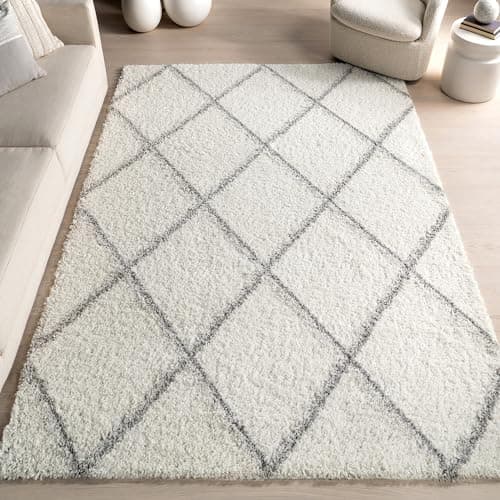
Product photo and price from Amazon, refreshed daily.
#ad We earn a commission · Price as of October 18, 2026
The high-pile end. A machine-woven polypropylene shag at roughly an inch or more of pile, which is the point where every practical rule changes: no door clears it, no caster rolls on it, and a beater bar damages it. Put it beside a bed, where depth underfoot is the entire purpose and none of those constraints apply.
What it is
- High-pile shag in polypropylene rather than wool
- Diamond trellis pattern that has been the category default for a decade
- Sizes from accent to oversized
What it does well
- Genuinely soft for a synthetic, which is what a bedside rug needs to be
- Cheap enough to replace on a five-year cycle without pain
- Deep pile swallows the small debris a bedroom generates
Don't buy it if
- High pile is miserable to vacuum and worse with a pet in the house
- Crushes permanently under a bed leg
- The trellis pattern is everywhere, so the room will not look distinctive
Right for the two feet beside a bed. Wrong anywhere a chair, a door or a vacuum has to cross it.
Pile height by room
| Room | Pile height | Why |
|---|---|---|
| Entryway | Flat or low | Grit grinds into a deep pile and door clearance is tight |
| Kitchen | Flat or low | Spills must be reachable; carts and stools need to roll |
| Dining room | Flat | Chair legs crush pile permanently and catch on it |
| Living room | Low to medium | Comfort without a traffic lane forming |
| Bedroom | Medium to high | Comfort underfoot, low traffic, no food |
| Bedside strip | High or shag | The one place depth is the whole point |
| Home office | Flat or low | Caster chairs will not roll on anything deeper |
| Hallway | Flat or low | Highest traffic concentration in the house |
| Bathroom | Low to medium | Must dry quickly; depth holds damp |
Pile height and how long the rug lasts
Density matters more than height for durability, and the two get confused constantly. A dense low pile outlasts a sparse high pile in the same fiber, every time, because wear is a function of how much fiber is sharing the load. The test in a showroom is to press your thumb into the pile and part it: if you can see the backing easily, the rug is sparse, and height will not save it.
Height does decide how visible the wear is. A high pile shows crushing - the traffic lane - long before it shows actual fiber loss, so it looks worn before it is worn. A flatweave shows no crushing at all and then fails abruptly at the edge. Neither is better; they just age differently, and knowing which you have prevents replacing a rug that is fine.
Vacuuming changes with the height
On a flatweave and a low pile, use suction with the beater bar on a low setting - there is nothing to pull out and the brush helps lift grit. On a medium pile, keep the brush on its highest setting. On a high pile or a shag, switch the rotating brush off entirely: it pulls long yarn out of the backing and that damage is permanent. Vacuuming rugs has the full settings table.
The short version
Measure the door gap, decide whether anything rolls across the rug, and pick the shallowest pile that still gives you the comfort you want in that room. Low pile is the right default almost everywhere outside a bedroom. If you want depth, confine it to the bedroom and buy a dense wool pile rather than a shag - the best shag rugs explains why, and the best rug material for a bedroom makes the case for the one room where this rule inverts.
Questions people actually ask
What is considered low pile for a rug?
Under about a quarter inch from backing to yarn tip, with flatweaves below an eighth of an inch. Low pile is the right default for kitchens, entries, hallways, dining rooms and offices.
What pile height is best for a living room?
Low to medium - roughly an eighth to half an inch. That gives comfort underfoot without developing a visible traffic lane, and it usually still clears an interior door.
What pile height works with an office chair?
Flatweave or low pile only. Casters do not roll on a medium pile and sink into a high one, and the repeated load crushes pile permanently where the chair sits.
Will a rug fit under my door?
Measure the gap between the bottom of the door and the finished floor, at the tightest point. Standard clearance is half to three quarters of an inch, and the rug plus the pad has to fit inside that.
Does higher pile mean better quality?
No. Density matters far more than height. A dense low pile outlasts a sparse high pile in the same fiber. Press your thumb into the pile and part it - if the backing shows easily, the rug is sparse.
What is the difference between pile height and rug thickness?
Pile height measures only the yarn above the backing; thickness includes the backing as well, and the figure quoted for a rug pad is separate again. Add the rug and the pad together when checking door clearance.
Sources
Read next
- Rug PadsWhat a pad does, the four constructions, and how to match one to hardwood, vinyl, tile or carpet.
- Vacuuming RugsWhich setting for which construction, why beater bars help some rugs and wreck others, and how often to vacuum.
- The Best Flatweave RugsFlatweave rugs across cotton, wool, sisal and polypropylene, judged on what each fiber does when there is no pile to hide behind.
- The Best Shag RugsThe polypropylene shag to buy for a bedside, the wool upgrade that lasts longer, and why a shag is wrong in every busy room.
- The Best Rugs for a Home OfficeOffice rugs that survive caster wheels, plus what to do about cable runs and the chair-mat question.
- Rug Sizes & PadsSize charts by room and bed, the 8x10 vs 9x12 decision, placement rules, and the right pad for hardwood, vinyl or carpet.