Rug Sizes & Pads
What Size Rug for a Dining Table?
This is the one rug size that is not a matter of taste. A chair that falls off the edge is a defect, and the arithmetic tells you the size.
The short answer
Take your table's length and width, add 48 inches to each — 24 inches on every side, which is how far a chair travels when someone stands. Four seats usually lands on 8x10, six to eight seats on 9x12, and a 42-inch round table on an 8-foot round. If the number falls between two sizes, go up.
Why 24 inches and not a judgment call
Every other rug decision in a house is negotiable. This one is not, because it is about a chair in motion. When someone pushes back from the table to stand, the back legs travel roughly 18 to 24 inches. If the rug stops short of that, the back legs drop off the edge mid-movement — the chair lurches, the rug binding takes the scuff, and over a few hundred meals the edge frays where every chair crosses it.
So the rug is sized to the chairs, not to the table and not to the room. Measure the table, add 24 inches on all four sides, and that is the minimum rug. 18 inches is the absolute floor when the room genuinely cannot take more; below that, a rug under the table is doing harm rather than good and bare floor is the better answer.
The arithmetic, table by table
| Table | Seats | Rug needed | Standard size |
|---|---|---|---|
| 36 x 48 in rectangular | 4 | 84 x 96 in | 8x10 (96 x 120) |
| 36 x 60 in rectangular | 4-6 | 84 x 108 in | 8x10, tight at the ends |
| 40 x 72 in rectangular | 6 | 88 x 120 in | 9x12 (108 x 144) |
| 42 x 96 in rectangular | 8 | 90 x 144 in | 9x12 — exactly |
| 42 x 120 in rectangular | 10 | 90 x 168 in | 10x14 or larger |
| 42 in round | 4 | 90 in across | 8 ft round (96 in) |
| 48 in round | 4-6 | 96 in across | 8 ft round — exactly |
| 60 in round | 6-8 | 108 in across | 9 ft round, or 10x10 square |
Two things to notice in that table. A six-seat rectangular table needs 120 inches of length, and an 8x10 is exactly 120 inches long — it meets the requirement with nothing to spare, which in practice means the end chairs ride the edge. That is why six seats is really a 9x12 question rather than an 8x10 one, and the full version of that decision is on 8x10 vs 9x12.
The second thing: nothing in that table is smaller than 8x10. A 6x9 is 72 inches wide, which fails the narrowest four-seat table by a foot. If you have been looking at 5x7 and 6x9 for a dining room, the answer is that neither size exists for this job.
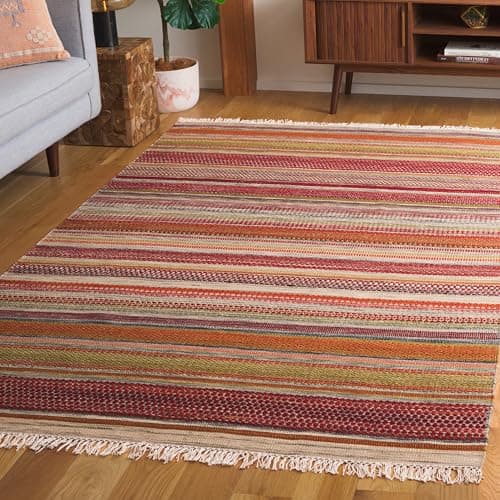
Safavieh Wool Flatweave Kilim Rug
The right construction
Product photo and price from Amazon, refreshed daily.
#ad We earn a commission · Price as of October 11, 2026
Effectively no pile, so chair legs slide instead of catching and crumbs lift out with a vacuum. Flatweave is the correct construction under a table and this one comes in the sizes the arithmetic asks for.
What it is
- Flatwoven — effectively no pile at all
- Wool fiber with a handwoven geometric pattern
- Reversible on many of the kilim patterns
What it does well
- Chairs slide over it instead of catching, which is exactly what a dining room needs
- No pile means nothing to crush, so furniture leaves no permanent dents
- Wool's soil resistance without wool's shedding
Don't buy it if
- Thin and firm underfoot — it will not feel luxurious
- Flatweaves need a good pad or they creep across the floor
- Spilled liquid goes straight through to the floor below
The correct rug shape for a dining room, in the correct fiber. Almost nobody buys this and regrets it.
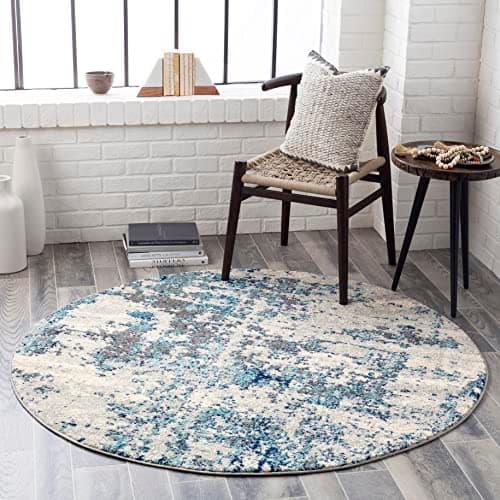
Artistic Weavers Round Area Rug
Round tables
Product photo and price from Amazon, refreshed daily.
#ad We earn a commission · Price as of October 11, 2026
A round table wants a round rug, and the diameters that match a four-seat table are a narrow band — this is one of the ranges that actually stocks them.
What it is
- Round sizes from four foot up to eight foot
- Medium pile
- Patterns designed to work from every viewing angle
What it does well
- Round patterns that actually resolve in the round, rather than a square design cropped to a circle
- Sizes that line up with standard round table diameters
- Pile height works under a chair without catching
Don't buy it if
- Round rugs are harder to place well and easy to get wrong by a foot
- Fewer sizes than the rectangular equivalents
- A round rug in a square room needs the rest of the furniture to cooperate
Worth it under a round table, where a rectangle always looks like a mistake.
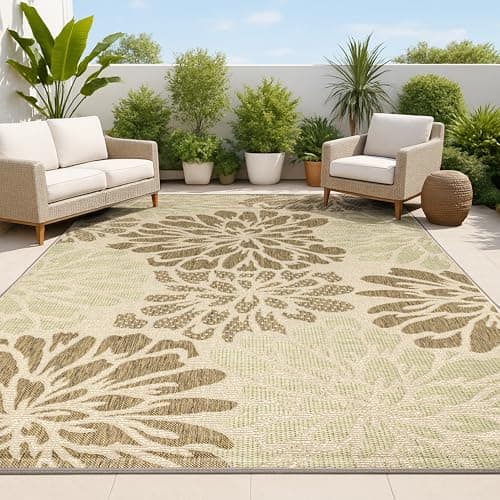
JONATHAN Y Modern Area Rug
Six seats and up
Product photo and price from Amazon, refreshed daily.
#ad We earn a commission · Price as of October 11, 2026
Six seats and up is 9x12 territory, which is exactly where most ranges stop. Worth knowing which lines go that far before you fall for a pattern that does not.
What it is
- Machine-woven polypropylene in contemporary patterns
- Strong availability at 8x10, 9x12 and larger
- Low to medium pile
What it does well
- Genuinely available in the big sizes an open-plan room needs, which a lot of design-led brands are not
- Contemporary patterns rather than the traditional default
- Pile low enough for a room with dining chairs in it
Don't buy it if
- Large synthetic rugs arrive heavily creased and take weeks to flatten
- The pattern repeat is visible on the very large sizes
- Edges can fray if a vacuum beater bar catches them
A practical answer to the hardest sizing problem in the category: covering a large open room without spending four figures.
How to measure yours
Measure the table top, not the base
Length and width at the widest point of the top, in inches. The top overhangs the base, and the chairs clear the top.
Add any extension leaf you actually use
If the table lives extended, or goes extended for every family meal, measure it extended. Sizing to the collapsed table means the rug is wrong exactly when the room is full.
Add 48 inches to each dimension
That is 24 inches per side. A 40 by 72 inch table becomes 88 by 120 inches of rug — the minimum, not the target.
Round up to the next standard size
Rugs come in fixed sizes and the arithmetic rarely lands on one. Up, never down: an inch of surplus rug is invisible and an inch short is a chair leg off the edge.
Check the rug still clears the walls and the doors
Leave 18 inches or so of bare floor to each wall, and check that the rug edge is not under a door swing or a chair rail where a cabinet door opens.
Construction matters more here than anywhere else
A dining room is the one place where the fiber decision is driven by the furniture rather than by feel. You want low pile or no pile — flatweave, or a tight loop. Two reasons, both practical:
- Chair legs slide over a flatweave and sink into a pile. On a plush rug every chair has to be lifted rather than pushed, which nobody does for long.
- Food falls on a dining rug. A flatweave releases crumbs to a vacuum; a shag holds them, and a spill that soaks into deep pile under a table is the reason a lot of dining rugs are thrown out in year two.
Flatwoven wool is the quietly correct answer — tough, naturally stain-resistant and it does not crush under a chair leg. A flatwoven synthetic is the cheaper version of the same idea. If there are young children at the table, a washable rug is a legitimate trade: thinner and less substantial underfoot, but a spill becomes a wash cycle rather than a professional clean. Avoid viscose entirely — it is permanently marked by water, which is a strange thing to put under a table.
Round tables and the diameter trap
A round table reads best on a round rug, and the arithmetic is the same: table diameter plus 48 inches. The trap is that round rugs are sold in a much narrower set of diameters than rectangles — commonly 6, 8 and 9 feet, with little in between. A 48-inch round table needs 96 inches, which is exactly an 8-foot round; a 54-inch table needs 102 inches, and there is nothing between the 8-foot and the 9-foot. Going down to the 8-foot leaves 21 inches per side, which is inside the workable band but not comfortable.
A square rug is the overlooked alternative: a 10x10 under a 60-inch round table clears 30 inches on every side and is easier to find than a 9-foot round. More on diameters and placement in round rugs.
The mistakes worth naming
- Sizing to the room instead of the table. A rug centered in the room but short of the chairs fails at the only job it has here.
- Measuring the collapsed table. The leaf goes in for the meals that matter and the chairs move further out, not less.
- Buying the rug you liked at 5x7 or 6x9 anyway. It will be a tripping edge under the end chairs within a week.
- Choosing a plush pile because the room is formal. Formal dining rooms traditionally use flatweaves and low-pile orientals for exactly this reason.
- Skipping the pad. The rug walks out from under the table a few inches a week and you will straighten it forever.
For the products that fit these sizes rather than the measurements themselves, see the best rugs for under a dining table.
Questions people actually ask
What size rug goes under a dining table?
Table length and width plus 48 inches each — 24 inches per side. Four seats usually means 8x10, six to eight seats 9x12.
Is a 6x9 big enough for a dining table?
No. At 72 inches wide it fails even a 36-inch-wide four-seat table, which needs 84 inches. Dining rugs start at 8x10.
How much should a rug stick out past a dining table?
24 inches on every side. 18 is the absolute minimum when the room cannot take more; less than that and the chairs ride the edge.
What size round rug for a round dining table?
Diameter plus 48 inches. A 42 or 48-inch round table takes an 8-foot round; a 60-inch table needs a 9-foot round or a 10x10 square.
What pile height is best under a dining table?
Low or none. A flatweave lets chairs slide and releases crumbs to a vacuum; deep pile traps food and has to be lifted over.
Should I measure the table with the leaf in?
Yes, if you ever use it extended. The meals where the table is full are the ones where the chairs move furthest out.
Read next
- The Best Rugs for Under a Dining TableDining rugs sized so chairs never catch, in the constructions that survive dropped food.
- 8x10 vs 9x12The 8x10 versus 9x12 decision settled with measurements rather than instinct.
- 5x7 vs 6x9The 5x7 versus 6x9 decision settled with measurements, including the rooms where neither is big enough.
- Round RugsHow to size a round rug to a round table, and the placements where a circle beats a rectangle.
- Rug PadsWhat a pad does, the four constructions, and how to match one to hardwood, vinyl, tile or carpet.
- Rug Sizes & PadsSize charts by room and bed, the 8x10 vs 9x12 decision, placement rules, and the right pad for hardwood, vinyl or carpet.