Rugs by Room
The Best Rug for the Kitchen Sink Area
This is the wettest and most stood-on square yard in the house, and the two problems want opposite things. Here is how to pick which one to solve.
Heads up: we earn a commission when you buy through links on this page, at no extra cost to you. It never changes which rug we put first — see how we choose and our affiliate disclosure.
Quick picks
The whole answer, before the detail. Tap any row to jump to that rug's full write-up further down the page.
| # | Rug | Best for | Construction | Price |
|---|---|---|---|---|
| 1 | No image Sweet Home Stores Kitchen RunnerThe default correct answer for the sink strip: low-pile polypropylene on a non-slip rubber back, in runner lengths that cover the whole working run rather than one spot. The busy mid-tone pattern is a functional feature here and not a styling one - it hides the splash marks that make a plain mat look filthy inside a week. Grease will finish it eventually, which is why the price matters. | The whole sink strip | Low-pile polypropylene, non-slip rubber back | |
| 2 | No image Mohawk Home Anti-Fatigue Kitchen MatIf the real complaint is your back and not the floor, this is the pick and nothing else on this page competes. A foam core does something no textile can: it gives under your heel for the twenty minutes you spend at the sink. The printed surface wipes clean instantly, which suits splashing. It will not absorb a spill, and it is not meant to. | Standing comfort | Foam core with a printed wipe-clean surface | |
| 3 | 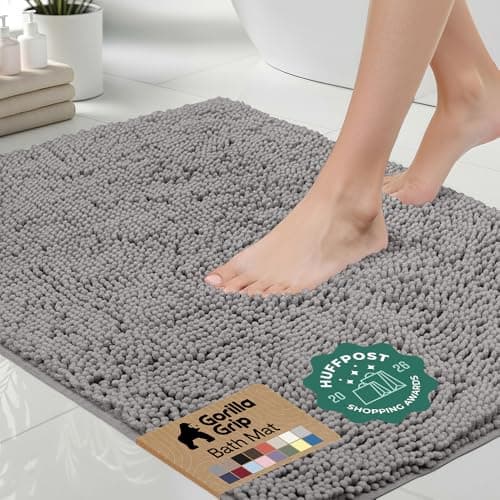 Gorilla Grip Chenille Bath RugBorrowed from the bathroom on purpose. If your sink area is genuinely wet - a sink without a splash guard, a dishwasher that drips, somebody who washes pans by hand - chenille on bonded rubber is the most absorbent thing you can put there, and it goes in the machine. The deep pile is the wrong surface to stand on for long and the right one to catch water. | A genuinely wet floor | Chenille microfiber pile on a TPR rubber backing | $11.98$15.99View on Amazon #ad We earn a commission · Price as of October 11, 2026 |
| 4 | 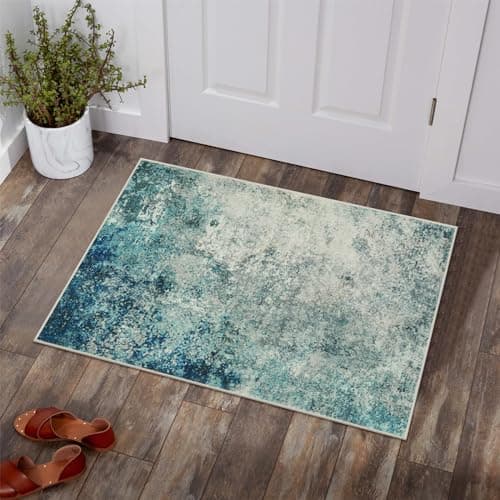 Lahome Washable Accent RugThe wash-it-constantly option. Ultra-thin, printed, and genuinely machine washable, so it suits a kitchen where cooking actually happens and the mat needs to go through the machine every week. It cushions nothing and absorbs little, so buy it for hygiene rather than for comfort. | Washing every week | Ultra-thin printed low-pile surface, machine washable | $22.79$23.99View on Amazon #ad We earn a commission · Price as of October 11, 2026 |
The short answer
Decide which problem you have first. If your feet and back hurt, buy an anti-fatigue mat - a foam core is the only thing that helps and no rug does. If the floor gets wet and stained, buy a low-pile non-slip runner that covers the whole sink strip. Our general pick is the Sweet Home Stores Kitchen Runner; if the complaint is standing, it is the Mohawk Home Anti-Fatigue Mat.
The reason this spot is hard is that it is two problems wearing one shape. Standing at a sink for twenty minutes is a cushioning problem, and cushioning means thickness and foam. Water splashing off dishes is an absorbency-and-grip problem, and that means textile and rubber. A product that is excellent at one is mediocre at the other, and the mats sold as doing both are usually doing neither well. So the first question is not which mat - it is which of the two is actually annoying you.
Which problem do you have
| What bothers you | What to buy | What it will not do |
|---|---|---|
| Feet and lower back ache | Anti-fatigue foam mat | Absorb a spill |
| Water marks on the floor | Low-pile non-slip runner | Cushion your heels |
| Standing water, puddles | Chenille on bonded rubber | Be comfortable to stand on |
| The mat is always grubby | Thin washable, bought in a pair | Cushion or absorb much |
| The mat slides | Any of the above with rubber bonded on | Fix a mat that has no backing |
One combination genuinely works: an anti-fatigue mat at the spot you stand, and a low-pile runner for the rest of the strip. It looks like two mats because it is two mats, and in a working kitchen it is the arrangement people keep rather than the one they buy first.
Sizing the strip
Measure the sink cabinet and add the dishwasher if it sits beside it, because that door opens onto the same floor and drips when you unload it. That total is usually between three and five feet, which is why a runner rather than a mat is the right format - a 2x3 mat covers the sink and leaves the drip zone bare.
- Width 20 to 24 inches. Deeper than that and the far edge sits out in the walking lane where it becomes a trip hazard and a thing that gets kicked.
- Length to the cabinet run, plus the dishwasher. Three to five feet covers most kitchens. Measure rather than guessing - the cabinet is wider than the sink.
- Leave the stove out of it. A mat in front of a gas stove is a fire question, not a comfort one. Keep the sink mat and the stove area separate.
- Check the dishwasher door clears it. A thick mat in front of a dishwasher stops the door opening flat, and the door wins.
- Confirm it washes. Anything in front of a sink needs to go in a machine, and a mat that says spot clean only will be thrown away rather than cleaned.
Sweet Home Stores Kitchen Runner
The whole sink strip
No licensed photo of this exact rug yet — see it on the Amazon listing.
The default correct answer for the sink strip: low-pile polypropylene on a non-slip rubber back, in runner lengths that cover the whole working run rather than one spot. The busy mid-tone pattern is a functional feature here and not a styling one - it hides the splash marks that make a plain mat look filthy inside a week. Grease will finish it eventually, which is why the price matters.
What it is
- Non-slip rubber backing rated for hard kitchen floors
- Patterned surface chosen to hide kitchen traffic
- Standard kitchen runner widths and lengths
What it does well
- Busy patterns are genuinely effective at hiding the splash zone around a sink
- Cheap enough to treat as a consumable, which a kitchen rug basically is
- Wipes clean for everyday spills without needing a full wash
Don't buy it if
- Not machine washable the way a dedicated washable rug is
- Grease eventually defeats it — plan on replacing rather than restoring
- Rubber backing, so the same LVP caution applies
A consumable, and the right way to think about any rug that lives in front of a sink.
Mohawk Home Anti-Fatigue Kitchen Mat
Standing comfort
No licensed photo of this exact rug yet — see it on the Amazon listing.
If the real complaint is your back and not the floor, this is the pick and nothing else on this page competes. A foam core does something no textile can: it gives under your heel for the twenty minutes you spend at the sink. The printed surface wipes clean instantly, which suits splashing. It will not absorb a spill, and it is not meant to.
What it is
- Cushioned foam core rather than a textile pile
- Wipe-clean printed surface
- Beveled edges
What it does well
- The cushioning is the point, and it makes a real difference across an hour of cooking
- Wipes clean instantly, which no textile kitchen rug does
- The beveled edge means it does not catch a foot
Don't buy it if
- It is a mat, not a rug — it does no decorative work in the room
- Foam compresses permanently over a couple of years
- Printed surfaces scuff where a chair or a dog's claws cross them
The correct product for the spot where you stand, as opposed to the spot you walk across.
Gorilla Grip Chenille Bath Rug
A genuinely wet floor
Product photo and price from Amazon, refreshed daily.
#ad We earn a commission · Price as of October 11, 2026
Borrowed from the bathroom on purpose. If your sink area is genuinely wet - a sink without a splash guard, a dishwasher that drips, somebody who washes pans by hand - chenille on bonded rubber is the most absorbent thing you can put there, and it goes in the machine. The deep pile is the wrong surface to stand on for long and the right one to catch water.
What it is
- Thermoplastic rubber (TPR) backing rather than latex
- Thick chenille microfiber pile, close to an inch
- Machine washable, many size options
What it does well
- The TPR backing grips wet tile better than a latex-backed mat
- Chenille absorbs faster than a woven cotton mat of the same size
- Survives weekly washing without the backing flaking, which is where cheap mats fail
Don't buy it if
- Thick pile takes a long time to dry in a bathroom with poor ventilation
- The pile mats down if it is not shaken out between washes
- The rubber backing should not go in a hot dryer
The default bath mat: it grips, it absorbs, and it survives the wash cycle that kills its competitors.
Lahome Washable Accent Rug
Washing every week
Product photo and price from Amazon, refreshed daily.
#ad We earn a commission · Price as of October 11, 2026
The wash-it-constantly option. Ultra-thin, printed, and genuinely machine washable, so it suits a kitchen where cooking actually happens and the mat needs to go through the machine every week. It cushions nothing and absorbs little, so buy it for hygiene rather than for comfort.
What it is
- Listed at roughly 0.3 in thick — thin enough to sit under a door or a furniture leg
- Machine washable, and light enough to carry to the machine one-handed
- Widely stocked at 2x3 and 3x5
- Backing varies by variant: some are non-slip coated, the woven cotton versions have no backing at all
What it does well
- The thinness is the feature — no lip to catch a toe, no door that has to be lifted over it
- Cheap enough per rug that you can keep a second one in rotation while the first is in the wash
- Prints and colorways turn over quickly, so it does not look like the rug everyone else has
Don't buy it if
- There is nothing underfoot. Thin is comfortable to nobody
- The non-slip coating is a surface treatment and it gets less grippy with each wash
- Backing and construction differ between listings under the same brand — read the specific variant, not the brand
The right answer where a small rug gets dirty faster than it gets admired: a kitchen sink, a back door, a laundry floor.
What not to put in front of a sink
No natural fiber. Jute and sisal absorb splashed water, dry slowly, and mark permanently where they get wet - the two worst properties available for this spot, and how to clean a jute rug exists largely to explain why. No high pile either, outside the genuinely-wet case above: pile in a kitchen collects crumbs and grease, and grease is the thing that cannot be washed out of a rug at home.
And no rug without a backing, on any kitchen floor. Tile and sealed wood in a kitchen get wet, and a wet floor under a loose mat is the standard way people fall in their own homes. If you already own the right mat with the wrong back, non-slip rug pads is the fix - but in a kitchen a bonded backing is better than a pad, because a pad traps water underneath.
How long one lasts
Shorter than you want. A mat in front of a sink is a consumable, and the thing that ends it is cooking grease rather than wear - airborne grease settles into the fibers, washing stops lifting it, and the mat stays faintly tacky. Two years is a good run in a kitchen where somebody cooks daily. Plan to replace it, buy accordingly, and keep a spare so the floor is never bare while one is in the wash.
For the rest of the kitchen floor, the best rugs for a kitchen covers the room, kitchen runners covers the walking strip between appliances, and washable rugs for a kitchen is the machine-washable version of the same question.
Questions people actually ask
What kind of rug should go in front of a kitchen sink?
A low-pile runner on a non-slip rubber back, 20 to 24 inches wide and long enough to cover the sink cabinet plus the dishwasher. If the complaint is aching feet rather than water, buy an anti-fatigue foam mat instead.
Are anti-fatigue mats better than rugs at the sink?
They are better at the only thing they do - cushioning your heels while you stand. They absorb almost nothing, so if your problem is splashed water rather than sore feet, a low-pile runner is the right buy.
What size rug goes in front of a kitchen sink?
Measure the sink cabinet and add the dishwasher if it sits alongside. That is usually three to five feet, by 20 to 24 inches wide - a runner rather than a 2x3 mat, which leaves the drip zone bare.
Can you put a jute rug in front of a sink?
No. Jute absorbs splashed water, dries slowly and water-marks permanently. Natural fiber is the worst available choice for this spot.
How often should you replace a kitchen sink mat?
About every two years in a kitchen where someone cooks daily. What ends it is airborne cooking grease rather than wear - once that is in the fibers, washing stops lifting it.
Should a kitchen sink rug be patterned?
Yes, and it is a functional choice here rather than a stylistic one. Splashes dry as rings that show badly on a plain pale mat and disappear into a busy mid-tone pattern.
Sources
Read next
- The Best Rugs for a KitchenKitchen rugs that handle water, grease and grit — and why the right answer is usually a runner plus a mat.
- Kitchen RunnersKitchen runners sized to the working strip, with the non-slip backings a wet floor requires.
- Washable Rugs for the KitchenThe washable picks that survive a kitchen, why a runner beats an area rug, and what belongs in front of the stove.
- The Best Runner Rugs for a BathroomRunner-length bathroom mats judged on backing grip and drying speed, with sizing for a single and a double vanity.
- Non-Slip Rug PadsWhy rugs slide, which pad constructions genuinely hold, and the thin options for tight door clearances.
- Rugs by RoomLiving room, bedroom, kitchen, bathroom, entryway, stairs and runners — the fiber, size and pile each room actually needs.