Rug Materials
The Best Rugs for Tile Floors (Grip First, Everything Else Second)
A rug that slides on tile is a fall risk, not an inconvenience - so this page is ordered by backing, not by looks.
Heads up: we earn a commission when you buy through links on this page, at no extra cost to you. It never changes which rug we put first — see how we choose and our affiliate disclosure.
Quick picks
The whole answer, before the detail. Tap any row to jump to that rug's full write-up further down the page.
| # | Rug | Best for | Construction | Price |
|---|---|---|---|---|
| 1 | 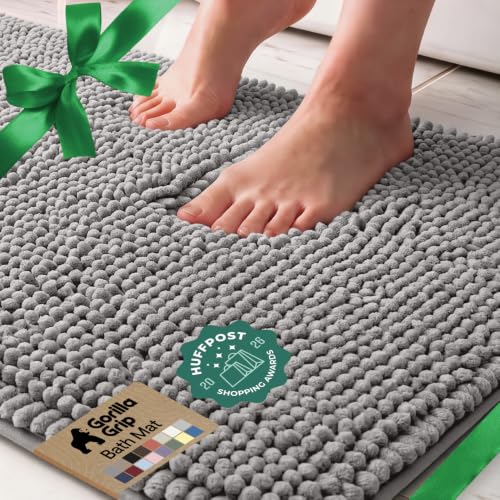 Gorilla Grip Chenille Bath RugThe best grip on tile of anything in our registry, and the backing is the reason: thermoplastic rubber rather than latex. TPR stays flexible, does not go brittle with repeated wetting, and - unlike latex - does not react with a sealed tile or stone surface and leave a mark. The chenille microfibre pile is close to an inch, so it absorbs water rather than letting it film across the tile, which is the actual mechanism behind most bathroom slips. Machine washable in many sizes. It holds water, so it needs hanging rather than leaving flat. | Wet tile, and the best grip here | Chenille microfiber pile on a TPR rubber backing | $11.38$15.99View on Amazon #ad We earn a commission · Price as of November 24, 2026 |
| 2 | 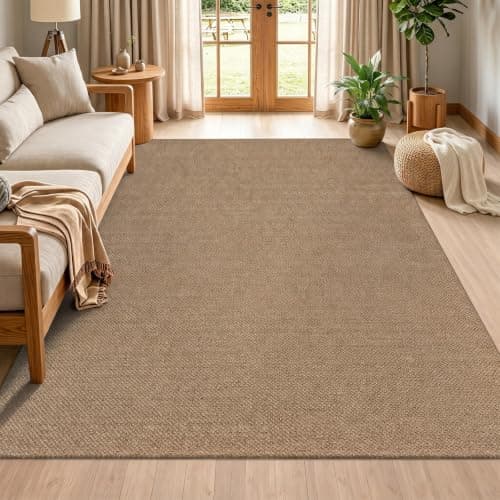 HEBE Cotton Woven Area RugThe pick if you want an area rug rather than a mat on a tiled floor - a kitchen, a tiled hallway, a sunroom. A braided weave of cotton blended with polyester on a rubber backing that is bonded to the rug rather than laid under it, which means no pad to buy and nothing to creep out from underneath. Roughly a quarter inch thick, so it clears most interior doors. The polyester in the blend is what lets it survive the gentle machine wash the listing describes, and it is a blend rather than pure cotton. | An area rug on kitchen tile | Braided cotton-and-polyester weave on a bonded rubber back | $64.99View on Amazon #ad We earn a commission · Price as of November 24, 2026 |
| 3 | 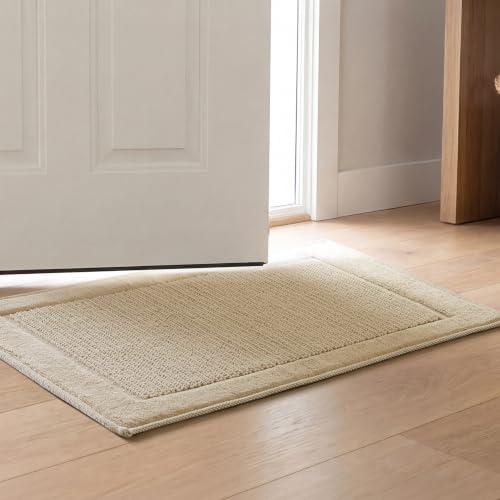 Madison Park Sanctuary Cotton Bath RugThe best-looking option for a tiled bathroom, and the one to choose if the door clearance is tight: 100 percent cotton in a densely woven flat weave listed at roughly 0.39 inch, with a non-slip backing, certified to OEKO-TEX Standard 100, in four sizes from 17 by 24 up to 24 by 48 inches. A woven cotton face reads as a textile rather than a bath mat, which matters in a bathroom you care about. Cotton holds water longer than microfibre, so it must be hung between uses or it stays damp. | A tiled bathroom, with door clearance | Densely woven 100% cotton in a textured flat weave, with a non-slip backing | $33.21View on Amazon #ad We earn a commission · Price as of November 24, 2026 |
| 4 | 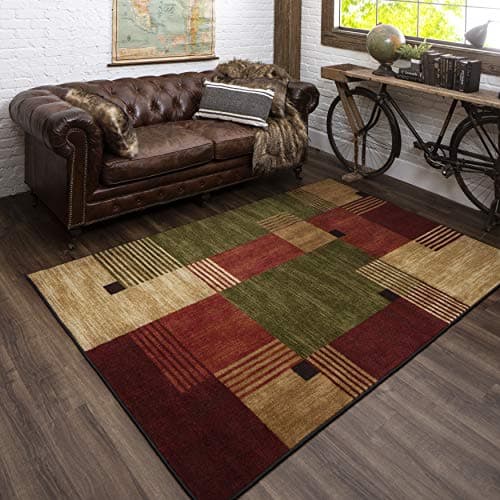 Mohawk Home Alliance Geometric RugThe one for a large tiled living space, where the problem is not slip so much as a big rug walking across a hard slick floor. A textured latex backing designed to grip a hard floor, a low-profile cut pile around 0.4 inch on the 5x8, with soil and stain protection and fade resistance stated on the listing. Enough pile to soften a tiled room acoustically, which tile badly needs. Latex backings can mark some sealed and polished stone over years - on natural stone, use a felt pad instead. | Large tiled living spaces | Low-profile synthetic cut pile on a textured latex backing | |
| 5 | 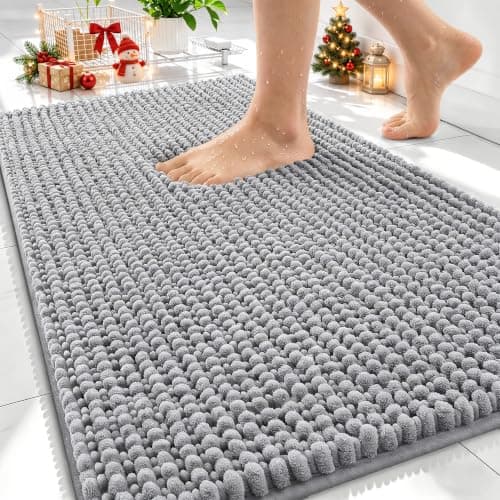 OLANLY Chenille Bath MatThe budget pick. The same principle as the category leader - chenille microfibre on a TP rubber backing - at the lowest price on this page, in neutral colourways only, machine washable. For a second bathroom, a utility room or beside a back door onto tile, it is the cheapest way to stop a slip, and buying two so one can be in the wash is still less than most single mats. Neutral colours only, and the pile mats down faster than the thicker chenille above it. | The cheapest safe answer | Chenille microfiber on TP rubber backing | $9.48$14.99View on Amazon #ad We earn a commission · Price as of November 24, 2026 |
The verdict. For tile that gets wet - a bathroom, a laundry, inside a back door - the Gorilla Grip chenille is the pick, because a thermoplastic rubber backing grips wet tile better than latex and does not go brittle after fifty washes. For a tiled kitchen or hallway that needs an actual area rug, the HEBE cotton woven is the one: a rubber back bonded to the rug, so there is no pad to buy and nothing to slide. The OLANLY chenille mat is the budget pick and the cheapest way to make a slippery tiled floor safe. The ordering principle on this page is deliberate: on tile, the backing is the product. Everything else is secondary.
Gorilla Grip Chenille Bath Rug
Wet tile, and the best grip here
Product photo and price from Amazon, refreshed daily.
#ad We earn a commission · Price as of November 24, 2026
The best grip on tile of anything in our registry, and the backing is the reason: thermoplastic rubber rather than latex. TPR stays flexible, does not go brittle with repeated wetting, and - unlike latex - does not react with a sealed tile or stone surface and leave a mark. The chenille microfibre pile is close to an inch, so it absorbs water rather than letting it film across the tile, which is the actual mechanism behind most bathroom slips. Machine washable in many sizes. It holds water, so it needs hanging rather than leaving flat.
What it is
- Thermoplastic rubber (TPR) backing rather than latex
- Thick chenille microfiber pile, close to an inch
- Machine washable, many size options
What it does well
- The TPR backing grips wet tile better than a latex-backed mat
- Chenille absorbs faster than a woven cotton mat of the same size
- Survives weekly washing without the backing flaking, which is where cheap mats fail
Don't buy it if
- Thick pile takes a long time to dry in a bathroom with poor ventilation
- The pile mats down if it is not shaken out between washes
- The rubber backing should not go in a hot dryer
The default bath mat: it grips, it absorbs, and it survives the wash cycle that kills its competitors.
HEBE Cotton Woven Area Rug
An area rug on kitchen tile
Product photo and price from Amazon, refreshed daily.
#ad We earn a commission · Price as of November 24, 2026
The pick if you want an area rug rather than a mat on a tiled floor - a kitchen, a tiled hallway, a sunroom. A braided weave of cotton blended with polyester on a rubber backing that is bonded to the rug rather than laid under it, which means no pad to buy and nothing to creep out from underneath. Roughly a quarter inch thick, so it clears most interior doors. The polyester in the blend is what lets it survive the gentle machine wash the listing describes, and it is a blend rather than pure cotton.
What it is
- Braided weave of cotton blended with polyester, not a 100% cotton rug
- Listing states gentle machine washing, quick drying and vacuuming
- Rubber backing bonded to the rug rather than a separate pad
- Roughly a quarter inch thick, so it clears most interior doors
What it does well
- One of the few cotton-blend rugs sold at full room sizes that the maker still calls machine washable
- The bonded rubber back means it needs no pad to stay put on a hard floor
- The braided texture hides crumbs and lint far better than a flat cotton weave does
Don't buy it if
- It is a blend. The polyester is what makes it survive washing, so a cotton purist should look elsewhere
- Bonded rubber backings stiffen with heat and age, and they rule out a hot dryer entirely
- Neutral colorways only — there is no real pattern range in this line
The practical answer when you want cotton's look at 5x7 or 6x9 and still want to be able to wash the thing.
Madison Park Sanctuary Cotton Bath Rug
A tiled bathroom, with door clearance
Product photo and price from Amazon, refreshed daily.
#ad We earn a commission · Price as of November 24, 2026
The best-looking option for a tiled bathroom, and the one to choose if the door clearance is tight: 100 percent cotton in a densely woven flat weave listed at roughly 0.39 inch, with a non-slip backing, certified to OEKO-TEX Standard 100, in four sizes from 17 by 24 up to 24 by 48 inches. A woven cotton face reads as a textile rather than a bath mat, which matters in a bathroom you care about. Cotton holds water longer than microfibre, so it must be hung between uses or it stays damp.
What it is
- 100% cotton, stated on the listing - not polyester microfiber or chenille
- Low-profile woven design listed at roughly 0.39 inch, so it clears a bathroom door
- Certified OEKO-TEX Standard 100
- Sold in four sizes from 17 by 24 up to 24 by 48 inches
What it does well
- Cotton absorbs and then releases water, where microfiber holds it - which is why a cotton mat smells less by the end of a week
- A flat weave at 0.39 inch dries far faster than a plush pile mat and fits under a door that a plush mat jams
- It reads as a small woven rug rather than as a bath mat, so it does not look out of place outside the bathroom
Don't buy it if
- Flat cotton is not plush. If you want to sink into something warm stepping out of a shower, this is the wrong mat
- Cotton stains more readily than a synthetic and will show a dropped hair dye or makeup mark
- Costs roughly three times the chenille mats it competes with
The bath rug to buy if the chenille mats keep going musty on you - cotton, flat, fast-drying and certified.
Mohawk Home Alliance Geometric Rug
Large tiled living spaces
The one for a large tiled living space, where the problem is not slip so much as a big rug walking across a hard slick floor. A textured latex backing designed to grip a hard floor, a low-profile cut pile around 0.4 inch on the 5x8, with soil and stain protection and fade resistance stated on the listing. Enough pile to soften a tiled room acoustically, which tile badly needs. Latex backings can mark some sealed and polished stone over years - on natural stone, use a felt pad instead.
What it is
- Synthetic cut pile with the maker's soil and stain protection, listed as fade resistant
- Low-profile pile — the 5x8 listing gives an overall height of about 0.4 in
- Textured latex backing for grip on hard floors
- Care line is vacuum, spot clean with mild detergent, or clean professionally
What it does well
- Cut pile rather than loop, which is the single most important thing on a rug a dog walks on
- Low profile means a vacuum head reaches the backing, which is where hair collects
- The latex backing holds it still without a separate pad on tile or laminate
Don't buy it if
- Spot clean only. If your problem is accidents rather than hair, a washable rug beats it outright
- Polyester pile mats down in a traffic lane faster than wool or nylon does
- Individual colorways and sizes go in and out of stock, so the exact variant you see may change
The rug to buy when the dog problem is claws, grit and hair rather than accidents — cut pile, low, and cheap enough to replace.
OLANLY Chenille Bath Mat
The cheapest safe answer
Product photo and price from Amazon, refreshed daily.
#ad We earn a commission · Price as of November 24, 2026
The budget pick. The same principle as the category leader - chenille microfibre on a TP rubber backing - at the lowest price on this page, in neutral colourways only, machine washable. For a second bathroom, a utility room or beside a back door onto tile, it is the cheapest way to stop a slip, and buying two so one can be in the wash is still less than most single mats. Neutral colours only, and the pile mats down faster than the thicker chenille above it.
What it is
- TP rubber backing, the same principle as the category leader
- Neutral colorways only
- Machine washable
What it does well
- Materially cheaper than the leader for very similar construction
- Neutral palette works in a rental where you cannot choose the tile
- Dries faster than the thickest chenille mats because the pile is shorter
Don't buy it if
- Thinner pile means less cushioning underfoot
- The color range is genuinely limited
- Edges can fray earlier than the premium equivalent
Right for the guest bathroom nobody uses twice a week — same idea, less money, slightly less of everything.
Why tile is the hardest floor for a rug to stay on
Glazed ceramic and porcelain are among the slickest surfaces in a house. They are non-porous, dimensionally flat, and - crucially - they offer a rug backing nothing to key into. A felt pad that holds beautifully on hardwood can slide on polished porcelain, because hardwood has a microscopically textured finish and porcelain does not. Add water and the coefficient of friction drops again, which is why bathrooms produce the majority of rug-related falls in a home.
So the backing has to generate grip chemically rather than mechanically, which means rubber. Natural rubber and thermoplastic rubber both work; the difference is longevity and what they do to the floor. The other half of the problem is water management: a rug that absorbs water keeps it off the tile, and a rug that repels water lets it film across the floor at the rug's edge, which is where people actually slip.
| Backing | Grip on dry tile | Grip on wet tile | Risk to the floor |
|---|---|---|---|
| Thermoplastic rubber (TPR) | Excellent | Excellent | Very low - stays flexible, does not react |
| Natural rubber pad | Excellent | Very good | Low on tile; can mark some sealed stone |
| Bonded rubber (built into the rug) | Excellent | Good | Low, but stiffens with heat over years |
| Textured latex | Good | Moderate | Can leave residue on polished stone over years |
| Sprayed non-slip coating | Moderate at first | Poor | None, but the coating washes away |
| Felt-only pad | Poor | Very poor | None - but it will not hold on tile |
| No backing | None | None | None - and a genuine fall risk |
The door-clearance problem, measured
Tiled rooms are usually the rooms with doors that open inward over the rug - bathrooms, utility rooms, back entries. A standard interior door is hung with a bottom clearance of between a quarter and a half inch over the finished floor, and that gap is what decides which rug you can buy. A 1-inch chenille bath rug will not fit under a door with a 3/8 inch gap, and forcing it means the door catches and drags the rug out of position every time it opens - which is how a gripping rug ends up bunched and tripped over anyway.
Measure the gap before you buy, not the room. If it is under half an inch, the only options are a flat woven cotton rug like the Madison Park at roughly 0.39 inch, or placing the rug entirely clear of the door swing. Rug pile height covers the measurement properly, and the arithmetic is the same whether the obstruction is a door or a dishwasher.
Tile that is not ceramic
- Natural stone - marble, travertine, limestone. Porous and reactive. Do not use a latex or sprayed-coating backing; both can leave a stain that cannot be removed from a porous stone. A natural rubber pad or a felt-and-rubber pad is the safe choice, and so is a rug with no backing at all placed on one.
- Polished porcelain. The slickest of all, and the one where a felt pad is genuinely useless. Rubber only.
- Quarry and terracotta. Porous, textured and usually sealed. Grip is easier here because the surface has tooth, but sealers soften under some backings - test in a corner first.
- Vinyl tile and LVT. Not tile in the way that matters. Plasticisers in some backings migrate into vinyl and discolour it permanently; see rug pad for vinyl plank before you put anything down.
- Heated tile floors. A rug over underfloor heating traps heat against the floor. Keep the pile low and the pad thin, and check the heating manufacturer's guidance - some systems specify a maximum covering thickness.
The acoustic reason to put a rug on tile at all
Slip is the safety argument and it is the one that matters, but the reason a tiled room feels unpleasant to be in is reverberation. A hard, flat, non-porous floor reflects almost all the sound that hits it, which is why a tiled kitchen is loud and a tiled bathroom echoes. Even a thin rug kills a surprising amount of that, and a rug with a pile and a pad under it kills most of it. If a tiled open-plan space feels harsh, the rug is doing acoustic work that no amount of soft furnishing elsewhere replaces.
For the room-by-room versions of this decision, rugs for the bathroom and rugs for the kitchen go into placement, and the best rugs for hardwood floors is the comparison page if some of the floor is tile and some is wood.
Questions people actually ask
What kind of rug backing works best on tile?
Rubber - thermoplastic rubber (TPR) or natural rubber. Tile is non-porous and offers nothing for a pad to key into mechanically, so the grip has to come from the backing material itself. Felt-only pads slide on tile.
Will a rug pad stop a rug sliding on tile?
Only a rubber or felt-and-rubber pad will. A felt-only pad holds well on hardwood and poorly on tile, and on polished porcelain it barely holds at all.
Can a rug damage a tile floor?
Ceramic and porcelain are essentially unaffected. Natural stone is a different matter: latex backings and sprayed coatings can stain porous marble, travertine and limestone permanently. On stone, use a natural rubber or felt-and-rubber pad.
Why do I see the grout lines through my rug?
The rug is too thin to bridge them. On deep or wide grout a thin rug telegraphs the grid and wears in that pattern. Choose a rug of at least a quarter inch, or bridge the lines with a felt pad underneath.
What thickness of rug fits under a bathroom door?
Measure the gap - interior doors are typically hung with a quarter to half an inch of clearance. A plush chenille mat near an inch thick will not pass under most of them; a woven cotton rug around 0.39 inch usually will.
Are rugs on heated tile floors a problem?
They trap heat against the floor, so keep both the pile and the pad thin and check the heating manufacturer's guidance - some underfloor systems specify a maximum covering thickness.
Sources
- Amazon - Gorilla Grip chenille bath rug listing (TPR backing, pile depth, washability)
- Amazon - HEBE cotton woven area rug listing (bonded rubber back, thickness, care)
- Amazon - Madison Park Sanctuary cotton bath rug listing (0.39 in profile, non-slip backing, sizes)
- Amazon - OLANLY chenille bath mat listing (TP rubber backing, washability)
- Tile Council of North America - natural stone and sealer considerations
Read next
- The Best Rugs for Hardwood FloorsRugs chosen for what touches the wood: safe backings, the latex and PVC problem, and the pad that matters more than the rug.
- Rug Pad for Vinyl Plank FlooringWhy some backings permanently discolor LVP, which pads are safe, and how to check before laying a rug.
- The Best Rugs for a BathroomBath rugs that grip wet tile, absorb fast and survive weekly washing — and the backing that decides all three.
- Non-Slip Rug PadsWhy rugs slide, which pad constructions genuinely hold, and the thin options for tight door clearances.
- Rug MaterialsWool, jute, sisal, polypropylene, cotton, viscose and the traditional weaves — compared on wear, feel, water and cost.