Rug Care
Can You Pressure Wash a Rug?
On a synthetic outdoor rug, carefully, yes. On wool, jute, sisal or anything tufted, a pressure washer does damage you cannot undo - and a garden hose does the same job.

The short answer
Only on a flatwoven synthetic outdoor rug, and only at low pressure from a distance. On wool, jute, sisal, viscose or any tufted rug, a pressure washer separates fiber from backing and cannot be undone. For almost every rug, a garden hose on a normal spray setting achieves the same cleaning with none of the risk.
The appeal is obvious - a filthy outdoor rug and a tool that cleans a driveway in minutes. The problem is that a rug is not a driveway. A pressure washer delivers a narrow jet at a thousand or more PSI, and a rug is layers of yarn held together by tension, stitching or adhesive. Concentrated force finds the weakest of those three and breaks it.
What it actually does to a rug
Three failure modes, depending on the construction. On a tufted rug - which is most affordable wool and most mid-price synthetics - the pile is glued to a backing cloth, and a pressure jet drives water between the layers and delaminates them. The rug does not look damaged at first. It fails weeks later as the backing bubbles and the pile lets go in patches.
On a woven or knotted rug, the jet abrades and fuzzes the pile where it hits, leaving a visibly different texture in a stripe you cannot remove. And on a natural fiber rug, the water itself is the damage before the pressure even matters: jute and sisal both discolor permanently when saturated, and wool felts and shrinks.
| Rug type | Pressure washer | Why |
|---|---|---|
| Flatwoven synthetic outdoor | Yes, with care | No pile, no adhesive, nothing absorbs |
| Braided synthetic outdoor | Low pressure only | Braids can loosen under a jet |
| Tufted wool or synthetic | No | Delaminates the glued backing |
| Woven or knotted wool | No | Abrades and fuzzes the pile |
| Jute or sisal | No | Water alone stains permanently |
| Viscose | No | Fiber loses strength when wet |
| Washable rug | No - use the machine | That is what it is for |
The one case where it works
A flatwoven, fully synthetic outdoor rug - polypropylene through the face and the backing, no pile, no adhesive layer. There is nothing in that construction for a jet to separate, and the fiber absorbs nothing, so the rug dries in under an hour. This is the category where people pressure wash rugs successfully and report that it is fine, and they are right about their own rug.
Fab Habitat Flatweave Outdoor Rug
The rug this works on
No licensed photo of this exact rug yet — see it on the Amazon listing.
The one construction on this site a pressure washer is genuinely safe on: flatwoven recycled polypropylene, fully reversible, no pile and no adhesive layer for a jet to separate. It is designed to be hosed down and hung to dry, which is the gentler version of the same job.
What it is
- Flatwoven from recycled polypropylene yarn
- Fully reversible — two usable faces
- Designed to be hosed down and hung to dry
What it does well
- Reversible construction effectively doubles the usable life
- Hoses clean in minutes and dries fast because there is no pile to hold water
- Rolls up small enough to store over winter without a dedicated space
Don't buy it if
- Very thin — you will feel every imperfection in the deck below it
- Flatweave slides more than a backed rug; it needs weighting or an outdoor pad
- Stripe patterns dominate the range if you want something plainer
The most practical outdoor rug here if your actual cleaning routine is a garden hose and ten minutes.
Gertmenian Outdoor Patio Rug
Large patio rugs
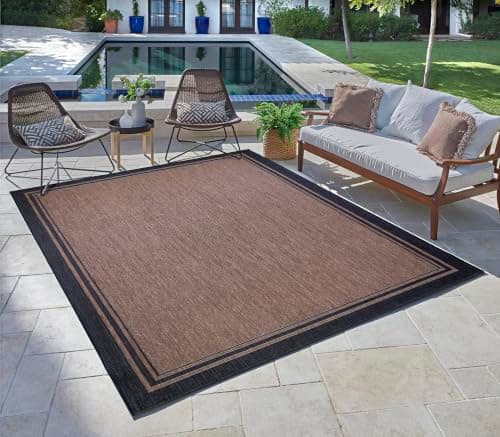
Product photo and price from Amazon, refreshed daily.
#ad We earn a commission · Price as of October 11, 2026
Polypropylene throughout, including the backing on most patterns, which is what makes a rinse safe rather than risky - there is no backing cloth to delaminate. Low pressure and a wide fan only; the pattern printing is the part that will fuzz if you get close with a narrow tip.
What it is
- Polypropylene throughout, including the backing on most patterns
- Wide pattern range beyond the usual neutral weave
- Large sizes stay unusually affordable
What it does well
- One of the few lines where a genuinely large outdoor rug does not cost more than the furniture on it
- Solution-dyed polypropylene means color runs through the fiber, so fading is slow
- Safe against composite decking, and it takes the scuffing patio furniture inflicts
Don't buy it if
- Flatwoven polypropylene is not soft — this is not a barefoot lounging surface
- Edges can curl for the first few weeks out of the box
- The pattern printing is decent rather than premium
The sensible default for a full-size patio: it covers the area, survives weather, and does not cost enough to make you precious about it.
nuLOOM Non-Slip Outdoor Rug Pad
The pad you can hose
No licensed photo of this exact rug yet — see it on the Amazon listing.
The only pad here that can be hosed freely. An open mesh drains and dries in minutes, where a felt-and-rubber pad soaks up water, takes days and can come apart - which is why the pad question has a different answer outdoors than in.
What it is
- Open mesh rather than solid felt, so water passes through
- Designed for deck and patio use
- Trimmable
What it does well
- The open weave is the whole point outdoors: it lets a deck dry instead of trapping water against it
- Stops a lightweight outdoor rug creeping in wind
- Rinses clean along with the rug
Don't buy it if
- Provides almost no cushioning — this is a grip and airflow product
- The mesh can print a faint grid onto a soft deck stain over a long summer
- Needs lifting and rinsing periodically or grit collects in the weave
The answer to the question that ruins decks: an outdoor rug needs a pad that breathes, not one that seals.
Even then, the settings matter more than the decision to do it:
Lay the rug flat on a hard surface
A driveway or patio, not grass - on grass the jet drives mud up through the weave and you finish dirtier than you started. Make sure the rug is flat with no folds, because a fold concentrates force on a crease.
Use the widest fan tip you have
A 40-degree white tip or a soap tip. Never a zero or 15-degree tip on any textile. The wide fan spreads the force over enough area that it washes rather than cuts.
Set the lowest pressure the machine offers
Around 1200 PSI is plenty, and an electric washer is safer than a gas one for this. If the machine has no adjustment, increase the distance instead.
Stay 18 to 24 inches back and keep moving
Hold the wand at that distance, angled slightly rather than straight down, and sweep steadily along the weave. Never hold it still, and never work against the direction of the weave.
Test an edge first
Do a corner and look closely at the fiber. If the surface is fuzzing, lifting or fraying, stop - that rug is not a candidate, and a hose will finish the job.
Rinse without detergent in the machine
Pressure-washer detergents are formulated for masonry and siding, not textiles. If the rug needs soap, apply a mild dish soap by hand first and use the washer only to rinse.
Dry it fully before it goes back down
Hang it or prop it against a rail so both faces get air. A rug put back down damp is how a clean rug becomes a mildew problem, and the surface underneath stays wet too.
What to use instead, by rug
For an outdoor rug, a garden hose with a normal spray nozzle, a stiff broom and mild dish soap. This genuinely does the same job - the dirt in an outdoor rug is loose debris and surface grime, not something bonded in that needs force. How to clean an outdoor rug has the full method.
For an indoor synthetic rug, vacuum thoroughly first, then spot-clean and use a carpet extractor or a wet-vac if the whole rug needs doing. How to clean a polypropylene rug covers it. For wool, the rules are specific and strict - how to clean a wool rug sets out what the fiber tolerates. For jute and sisal, dry methods only, which how to clean a jute rug and how to clean a sisal rug both explain.
And on a rug pad
No. A felt-and-rubber pad will absorb a large amount of water, take days to dry and may separate - and the whole point of a pad is to be dry between the rug and the floor. If a pad is dirty enough to need washing, a rinse with a hose and a long dry is the most it should get. An open mesh outdoor pad can be hosed freely, which is one of several reasons it is the right pad outdoors - outdoor rug pads covers why it has to breathe.
The short version
If the rug is a flat, fully synthetic outdoor rug, a pressure washer on a wide tip at low pressure from two feet away is fine - and a hose would have done it anyway. For anything else, the pressure washer is the tool that turns a dirty rug into a ruined one, usually weeks after you think you got away with it. How to clean an area rug starts with identifying what you have, which is the step that prevents all of this.
Questions people actually ask
Can you pressure wash an area rug?
Only a flatwoven synthetic outdoor rug, at low pressure with a wide fan tip from 18 to 24 inches away. On wool, jute, sisal, viscose or any tufted rug it causes damage that cannot be undone.
What pressure is safe for a rug?
Around 1200 PSI with a 40-degree fan tip, and only on a flat synthetic outdoor rug. Never use a zero or 15-degree tip on any textile, and increase distance if the machine has no pressure control.
Why does pressure washing ruin a tufted rug?
The pile is glued to a backing cloth. A jet drives water between those layers and separates them, so the backing bubbles and the pile releases in patches - usually weeks later, not immediately.
Can you pressure wash a Ruggable or other washable rug?
No, and there is no reason to. The rug is designed for a washing machine, which cleans it more thoroughly with none of the risk to the cover or the pad.
Will a hose clean an outdoor rug as well?
Yes. Outdoor rug dirt is loose debris and surface grime rather than anything bonded in, so a normal spray nozzle, a stiff broom and mild dish soap do the same job.
Can you pressure wash a rug pad?
No. A felt-and-rubber pad soaks up a lot of water, takes days to dry and can delaminate. Only an open mesh outdoor pad can be hosed freely.
Sources
Read next
- How to Clean an Outdoor RugThe hose-and-brush routine, why drying both faces matters most, and how to handle mildew.
- How to Clean an Area RugHow to identify your rug's fiber, the three rules that apply to all of them, and where to go next.
- How to Clean a Wool RugThe cool-water method for wool, why heat felts it permanently, and what to do about set-in stains.
- How to Clean a Polypropylene RugThe forgiving fiber: what you can do freely, the two real limits, and how to deal with oily soil.
- Outdoor Rug PadsWhy outdoor pads work backwards from indoor ones, and the open-weave mesh that keeps a deck dry.
- Rug CareCleaning method by fiber — wool, jute, sisal, polypropylene, outdoor — plus pet stains, vacuuming and off-season storage.