Rug Sizes & Pads
What Size Rug for a Living Room?
Measure the seating group, not the room. Then take the larger of the two sizes you are torn between.
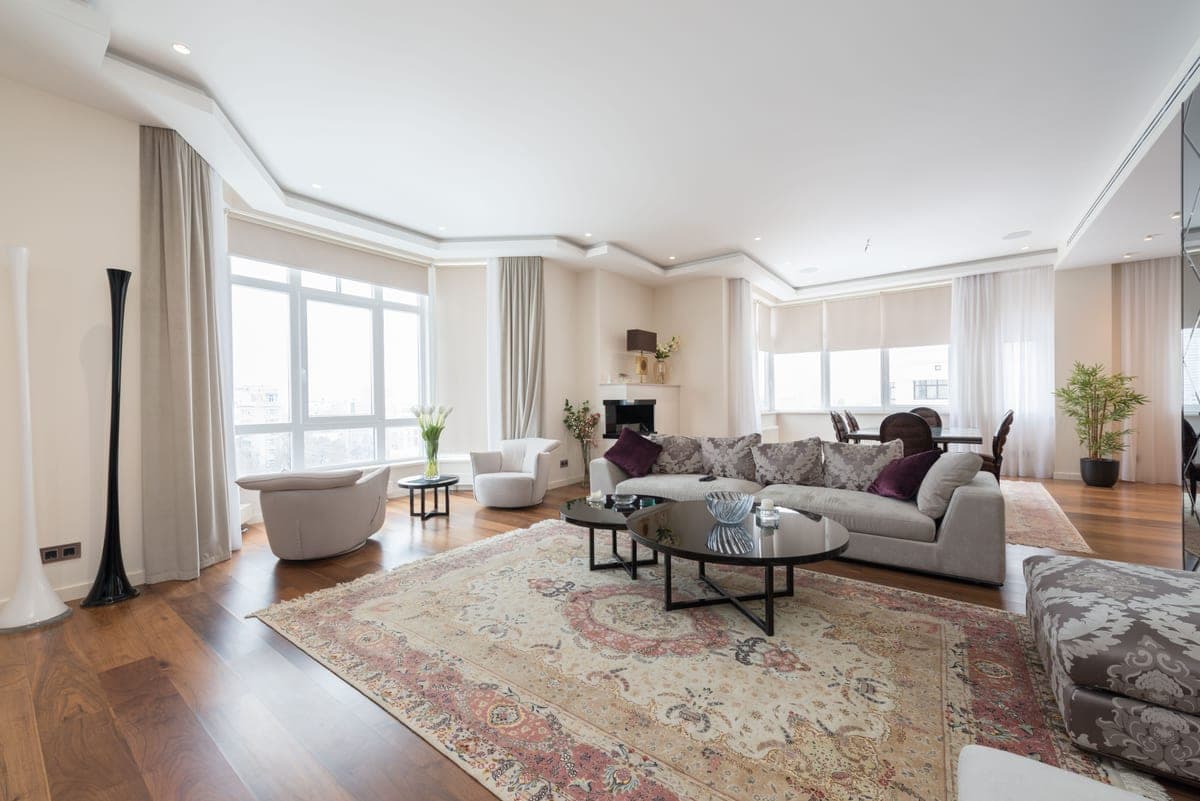
The short answer
Measure the seating group, add about two feet on every side, and round up to the nearest standard size. In most standard living rooms that lands on 8x10; in an open-plan space it lands on 9x12. The rule that matters is that the front legs of every seat sit on the rug.
How to measure it properly
Arrange the furniture where you want it
Measure the room as it will actually be used, not as it is now. Moving the sofa after buying the rug is how sizing goes wrong.
Measure the outer footprint of the seating group
From the outside edge of the leftmost piece to the outside edge of the rightmost, and from the sofa back to the far side of the coffee table or opposite chairs.
Add about two feet on every side
That extra is what lets the front legs sit comfortably on the rug rather than balancing on the binding.
Round up to a standard size
Rugs come in fixed sizes. Round up rather than down — the space between sizes is where too-small rugs come from.
Check the wall clearance
Leave at least 8 to 18 inches of bare floor between the rug and the walls, so the room still reads as a floor with a rug on it.
JONATHAN Y Modern Area Rug
Open-plan living rooms
Illustrative photo of this rug type — not manufacturer imagery. Current product photos are on the Amazon listing.
Most living rooms resolve to 8x10 or 9x12, and 9x12 is where availability thins out. This line carries the large sizes an open-plan room actually needs.
What it is
- Machine-woven polypropylene in contemporary patterns
- Strong availability at 8x10, 9x12 and larger
- Low to medium pile
What it does well
- Genuinely available in the big sizes an open-plan room needs, which a lot of design-led brands are not
- Contemporary patterns rather than the traditional default
- Pile low enough for a room with dining chairs in it
Don't buy it if
- Large synthetic rugs arrive heavily creased and take weeks to flatten
- The pattern repeat is visible on the very large sizes
- Edges can fray if a vacuum beater bar catches them
A practical answer to the hardest sizing problem in the category: covering a large open room without spending four figures.
Well Woven Area Rug
Small rooms
Illustrative photo of this rug type — not manufacturer imagery. Current product photos are on the Amazon listing.
For a genuinely small living room. A 5x7 is a front-legs-on rug at best in most rooms — worth knowing before you order rather than after.
What it is
- Strong coverage of the 5x7 and 5x8 sizes
- Medium pile with a defined pattern
- Jute-blend backing
What it does well
- 5x7 is the size most small living rooms actually need and it is often skipped
- Medium pile is a reasonable compromise between comfort and maintenance
- Patterns busy enough to hide a small room's concentrated traffic
Don't buy it if
- 5x7 is too small to get all the furniture legs on in most rooms — know that before buying
- Medium pile shows vacuum lines
- The backing can shed a little jute dust in the first weeks
The right size for an apartment, with the caveat that a 5x7 is a front-legs-on rug, not an all-legs-on one.
The three standard layouts
| Layout | What it means | Typical size |
|---|---|---|
| All legs on | Every piece of furniture fully on the rug | 9x12 or larger |
| Front legs on | Front legs on, back legs off | 8x10 |
| Floating | Rug sits between the furniture, no legs on | 5x7 or 6x9 — usually a mistake |
All legs on is the most considered-looking and needs the most rug. Front legs on is the workhorse layout and looks entirely right. Floating is the one to avoid — it is what happens when someone buys the rug they could afford rather than the one the room needed, and it makes the whole room read as unfinished.
The open-plan case
In an open-plan room the rug is doing extra work: it defines where the living area ends and the dining or kitchen area begins. That argues for going large enough that the boundary is unambiguous — usually 9x12 or bigger. See large area rugs for what is available at that end.
If you have a sectional, the normal rules bend because an L-shape has no symmetrical front — rug size for a sectional handles it. And once the size is settled, rug placement in a living room covers where exactly to put it.
Questions people actually ask
What size rug for a standard living room?
8x10 in most cases. Measure the seating group, add two feet on every side and round up.
Do all the furniture legs need to be on the rug?
No. Front legs on is the standard and looks entirely right. All legs on is better if the room allows it.
Can a living room rug be too big?
Rarely, but leave at least 8 to 18 inches of bare floor to the walls so it does not read as fitted carpet.
Is a 5x7 ever right in a living room?
Only in a genuinely small room with a two-seat sofa. In a full-size living room it floats and the room looks unfinished.
How do I size a rug for an open-plan space?
Size it so it clearly defines the seating zone, usually 9x12 or larger. The rug is acting as the boundary between areas.
Read next
- Rug Placement in a Living RoomThe three living room layouts, how to handle sectionals and open-plan, and the placement errors that look worst.
- Rug Size for a SectionalSizing a rug for an L-shaped sectional, where symmetry rules break — and the three layouts that work.
- 8x10 vs 9x12The 8x10 versus 9x12 decision settled with measurements rather than instinct.
- The Best Rugs for a Living RoomLiving room rugs, starting with the sizing rule that decides everything, then the fibers that survive a traffic lane.
- Large Area RugsLarge rugs from 9x12 up — what each size covers, and the practical realities of buying at this scale.
- Rug Sizes & PadsSize charts by room and bed, the 8x10 vs 9x12 decision, placement rules, and the right pad for hardwood, vinyl or carpet.