Rug Materials
Do Wool Rugs Shed?
Every new wool rug sheds, and the volume in week one alarms people who have just spent real money. Here is how long it lasts and when it is not normal.
The short answer
Yes. A new wool rug sheds heavily for the first two to six weeks and lightly for three to six months, then settles to almost nothing. Hand-tufted pile sheds most; flatwoven wool sheds least. Shedding that is still heavy after six months, or that comes out in long strands rather than short fluff, is a construction problem rather than a normal one.
This is the most common complaint about an expensive rug, and nearly all of it is normal. It alarms people because the quantity in the first week genuinely is large - a full vacuum canister from one room is not unusual - and because it feels like the rug is disintegrating. It is not. What is coming out was never attached in the first place.
Why wool sheds and polypropylene does not
Wool is a staple fiber: it comes off the sheep in short lengths, typically two to five inches, which are then spun together into yarn. Spinning holds those short fibers together by twist and friction, not by any bond - so some of them were always going to work loose. Synthetic yarn, by contrast, is extruded as one continuous filament that runs the full length of the strand. There are no short fibers in it to come out, which is why a polypropylene rug sheds essentially nothing.
Then construction multiplies or suppresses that. A hand-tufted rug is sheared flat after tufting, and shearing leaves a mass of cut fiber sitting loose in the pile. A hand-knotted or flatwoven rug has every strand anchored at both ends and nothing is sheared loose, so very little escapes. That is the entire explanation for why two wool rugs at the same price can behave completely differently.
What to look for before you buy
- Construction, which decides it. Flatwoven and hand-knotted shed least; hand-tufted sheds most; machine-woven wool sits in between. This is a bigger factor than the wool's grade.
- Cut pile or loop pile. A loop pile has no cut ends at the surface, so it sheds less than a cut pile of the same fiber. It also does not shed fuzz onto socks the way a sheared pile does.
- Pile density. A dense pile grips its own fibers better than a sparse one. A rug you can part with a finger to see the backing will shed more and longer.
- Whether it is a blend. Wool blended with a synthetic generally sheds less than pure wool, because the synthetic content contributes no loose fiber at all.
- The maker's own statement. Reputable listings say outright that shedding is expected and for how long. A listing that claims a wool pile rug does not shed is worth distrusting.
Safavieh Hand-Tufted Wool Rug
Pile depth, if you can wait out the shedding
No licensed photo of this exact rug yet — see it on the Amazon listing.
The construction that sheds the most, and worth buying anyway with your eyes open. Hand-tufted wool pile is sheared level after tufting, which leaves a large quantity of short loose fiber in the pile with nothing gripping it - so expect six to eight weeks of real shedding. What you get for it is depth and softness no woven rug can match, and the shedding does settle.
What it is
- Wool pile hand-tufted to a cotton backing
- Made in India across a large pattern catalog
- Cut pile, generally medium height
What it does well
- Wool springs back from furniture compression in a way no synthetic does
- Naturally flame-resistant and naturally soil-resistant thanks to the lanolin in the fiber
- With normal care it outlives every synthetic rug on this page several times over
Don't buy it if
- Sheds noticeably for the first few months — normal for a tufted wool rug, not a defect
- Hand-tufted rugs are glued, and the latex adhesive can break down after many years
- Costs several times what a comparable polypropylene rug costs
The long-horizon purchase in this category: expensive once rather than cheap repeatedly.
Safavieh Wool Flatweave Kilim Rug
Wool with almost no shedding
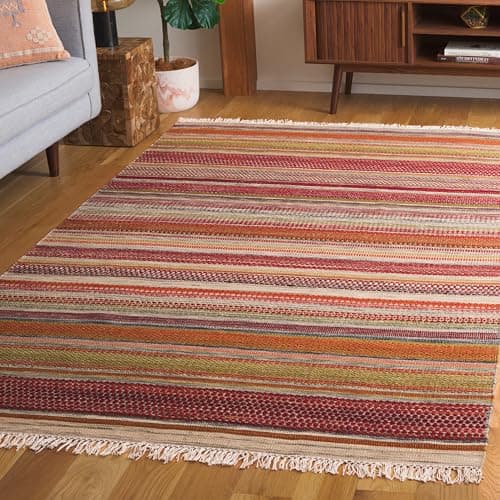
The low-shedding wool, and the pick if shedding is the thing you want to avoid rather than merely survive. A flatwoven kilim has no cut pile at all - every strand is woven into the structure and anchored at both ends - so there is very little loose fiber to release. It sheds lightly for a couple of weeks and then essentially stops. The trade is that it is thin and firm underfoot.
What it is
- Flatwoven — effectively no pile at all
- Wool fiber with a handwoven geometric pattern
- Reversible on many of the kilim patterns
What it does well
- Chairs slide over it instead of catching, which is exactly what a dining room needs
- No pile means nothing to crush, so furniture leaves no permanent dents
- Wool's soil resistance without wool's shedding
Don't buy it if
- Thin and firm underfoot — it will not feel luxurious
- Flatweaves need a good pad or they creep across the floor
- Spilled liquid goes straight through to the floor below
The correct rug shape for a dining room, in the correct fiber. Almost nobody buys this and regrets it.
Natural Area Rugs Wool-Sisal Blend Rug
Some softness, less shedding
No licensed photo of this exact rug yet — see it on the Amazon listing.
The middle path. A handmade wool and sisal blend with a stitched border: the sisal content gives it structure and the woven construction means far less loose fiber than a tufted pile, while the wool softens the hand. Expect some shedding from the wool portion in the first month, well below a tufted rug and above a pure flatweave.
What it is
- Sold as a wool sisal rug — the blend, not pure sisal
- Handmade and bordered in the same way as this brand's pure sisal weaves
- Wool brings the crimp and recovery that sisal has none of
What it does well
- The only honest answer to 'I want sisal but I have to walk on it barefoot'
- Wool recovers from furniture compression where pure sisal just stays crushed
- Reads as a natural fiber rug across a room without the sandpaper feel
Don't buy it if
- Costs meaningfully more than the pure sisal in the same size
- The wool component can shed for the first few months
- Still not a wet-clean rug — the sisal in the blend sets that rule
The compromise worth paying for in a living room or a bedroom edge, where pure sisal is simply too harsh.
The normal timeline
| Period | Hand-tufted pile | Flatwoven wool |
|---|---|---|
| Week 1 | Heavy - a full canister is normal | Light fuzz |
| Weeks 2 to 6 | Noticeable, declining steadily | Minimal |
| Months 2 to 6 | Light, mostly after vacuuming | Essentially none |
| After 6 months | Occasional fluff only | None |
| Still heavy at 6 months | Not normal - see below | Not normal |
How to get through it faster
- Vacuum often, with the beater bar off. Suction removes loose fiber; a rotating brush pulls out fiber that was not loose yet, which extends the shedding rather than ending it. Two or three passes a week for the first month genuinely shortens the whole period. Vacuuming rugs has the settings.
- Do not pull loose strands. On a tufted rug a pulled strand brings more with it. Trim anything protruding level with the pile using scissors.
- Take it outside and shake it, if it is small enough. This removes in ten minutes what a week of vacuuming would.
- Use a pad. A pad stops the rug shifting against the floor, and that abrasion from underneath is a quiet contributor to fiber loss over the long run.
- Accept the first month. The single most effective thing is not treating week one as evidence of a faulty rug and sending it back - the second rug will do exactly the same.
Shedding versus pilling, which are different problems
Shedding is loose fiber leaving the rug. Pilling is fiber staying on the rug and tangling into small balls on the surface. Pilling looks worse and is less serious: it is caused by friction and is cosmetic, and the fix is to shear the pills off with scissors or a fabric shaver rather than to pull them, which would pull pile with them.
A third thing gets confused with both: sprouting, where a single loop or tuft stands proud of the surface. Never pull a sprout. Cut it level with the surrounding pile and the rug is unaffected.
Does shedding mean the wool is low quality?
Not reliably, and this is where most of the anxiety comes from. Longer-staple wool sheds somewhat less than short-staple wool, so there is a grain of truth in it - but construction swamps that difference completely. An expensive hand-tufted rug in excellent wool will shed far more than a cheap flatwoven one in ordinary wool, because shearing creates loose fiber and weaving does not. Judge the construction, not the shedding.
The short version
Shedding is the price of a wool pile, it peaks in week one, and it is largely over inside two months with regular vacuuming. If that is unacceptable rather than merely annoying, buy a flatwoven wool rug and get wool's durability and warmth without the loose fiber - the best flatweave rugs covers that category. For the fiber's full picture, wool rugs is the guide, hand-tufted versus hand-knotted explains the construction that drives all of this, and the best wool rugs is the roundup.
Questions people actually ask
How long do wool rugs shed for?
Heavily for two to six weeks and lightly for three to six months, after which it settles to almost nothing. Flatwoven wool is largely done inside a couple of weeks; hand-tufted pile takes the longest.
Is it normal for a new wool rug to shed a lot?
Yes. Wool is spun from short fibers, and a sheared pile leaves a large quantity of them loose. Filling a vacuum canister from one room in the first week is normal, not a defect.
How do you stop a wool rug from shedding?
You cannot stop it, only shorten it. Vacuum two or three times a week with the beater bar off, shake the rug outside if it is small enough, and trim rather than pull any protruding strands.
Do all wool rugs shed?
All of them shed something, but the amount varies enormously by construction. Hand-tufted pile sheds most, machine-woven wool less, and flatwoven or hand-knotted wool very little because every strand is anchored.
Does shedding mean a wool rug is poor quality?
Not usually. Construction matters far more than wool grade - an expensive tufted rug sheds more than a cheap flatweave. Shedding that is still heavy after six months, or comes out in long strands, is the signal that something is wrong.
Should you vacuum a new wool rug?
Yes, often, with the rotating brush switched off. Suction removes fiber that is already loose and shortens the shedding period; a beater bar pulls out fiber that was still attached and prolongs it.
Sources
Read next
- Wool RugsWhat wool physically does that synthetics cannot — crimp recovery and lanolin — and what that buys you.
- Hand-Tufted vs Hand-Knotted RugsGlued versus tied, and what that means for price, lifespan, shedding and resale. Plus how to tell them apart from the back in five seconds.
- The Best Wool Rugs (October 2026)Tufted, flatwoven and blended wool compared on pile, shedding and the room each one belongs in - with the honest cost of each.
- Vacuuming RugsWhich setting for which construction, why beater bars help some rugs and wreck others, and how often to vacuum.
- Do Jute Rugs Shed?Yes, heavily, for four to six weeks. What is normal, how to speed it up, and the constructions that shed least.
- Rug MaterialsWool, jute, sisal, polypropylene, cotton, viscose and the traditional weaves — compared on wear, feel, water and cost.