Rug Materials
Hand-Tufted vs Hand-Knotted Rugs
Two words that sound like the same thing and describe rugs that are barely the same product. One lasts five to fifteen years. One lasts a century.
Heads up: we earn a commission when you buy through links on this page, at no extra cost to you. It never changes which rug we put first — see how we choose and our affiliate disclosure.
Quick picks
The whole answer, before the detail. Tap any row to jump to that rug's full write-up further down the page.
| # | Rug | Best for | Construction | Price |
|---|---|---|---|---|
| 1 | No image Safavieh Hand-Tufted Wool RugThe hand-tufted side of the comparison, and a fair example of what the construction does well: real wool pile, genuine depth and softness underfoot, and a price a normal household can justify for a living room. The cotton backing is glued to the tufts, which is the construction's defining compromise - it is also why this rug costs a fraction of a knotted wool rug of the same size. | Wool pile at a reachable price | Hand-tufted wool pile on a cotton backing | |
| 2 | 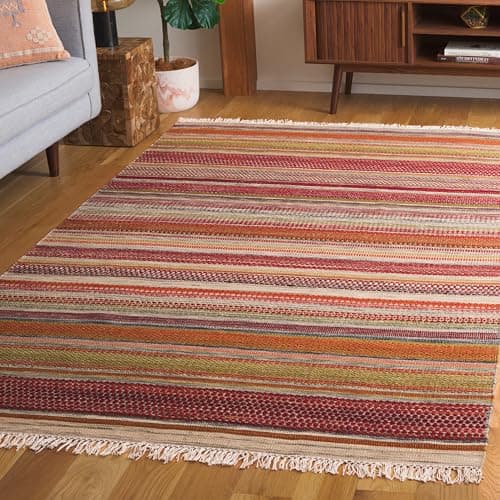 Safavieh Wool Flatweave Kilim RugThe honest alternative if what attracts you about hand-knotted is longevity rather than pile. A flatwoven wool kilim is woven rather than glued, has no latex layer to fail, is frequently reversible, and will outlive any tufted rug in the same room. You give up softness entirely - this is a thin, firm rug - and you keep the twenty-year horizon. | Longevity without the knotted price | Flatwoven wool, effectively no pile | |
| 3 | No image Natural Area Rugs Wool-Sisal Blend RugThe third path, and the one people overlook. A handmade wool and sisal blend with a stitched fabric border: woven construction rather than glued, a bound edge that is the usual failure point on a cheap rug, and a texture that sits between a flatweave and a pile. It is not a knotted rug and does not pretend to be, but it is built rather than assembled. | Handmade construction, not glued | Handmade wool and sisal blend with a fabric border |
The short answer
A hand-tufted rug is made by punching yarn through a fabric backing with a tufting gun and gluing a second backing over it. A hand-knotted rug is made by tying every single knot onto a warp by hand, with no glue anywhere. Tufted costs a fraction as much and lasts five to fifteen years; knotted lasts generations.
These two terms sit next to each other in listings and almost nothing about the rugs is comparable. Understanding the difference takes about a minute and saves people from two opposite mistakes: paying a knotted price for a tufted rug, and dismissing a tufted rug that would have been exactly right for their room.
How each one is actually made
Hand-tufted. A maker stretches a primary backing cloth on a frame and uses a handheld tufting gun to punch loops of yarn through it, following a pattern drawn on the cloth. The loops are held in place only by friction until a layer of latex adhesive is spread across the back and a secondary backing - usually cotton scrim - is laid over it. The pile is then sheared level. It is skilled work and it is fast: a large rug takes days rather than months.
Hand-knotted. A weaver sets up warp threads on a vertical loom and ties individual knots of yarn around pairs of warps, row by row, beating each row down and weaving weft threads between them. The pile, the structure and the backing are all the same set of threads - there is no separate backing and no adhesive anywhere in the rug. A 9x12 at a moderate knot density represents months of continuous work by several weavers.
Everything that follows from that
| Hand-tufted | Hand-knotted | |
|---|---|---|
| How the pile is held | Latex adhesive and a glued backing | Tied knots - no adhesive at all |
| Typical lifespan | 5 to 15 years | 50 years and up |
| Relative price | Low to moderate | High to very high |
| Shedding | Heavy at first, often ongoing | Minimal after the first weeks |
| The back | Covered by a cloth scrim | Shows the pattern in reverse |
| Reversible | No | Not usually, but wears on both faces |
| Repairable | Rarely worth it | Yes, including reweaving |
| Resale value | Essentially none | Holds or appreciates |
The lifespan row is the one worth dwelling on, because it has a specific mechanism rather than being a general quality statement. A tufted rug fails when its latex layer dries out, becomes brittle and crumbles - at which point the tufts have nothing holding them and the rug begins to shed continuously and shed structurally. That is not wear from walking on it; it is the adhesive aging. It happens in a lightly used rug in a spare room on roughly the same schedule as in a busy one.
How to tell them apart in five seconds
Turn the corner over. A hand-knotted rug shows the pattern on the back almost as clearly as on the front, in slightly softer focus, with visible individual knots and small irregularities - the back is the structure. A hand-tufted rug shows a plain cloth backing glued across the whole underside, hiding everything. If you cannot see the pattern from behind, it is not knotted.
Two secondary tells. A hand-knotted rug's fringe is a continuation of the warp threads and is structural, so it cannot be pulled off; a tufted rug's fringe, where it has one, is a separate strip sewn on. And a tufted rug smells faintly of latex when new, which a knotted rug never does.
Safavieh Hand-Tufted Wool Rug
Wool pile at a reachable price
No licensed photo of this exact rug yet — see it on the Amazon listing.
The hand-tufted side of the comparison, and a fair example of what the construction does well: real wool pile, genuine depth and softness underfoot, and a price a normal household can justify for a living room. The cotton backing is glued to the tufts, which is the construction's defining compromise - it is also why this rug costs a fraction of a knotted wool rug of the same size.
What it is
- Wool pile hand-tufted to a cotton backing
- Made in India across a large pattern catalog
- Cut pile, generally medium height
What it does well
- Wool springs back from furniture compression in a way no synthetic does
- Naturally flame-resistant and naturally soil-resistant thanks to the lanolin in the fiber
- With normal care it outlives every synthetic rug on this page several times over
Don't buy it if
- Sheds noticeably for the first few months — normal for a tufted wool rug, not a defect
- Hand-tufted rugs are glued, and the latex adhesive can break down after many years
- Costs several times what a comparable polypropylene rug costs
The long-horizon purchase in this category: expensive once rather than cheap repeatedly.
Safavieh Wool Flatweave Kilim Rug
Longevity without the knotted price
The honest alternative if what attracts you about hand-knotted is longevity rather than pile. A flatwoven wool kilim is woven rather than glued, has no latex layer to fail, is frequently reversible, and will outlive any tufted rug in the same room. You give up softness entirely - this is a thin, firm rug - and you keep the twenty-year horizon.
What it is
- Flatwoven — effectively no pile at all
- Wool fiber with a handwoven geometric pattern
- Reversible on many of the kilim patterns
What it does well
- Chairs slide over it instead of catching, which is exactly what a dining room needs
- No pile means nothing to crush, so furniture leaves no permanent dents
- Wool's soil resistance without wool's shedding
Don't buy it if
- Thin and firm underfoot — it will not feel luxurious
- Flatweaves need a good pad or they creep across the floor
- Spilled liquid goes straight through to the floor below
The correct rug shape for a dining room, in the correct fiber. Almost nobody buys this and regrets it.
Natural Area Rugs Wool-Sisal Blend Rug
Handmade construction, not glued
No licensed photo of this exact rug yet — see it on the Amazon listing.
The third path, and the one people overlook. A handmade wool and sisal blend with a stitched fabric border: woven construction rather than glued, a bound edge that is the usual failure point on a cheap rug, and a texture that sits between a flatweave and a pile. It is not a knotted rug and does not pretend to be, but it is built rather than assembled.
What it is
- Sold as a wool sisal rug — the blend, not pure sisal
- Handmade and bordered in the same way as this brand's pure sisal weaves
- Wool brings the crimp and recovery that sisal has none of
What it does well
- The only honest answer to 'I want sisal but I have to walk on it barefoot'
- Wool recovers from furniture compression where pure sisal just stays crushed
- Reads as a natural fiber rug across a room without the sandpaper feel
Don't buy it if
- Costs meaningfully more than the pure sisal in the same size
- The wool component can shed for the first few months
- Still not a wet-clean rug — the sisal in the blend sets that rule
The compromise worth paying for in a living room or a bedroom edge, where pure sisal is simply too harsh.
Machine-made, and where it fits
Most rugs sold today are neither of these: they are power-loomed, woven by machine from synthetic or wool yarn on an industrial loom. A power-loomed rug has a woven structure rather than a glued one, which means it does not have the tufted rug's adhesive failure mode, and good ones outlast cheap tufted rugs comfortably. It will not have the depth or the hand of a tufted wool pile. The best polypropylene rugs covers that category properly.
So the real ladder is not two rungs but four: power-loomed synthetic, hand-tufted wool, handwoven flatweave, hand-knotted. Price rises along it, and so does lifespan - but not evenly, which is the useful part. A handwoven flatweave often outlasts a hand-tufted pile rug while costing less, because it has no adhesive in it at all.
What about shedding?
Hand-tufted rugs shed, often heavily, for months - the shearing process leaves a large quantity of short loose fiber in the pile, and the glued construction has no mechanism to grip it. Hand-knotted rugs shed lightly for a few weeks and then essentially stop, because every strand in them is tied at both ends. If continuous shedding is the thing you want to avoid, that distinction matters more than the fiber does. Do wool rugs shed covers the timeline and when shedding stops being normal.
Cleaning, which is where tufted rugs get ruined
Never saturate a hand-tufted rug. Water that reaches the latex layer softens it, can brown-stain through to the face, and accelerates the adhesive's breakdown - which is why professional cleaners charge differently for tufted and knotted rugs and why some decline tufted ones altogether. Blot spills, use as little moisture as possible, and never put one through any kind of immersion wash. How to clean a wool rug has the safe method; can you pressure wash a rug covers the fastest way to destroy one.
Which one to buy
Buy hand-tufted if you want wool pile underfoot in a specific room at a price that does not require a decision, and you accept replacing it in a decade. Buy hand-knotted if you want an object rather than a furnishing, you are prepared for the price, and you want something that is worth repairing. Buy a handwoven flatweave if longevity is the real motive and softness is not - it is the overlooked answer and it is usually the right one. The best wool rugs covers the pile side, the best flatweave rugs the woven side, and Persian rugs explains what the knotted tradition actually refers to.
Questions people actually ask
Is hand-tufted the same as hand-knotted?
No. Hand-tufted rugs are punched through a backing cloth with a gun and held by glue. Hand-knotted rugs are tied knot by knot with no adhesive. They differ in price, lifespan, shedding and resale.
How can you tell if a rug is hand-knotted?
Look at the back. A hand-knotted rug shows the pattern in reverse with individual knots visible. A hand-tufted rug has a plain glued-on cloth backing that hides everything. The fringe is also structural on a knotted rug and sewn on when present on a tufted one.
How long do hand-tufted rugs last?
Roughly five to fifteen years, depending on traffic. They fail when the latex adhesive holding the tufts becomes brittle, which happens with age rather than only with use.
Are hand-tufted rugs worth buying?
Yes, for the right reason: they are the cheapest way to own genuine wool pile with real depth underfoot. They are not worth buying as a long-term investment or at a price close to a knotted rug.
Why do hand-tufted rugs shed so much?
Shearing the pile level leaves a lot of short loose fiber behind, and the glued construction has nothing gripping those strands. Shedding is heaviest in the first months and often continues at a lower level for the rug's life.
Can hand-tufted rugs be professionally cleaned?
Yes, but with low moisture. Saturating one softens the latex layer and can cause browning and premature breakdown, which is why some cleaners price tufted rugs differently or decline them.
Sources
Read next
- The Best Wool Rugs (October 2026)Tufted, flatwoven and blended wool compared on pile, shedding and the room each one belongs in - with the honest cost of each.
- The Best Flatweave RugsFlatweave rugs across cotton, wool, sisal and polypropylene, judged on what each fiber does when there is no pile to hide behind.
- Do Wool Rugs Shed?Yes - heavily for the first weeks and lightly for three to six months. What is normal, what is a construction fault, and how to get through it faster.
- Persian RugsWhat 'Persian' actually denotes, how to tell hand-knotted from machine-woven, and what you are paying for.
- How to Clean a Wool RugThe cool-water method for wool, why heat felts it permanently, and what to do about set-in stains.
- Rug MaterialsWool, jute, sisal, polypropylene, cotton, viscose and the traditional weaves — compared on wear, feel, water and cost.