Outdoor Rugs
The Best Fade-Resistant Outdoor Rugs
Sun, not rain, is what finishes an outdoor rug. These are the ones with the pigment built into the fiber - and the honest way to tell before you buy.
Heads up: we earn a commission when you buy through links on this page, at no extra cost to you. It never changes which rug we put first — see how we choose and our affiliate disclosure.
Quick picks
The whole answer, before the detail. Tap any row to jump to that rug's full write-up further down the page.
| # | Rug | Best for | Construction | Price |
|---|---|---|---|---|
| 1 | 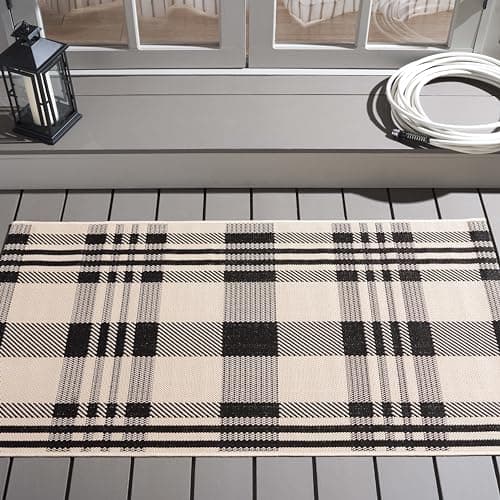 Safavieh Courtyard Indoor/Outdoor RugThe first pick because it is the one that gives you a real pattern without giving up the fiber that holds color. Polypropylene power loomed to about a quarter-inch pile, rated for either side of the door, in a catalog of borders, geometrics and traditional medallions rather than the stripe-and-solid range most outdoor lines stop at. That matters for fade specifically: a patterned mid-tone weave hides the uneven lightening a flat saturated field advertises, so the rug reads as aged rather than worn long after the pigment has started to go. | Sunny patios with a pattern | Power-loomed polypropylene, roughly a quarter-inch pile, no backing | $19.78$25.43View on Amazon #ad We earn a commission · Price as of October 12, 2026 |
| 2 | No image Fab Habitat Flatweave Outdoor RugThe pick with the one feature nothing else here can match: a second, unexposed face. It is a fully reversible flatweave in recycled polypropylene, so at the end of a hard summer you flip it and start again with an unfaded surface. No specification difference between outdoor rugs is worth as much as that, and it costs nothing extra. The trade is that a reversible flatweave has no backing and no weight, so it needs an outdoor pad or it will travel. | Flipping to reset the surface | Flatwoven recycled polypropylene, fully reversible | |
| 3 | 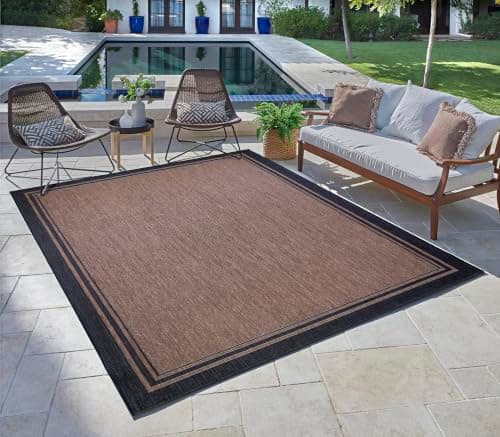 Gertmenian Outdoor Patio RugThe area-coverage answer. Solution-dyed polypropylene - pigment mixed into the polymer before the fiber is extruded - in sizes big enough to sit a full patio set on without the rug costing more than the furniture. If the deciding factor is square footage in open sun rather than refinement underfoot, this is the sensible purchase, and the flatwoven backing means the whole rug is the same weatherproof fiber rather than a synthetic face on something that absorbs. | Covering a large area | Flatwoven polypropylene, reversible on some patterns | $200.65View on Amazon #ad We earn a commission · Price as of October 12, 2026 |
| 4 | No image nuLOOM Lefebvre Braided Indoor/Outdoor RugThe pick that hides fade by construction rather than resisting it. A braided weave presents dozens of tonal variations per square foot, so as the pigment lightens there is no uniform reference tone for the eye to measure the change against. It is rated for either side of the door and reads as natural fiber from standing height, which makes it the right choice for a screened porch or a sunroom where the rug has to look like part of the house. | Hiding fade by design | Braided polypropylene, low pile | |
| 5 | No image Playa Reversible Outdoor MatHere as the honest low-commitment option rather than as a patio rug. Woven recycled plastic straw with pigment through the strand, reversible, and light enough to pack into a bag - which is the point. If the rug lives in full sun on grass, at a campsite or on a dock, buy something you can shake out and replace on a short cycle instead of asking a furniture-grade rug to survive conditions nothing survives. | A mat you expect to replace | Woven recycled plastic straw, reversible |
The short answer
Buy solution-dyed polypropylene in a mid-tone or patterned colorway, and rotate it a quarter turn twice a season. The dye method decides almost everything: pigment mixed into the polymer before the fiber is spun fades slowly, and pigment printed onto finished fiber does not. Reversible flatweaves last longest, because you can flip them.
Nothing on this page is fade proof, and any listing implying otherwise is overselling. What you are actually choosing between is a rug that looks tired after two summers and one that still looks deliberate after six - and that difference is set by where the pigment sits in the fiber, not by the brand on the label.
Why outdoor rugs fade, and why the dye method is the whole answer
Ultraviolet light breaks the chemical bonds that hold a pigment's color. Where that pigment sits decides how much of it is exposed. In a solution-dyed fiber the pigment is mixed into molten polymer before the strand is extruded, so color runs all the way through and the surface layer UV destroys is a tiny fraction of what is there. In a surface-dyed or printed fiber the color is a coating microns thick, and once UV has destroyed that coating there is undyed white polymer underneath. That is the chalky look people describe after a single season.
Kvadrat, which sells solution-dyed polypropylene outdoor rugs into the contract market, describes the process in exactly those terms and rates colorfastness to light on the ISO 105-B02 scale, where 1 is the worst result and 8 the best. Consumer listings effectively never publish a number on that scale. What they will usually tell you is the fiber, and sometimes the dye method - which is why those two facts do most of the work in the picks below. Polypropylene rugs covers the fiber in full.
The five things we judged these on
- Dye method, where the listing states it. Solution-dyed or mass-pigmented beats surface-printed every time. Where a listing is silent, we say it is silent rather than assume the better answer.
- Fiber. Polypropylene carries pigment inside the polymer and is the default outdoor fiber for exactly that reason. Printed polyester outdoor rugs cost less and fade faster. Natural fiber is not in this conversation at all - jute and sisal sun-bleach and water-stain, and belong indoors.
- Reversibility. A reversible flatweave is the only outdoor rug with a second unfaded face. That is a doubling of usable surface for no extra money, and it is why one pick here outranks rugs that beat it on every other line.
- Tone and pattern. A mid-tone, heathered or busy weave hides uneven fade; a flat saturated navy or brick red advertises it. This decides more than the brand name does.
- Weave density and pile height. A dense flatweave puts less fiber surface per square inch in front of the sun than an open or a high pile, and it holds its geometry as the surface ages.
We compared published fiber content, dye-method statements, backing construction and stated size ranges across current listings. We do not run light-box exposure tests and we make no testing claims - how we choose sets out the method and its limits plainly.
Safavieh Courtyard Indoor/Outdoor Rug
Sunny patios with a pattern
Product photo and price from Amazon, refreshed daily.
#ad We earn a commission · Price as of October 12, 2026
The first pick because it is the one that gives you a real pattern without giving up the fiber that holds color. Polypropylene power loomed to about a quarter-inch pile, rated for either side of the door, in a catalog of borders, geometrics and traditional medallions rather than the stripe-and-solid range most outdoor lines stop at. That matters for fade specifically: a patterned mid-tone weave hides the uneven lightening a flat saturated field advertises, so the rug reads as aged rather than worn long after the pigment has started to go.
What it is
- 100 percent polypropylene, power loomed in Turkey
- Pile around a quarter of an inch, with no applied backing
- Rated for indoor or outdoor use and listed as cleanable with a garden hose
What it does well
- A far deeper pattern catalog than the stripe-and-solid outdoor norm - borders, geometrics and traditional medallions
- Polypropylene absorbs no water, so nothing in the rug can feed mildew
- The quarter-inch pile hoses clean and dries far faster than any cut-pile rug
Don't buy it if
- Fade resistant is not fade proof - a quarter-inch pigmented pile in unshaded afternoon sun will still lighten over a few summers
- No backing at all, so it slides and creeps without an outdoor pad
- A quarter-inch pile is firm underfoot; comfort is not what this line is for
The outdoor rug for people who want a pattern rather than a stripe, bought with clear eyes about what a south-facing summer does to any synthetic.
Fab Habitat Flatweave Outdoor Rug
Flipping to reset the surface
No licensed photo of this exact rug yet — see it on the Amazon listing.
The pick with the one feature nothing else here can match: a second, unexposed face. It is a fully reversible flatweave in recycled polypropylene, so at the end of a hard summer you flip it and start again with an unfaded surface. No specification difference between outdoor rugs is worth as much as that, and it costs nothing extra. The trade is that a reversible flatweave has no backing and no weight, so it needs an outdoor pad or it will travel.
What it is
- Flatwoven from recycled polypropylene yarn
- Fully reversible — two usable faces
- Designed to be hosed down and hung to dry
What it does well
- Reversible construction effectively doubles the usable life
- Hoses clean in minutes and dries fast because there is no pile to hold water
- Rolls up small enough to store over winter without a dedicated space
Don't buy it if
- Very thin — you will feel every imperfection in the deck below it
- Flatweave slides more than a backed rug; it needs weighting or an outdoor pad
- Stripe patterns dominate the range if you want something plainer
The most practical outdoor rug here if your actual cleaning routine is a garden hose and ten minutes.
Gertmenian Outdoor Patio Rug
Covering a large area
Product photo and price from Amazon, refreshed daily.
#ad We earn a commission · Price as of October 12, 2026
The area-coverage answer. Solution-dyed polypropylene - pigment mixed into the polymer before the fiber is extruded - in sizes big enough to sit a full patio set on without the rug costing more than the furniture. If the deciding factor is square footage in open sun rather than refinement underfoot, this is the sensible purchase, and the flatwoven backing means the whole rug is the same weatherproof fiber rather than a synthetic face on something that absorbs.
What it is
- Polypropylene throughout, including the backing on most patterns
- Wide pattern range beyond the usual neutral weave
- Large sizes stay unusually affordable
What it does well
- One of the few lines where a genuinely large outdoor rug does not cost more than the furniture on it
- Solution-dyed polypropylene means color runs through the fiber, so fading is slow
- Safe against composite decking, and it takes the scuffing patio furniture inflicts
Don't buy it if
- Flatwoven polypropylene is not soft — this is not a barefoot lounging surface
- Edges can curl for the first few weeks out of the box
- The pattern printing is decent rather than premium
The sensible default for a full-size patio: it covers the area, survives weather, and does not cost enough to make you precious about it.
nuLOOM Lefebvre Braided Indoor/Outdoor Rug
Hiding fade by design
No licensed photo of this exact rug yet — see it on the Amazon listing.
The pick that hides fade by construction rather than resisting it. A braided weave presents dozens of tonal variations per square foot, so as the pigment lightens there is no uniform reference tone for the eye to measure the change against. It is rated for either side of the door and reads as natural fiber from standing height, which makes it the right choice for a screened porch or a sunroom where the rug has to look like part of the house.
What it is
- Braided construction that reads as natural fiber from a distance
- Around ten size options plus round and runner shapes
- Rated for indoor or outdoor use
What it does well
- Looks like jute without any of jute's water problems
- Low braided pile handles traffic better than a cut pile
- The shape range is deeper than most outdoor lines
Don't buy it if
- The braided texture traps grit, so it needs shaking out rather than just a vacuum
- Lighter colorways show dirt quickly on a deck
- Not reversible, despite the braided look
The rug to choose when the space is technically outdoors but you want it to read as part of the house.
Playa Reversible Outdoor Mat
A mat you expect to replace
No licensed photo of this exact rug yet — see it on the Amazon listing.
Here as the honest low-commitment option rather than as a patio rug. Woven recycled plastic straw with pigment through the strand, reversible, and light enough to pack into a bag - which is the point. If the rug lives in full sun on grass, at a campsite or on a dock, buy something you can shake out and replace on a short cycle instead of asking a furniture-grade rug to survive conditions nothing survives.
What it is
- Woven recycled plastic straw rather than a pile construction
- Reversible with a different color on each face
- Packs into a carry bag
What it does well
- Genuinely portable, which no conventional outdoor rug is
- Nothing absorbs, so mildew is effectively off the table
- Shakes clean — no hose needed
Don't buy it if
- Plastic-straw texture is not pleasant underfoot barefoot
- Light enough to need anchoring in any real wind
- It reads as a camp mat, not as furniture
A camp and lawn mat that people buy as a patio rug and then find disappointing on a deck. Buy it for what it is.
Fiber by fiber: what holds color outdoors
| Fiber | How color is usually applied | In full sun | Verdict |
|---|---|---|---|
| Solution-dyed polypropylene | Pigment in the polymer before extrusion | Lightens slowly and evenly | The default |
| Surface-dyed polypropylene | Dye applied to finished fiber | Visibly lighter in a season or two | Fine in shade |
| Printed polyester | Pattern printed onto the surface | Fastest to go chalky | Covered areas only |
| Recycled plastic straw | Pigment through the strand | Holds color; the weave fails first | Portable use |
| Jute or sisal | Natural color, sometimes dyed | Sun-bleaches and water-stains | Indoors only |
| Wool | Dyed fiber | Sun-bleaches, and it absorbs | Indoors only |
What a listing will tell you, and what it will not
Three things are usually there. Fiber content, which is the single most useful line in any outdoor listing, because polypropylene versus polyester predicts fade behavior better than any marketing phrase on the page. Whether the rug is rated for outdoor use, which tells you the backing is synthetic too rather than a cotton scrim that will rot. And the care instruction, which is the most overlooked of the three - a maker telling you to hose the rug and dry it flat is describing a rug that survives being cleaned properly.
Two things are usually missing. The dye method is rarely stated on consumer listings even when the rug is solution-dyed, so its absence is not evidence either way. And nobody publishes a lightfastness rating, so there is no number to compare across brands. Where a listing is silent, the honest move is to assume nothing and buy on fiber, tone and reversibility - which is exactly the order the criteria above are in.
How to tell, once the rug arrives
Two checks, both free, both doable in the first ten minutes out of the box. First, look at the back. On a solution-dyed flatweave the pattern is visible from behind in the same colors, because the colored yarn runs all the way through the weave. On a printed rug the back is pale or plain - the pattern lives on the surface only. A reversible rug passes this test by definition, which is part of why reversibility is such a good proxy for the whole question.
Second, look into the weave rather than at it. Part the yarns with a fingernail and look at the base of the fiber, where no light reaches. In a mass-pigmented rug the color at the base matches the color at the tip. In a surface-dyed or printed rug the base is noticeably paler - and that pale color is what the rug will look like in three summers. Neither check is laboratory-grade and neither is grounds for a return on its own, but together they tell you what you have bought before the sun does.
Color choice does more work than brand choice
Two identical rugs in different colorways do not age the same way. Saturated single-color fields - deep navy, charcoal, brick red - lose the most visible value, because there is a large uniform area for the eye to compare against the unfaded rectangle under a planter. Heathered, two-tone and busy geometric weaves lose the same quantity of pigment and look fine, because there is no reference tone to measure the loss against.
The practical rule: in full southern or western sun, buy the busiest pattern you can live with in a mid-tone. If you want a solid field, buy it for a covered porch or a north-facing deck and treat it as a shade-rated purchase. Light neutrals are not more fade resistant - they simply have less distance to fall, which comes to the same thing visually and is a perfectly good reason to choose one.
Where the rug sits decides how long it lasts
Hours of direct sun per day is the biggest single variable, and it is entirely about placement rather than product. A rug under a pergola or a solid awning will outlast the identical rug six feet away in the open by years. South and west exposures take the longest, hardest afternoon sun; a north-facing deck is the gentlest spot on most properties, and a screened porch is gentler still.
Heat compounds it. A dark synthetic rug in direct sun gets hot enough to be unpleasant barefoot, and that same heat accelerates the polymer's breakdown - do outdoor rugs get hot covers the surface-temperature side. Size the rug to leave a visible border of deck or patio all the way around, which keeps water moving and makes the rug easy to lift and rotate: outdoor rug sizes has the dimensions by space.
Two placements people misjudge. A balcony with a glass or clear-panel balustrade takes more sun than it appears to, because the rug collects light from below the rail as well as above it. And a rug in a sunroom behind modern low-emissivity glazing fades more slowly than one in the open but faster than one properly indoors - the coating cuts a good deal of ultraviolet, not all of it. If the rug is going behind glass, treat it as a half-shade position rather than an indoor one.
Four habits that visibly slow fading
Rotate it a quarter turn twice a season
The habit that matters most, and it costs nothing. Fade happens where the sun falls, so a rug left in one orientation develops a hard line at the shade boundary. Rotating turns that line into an even, uniform lightening - the difference between a rug that looks damaged and one that looks aged.
Flip it if it is reversible
A reversible flatweave has a second face that spent the summer in the dark. Flipping it at the end of a hard season resets the surface completely, and it is the cheapest life extension available on any outdoor rug.
Bring it in for the off-season
Months of winter sun, snowmelt and freeze-thaw do real damage for no benefit, because nobody is using the patio. Hose it, dry it completely, roll it and store it - storing rugs covers doing that without creating a mildew problem, and can you leave outdoor rugs outside covers the year-round question.
Keep grit out of the weave
Sand and grit act as an abrasive underfoot and mechanically wear the pigmented surface off the top of each strand, which looks exactly like fading and is not. Shake or hose the rug monthly in season; how to clean an outdoor rug has the full routine.
What fading actually costs you
The honest way to think about the money: in full sun, treat any outdoor rug as a three-to-five-year item whatever the listing implies, and judge it on cost per year rather than on sticker price. On that basis a mid-priced solution-dyed flatweave that gets flipped once beats a premium rug left in one orientation, and it comfortably beats a cheap printed polyester rug replaced every second summer. The cheapest outdoor rugs are very rarely the cheapest outdoor rugs.
The one place to spend more rather than less is the pad, and only on a deck - for a reason that has nothing to do with fade. An open-mesh outdoor pad keeps the boards underneath drying, which is a rot question: outdoor rug pads and do outdoor rugs damage decks both cover it.
What we would buy
For a sunny patio that needs a pattern and real area coverage, the Safavieh Courtyard. For a deck in unshaded afternoon sun where the rug will genuinely be hosed and flipped, the reversible Fab Habitat flatweave - that second face is worth more than any specification difference between the two. For a screened porch or sunroom that should read as part of the house, the braided nuLOOM. If the no-pile construction is what you are really after, the best flatweave rugs compares it across cotton, wool, sisal and polypropylene. If you want the broader shortlist rather than the fade-first one, the best outdoor rugs is the general roundup and the best indoor-outdoor rugs covers rugs that have to work on both sides of the door.
Questions people actually ask
Which outdoor rug material fades the least?
Solution-dyed polypropylene, where the pigment is mixed into the polymer before the fiber is extruded so color runs through the strand. Printed polyester fades fastest. Jute and sisal sun-bleach and should not be outdoors at all.
How long before an outdoor rug fades?
In full, unshaded sun expect visible lightening within one to two summers and treat the rug as a three-to-five-year item. Under a pergola or an awning the same rug can look close to new for years longer.
Does rotating an outdoor rug actually help?
It does not reduce the total fade, but it changes how the fade looks. A quarter turn twice a season converts a hard line at the shade boundary into an even lightening across the whole rug, which is the difference between worn and aged.
Are dark outdoor rugs worse than light ones?
Visually, usually yes. Dark saturated fields show the contrast between faded and unfaded areas most clearly, and they run hotter in sun. A mid-tone, heathered or busy pattern hides the same amount of pigment loss.
Is a fade-resistant rug also waterproof?
Not necessarily, and the two properties are unrelated. Fade resistance is dye chemistry; shedding water is weave and backing. A rug can be excellent at one and entirely ordinary at the other.
Can a faded outdoor rug be re-dyed or restored?
No, not usefully. Once UV has destroyed the pigment at the surface of a synthetic strand there is nothing left to restore, and consumer dyes do not bond to polypropylene. Replacement is the only fix, which is why cost per year is the number that matters.
Sources
Read next
- The Best Outdoor Rugs (September 2026)Outdoor rugs compared on fiber, drainage and reversibility — and what each one does to the surface underneath.
- The Best Indoor-Outdoor RugsRugs rated for both sides of the door, compared on weave, drainage and whether they still look right indoors.
- Can You Leave Outdoor Rugs Outside?Whether an outdoor rug can stay out year-round, what winter actually does to it, and the storage routine that pays.
- Waterproof Outdoor RugsWhat 'waterproof' actually means on an outdoor rug listing, and the constructions that genuinely drain fastest.
- Polypropylene RugsWhy solution-dyeing and water repellency make polypropylene the default budget and outdoor fiber — and its real limits.
- Outdoor RugsOutdoor rugs by fiber and backing, plus the drainage question that decides whether the rug quietly ruins the deck under it.