Rug Care
How Long Do Rugs Last?
The honest answer spans a factor of ten, and almost all of it is decided by two things you choose at the point of purchase.
The short answer
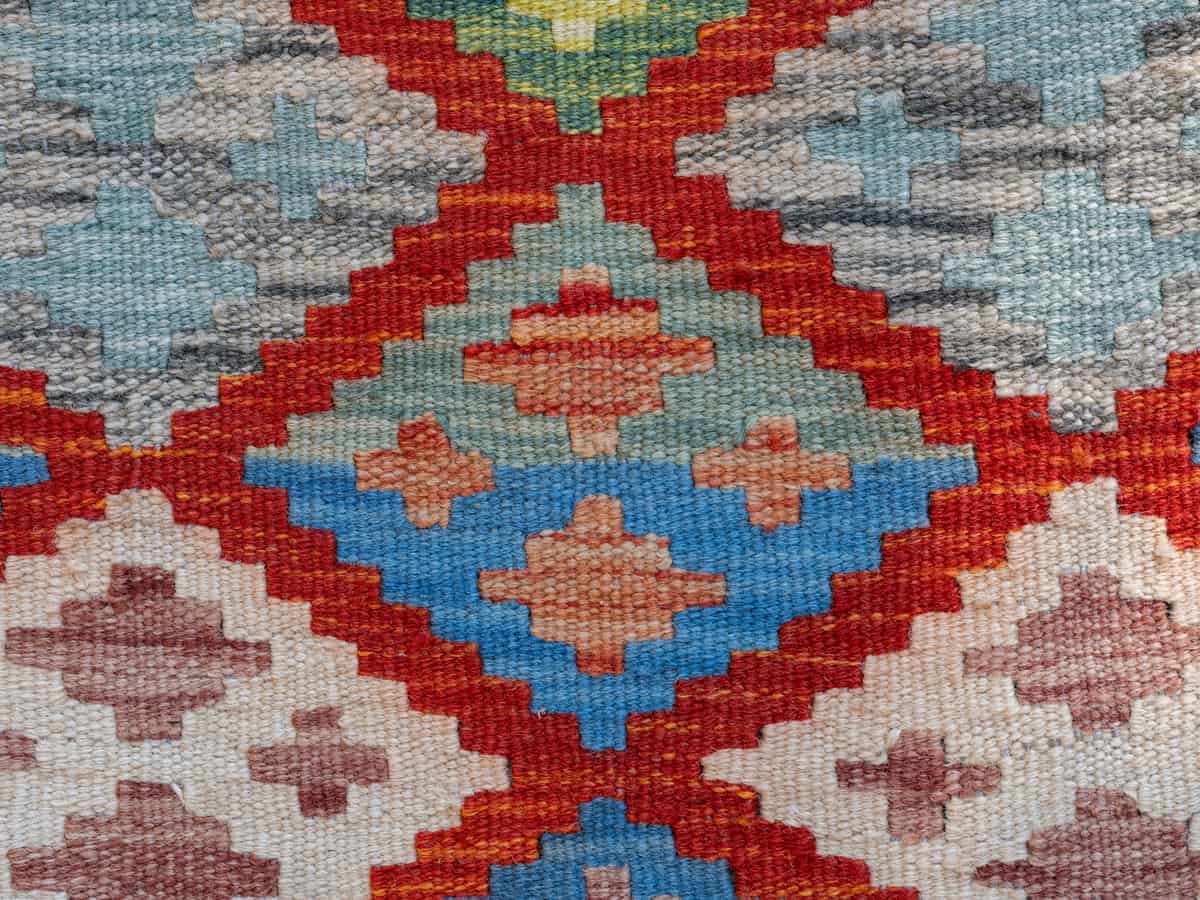
A cotton rug lasts three to five years in traffic. A synthetic pile rug lasts five to ten. A hand-tufted wool rug lasts ten to fifteen, a flatwoven wool rug fifteen to twenty-five, and a hand-knotted rug lasts generations. Fiber and construction decide most of it; traffic and a pad decide the rest.
This question usually gets a shrug, and it deserves a real answer because it changes which rug you should buy. A rug that costs four times as much and lasts five times as long is the cheaper rug, and a rug that lasts twenty years in a room you will redecorate in five is money spent on durability you will never use.
The table
| Rug | Lifespan | What ends it |
|---|---|---|
| Cotton flatweave | 3 to 5 years | Thins in the traffic lane; fiber does not recover |
| Polyester pile | 4 to 8 years | Pile crushes permanently and mats |
| Polypropylene pile | 5 to 10 years | Pile crushes; fades in direct sun |
| Jute | 5 to 10 years | Sheds, stains, and fails at the border |
| Hand-tufted wool | 10 to 15 years | Latex backing becomes brittle and crumbles |
| Sisal | 8 to 12 years | Wears steadily, then fails at the edge |
| Machine-woven wool | 10 to 20 years | Gradual pile loss |
| Flatwoven wool kilim | 15 to 25 years | Very little - usually the edge |
| Hand-knotted wool | 50 years and up | Nothing, if it is repaired |
Two rows are worth pausing on. A hand-tufted wool rug is limited by its adhesive, not by its wool - the latex layer holding the tufts dries out and becomes brittle with age whether the rug is walked on or not, which is why a lightly used tufted rug in a spare room fails on roughly the same schedule as a busy one. And a flatwoven wool rug outlasts a hand-tufted one at a lower price, because it has no adhesive in it at all. Hand-tufted vs hand-knotted covers that construction difference properly.
What to look for if lifespan is the priority
- Woven, not glued. Any construction where the pile is part of the structure - flatweave, hand-knotted, well-made power-loomed - outlasts a construction where the pile is held on by adhesive. This matters more than fiber.
- Pile density, not pile height. Press your thumb in and part the pile. If the backing shows easily the rug is sparse, and wear is concentrated on fewer fibers. A dense low pile beats a sparse deep one in any fiber.
- A bound or stitched border. Natural-fiber and flatwoven rugs almost always fail at the edge rather than in the field. A finished edge is the cheapest longevity feature there is.
- Crimped fiber. Wool recovers from compression because the fiber is crimped. Cotton and most synthetics do not, so their pile stays flat once it is flattened.
- Solution-dyed, if it will see sun. Pigment through the strand rather than on it is why a solution-dyed synthetic holds color for years in a sunny room - fade-resistant outdoor rugs covers the mechanism.
Safavieh Hand-Tufted Wool Rug
Fifteen years of pile
No licensed photo of this exact rug yet — see it on the Amazon listing.
The long-horizon pick among pile rugs, and the one where the lifespan argument is doing real work. Wool's crimp means the pile recovers from compression instead of staying flat, which is what separates a rug that looks tired in five years from one that looks right in fifteen. The limit on this construction is the glued backing rather than the fiber - keep it dry and it will outlast anything synthetic in the same room.
What it is
- Wool pile hand-tufted to a cotton backing
- Made in India across a large pattern catalog
- Cut pile, generally medium height
What it does well
- Wool springs back from furniture compression in a way no synthetic does
- Naturally flame-resistant and naturally soil-resistant thanks to the lanolin in the fiber
- With normal care it outlives every synthetic rug on this page several times over
Don't buy it if
- Sheds noticeably for the first few months — normal for a tufted wool rug, not a defect
- Hand-tufted rugs are glued, and the latex adhesive can break down after many years
- Costs several times what a comparable polypropylene rug costs
The long-horizon purchase in this category: expensive once rather than cheap repeatedly.
Safavieh Natural Fiber Sisal Rug
A decade of heavy traffic
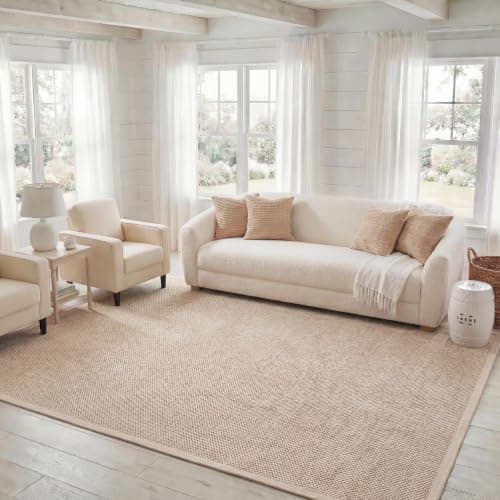
Product photo and price from Amazon, refreshed daily.
#ad We earn a commission · Price as of October 18, 2026
The toughest surface here, and the right pick where traffic rather than comfort is the problem. Power-loomed sisal with latex and a woven border takes punishment that would flatten wool, and the bound border matters specifically because the edge is where a natural-fiber rug actually fails. It wears steadily for about a decade and then goes fairly abruptly, which is a predictable failure mode rather than a flaw.
What it is
- Listings in this collection state sisal with latex fibers and a 3/8 inch pile
- Most designs carry a woven contrast border rather than a raw cut edge
- Sold in a long size ladder — small accents through 8x11 and 9x12
What it does well
- The easiest sisal to actually buy in the size you need, which is the whole problem with this fiber
- The border finishes the edge, so it does not fray the way a cut natural fiber edge can
- The latex component holds the weave together and limits creep on a hard floor
Don't buy it if
- The latex backing is why it should not be laid over radiant heat or left on a floor it can mark
- Colorways are natural, maize and marble tones — there is no real color range here
- It is still sisal: coarse barefoot, and it will not forgive a spill
The default sisal for most rooms, because the size ladder and the bordered edge remove the two things that usually derail a sisal purchase.
RUGPADUSA Superior-Lock Rug Pad
Adding years to a rug you already own
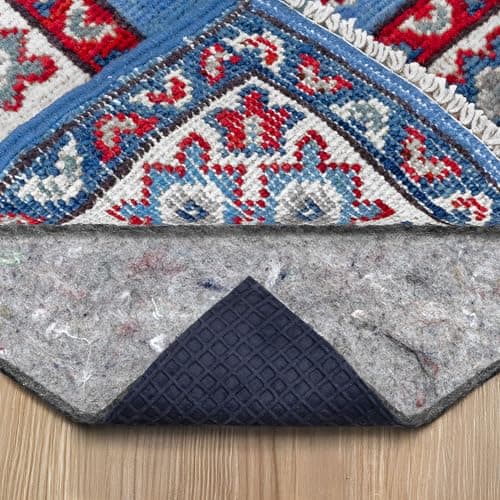
Product photo and price from Amazon, refreshed daily.
#ad We earn a commission · Price as of October 18, 2026
The single cheapest way to extend any rug's life, and the one most people skip. Most rug degradation is not footfall on the pile - it is grit working down to the backing and grinding against the floor every time the rug shifts. A felt-and-rubber pad stops the shifting and absorbs the load, and on a hardwood floor it does it without the plasticizers that mark a finish.
What it is
- Dense heat-pressed felt over a natural rubber gripping layer
- Available in quarter-inch and half-inch thicknesses
- Cuts to size with household scissors
What it does well
- Natural rubber rather than PVC or an adhesive-backed synthetic — this is the distinction that protects a hardwood finish
- The felt layer does real sound-dampening work in a room with hard floors
- Grips on glossy finishes where thinner pads slide
Don't buy it if
- Expensive relative to the rug it protects, which stops a lot of people buying one
- The half-inch version raises the rug enough to catch a door
- Heavy and awkward to handle at large sizes
The pad to buy if the floor under the rug is worth more than the rug, which on hardwood it almost always is.
What actually kills rugs
Grit, from underneath. This is the big one and it is invisible. Sand and grit work down through the pile, settle on the backing, and then act as an abrasive every time the rug flexes or shifts against the floor. It cuts fibers at their base, where no amount of cleaning reaches. A pad and regular vacuuming both attack this directly, and together they probably add more years than any other intervention.
Sunlight. UV breaks down dye and, over long exposure, the fiber itself. A rug in a south-facing window fades unevenly within a couple of years, and wool and natural dyes go fastest. Rotating the rug twice a year is free and genuinely works.
Moisture. A rug that gets wet and dries slowly loses to mildew, and in a natural fiber that is terminal rather than cosmetic. This is why fiber choice by room matters so much - the best rugs for a basement is really a guide about this one failure mode.
Over-cleaning, and cleaning wrong. Saturating a tufted rug degrades its backing. Pressure-washing destroys a weave. Hot water felts wool permanently. More rugs are damaged by enthusiastic cleaning than by neglect - can you pressure wash a rug is the clearest example.
The four habits that add years
- Vacuum weekly, at the right setting for the pile. This removes grit before it reaches the backing. Vacuuming rugs has the settings.
- Rotate the rug 180 degrees twice a year. Evens out both sun fading and the traffic lane. Takes two minutes.
- Blot spills immediately, and never rub. Rubbing pushes the spill into the base of the pile and distorts the fibers, which is a permanent change even after the stain comes out.
- Deal with a curling corner the day it starts. A lifted corner catches feet, folds back on itself and cracks the backing along the fold.
Cost per year, which is the useful number
Divide the price by the expected life and the comparison gets much clearer. A cheap synthetic rug replaced three times over fifteen years can cost more than one wool rug bought once, and the wool rug does not involve three deliveries and three disposals. The arithmetic flips completely in a room where the rug needs washing, because a wool rug cannot be washed and the durability you paid for is unusable - cotton vs wool works through exactly that trade.
It also flips in a room you expect to change. Buying a twenty-five-year rug for a nursery, a first apartment or a room whose purpose is undecided is paying for time you will not use. There is nothing wrong with buying a five-year rug on purpose.
The short version
Three to five years for cotton, five to ten for synthetic pile, ten to fifteen for tufted wool, fifteen to twenty-five for flatwoven wool, and indefinitely for hand-knotted. Buy woven rather than glued, buy a bound edge, put a pad under it, and vacuum it. The best wool rugs covers the long-horizon end, the best cheap rugs covers the deliberately short-horizon end, and the rug care hub covers keeping whichever one you bought alive.
Questions people actually ask
How long should an area rug last?
Between three and twenty-five years depending on fiber and construction. Cotton lasts three to five years in traffic, synthetic pile five to ten, tufted wool ten to fifteen, and flatwoven wool fifteen to twenty-five.
Why do hand-tufted rugs wear out faster than other wool rugs?
Because the pile is held on by a latex adhesive rather than woven in. That adhesive becomes brittle and crumbles with age whether the rug is used heavily or not, which caps the rug's life at around ten to fifteen years.
Does a rug pad make a rug last longer?
Yes, measurably. Most wear comes from grit grinding against the backing as the rug shifts on the floor. A pad stops the shifting and absorbs footfall, and it costs a fraction of the rug.
When should you replace a rug?
When the backing is visible through the pile in the traffic lane, when a tufted rug starts shedding structurally rather than losing fluff, when the edge has failed along a length you cannot repair, or when it has been soaked and has stayed damp.
Do expensive rugs last longer?
Usually, but construction explains it better than price. A woven rug outlasts a glued one at the same price, and a flatwoven wool rug frequently outlasts a more expensive hand-tufted one.
How often should you replace a cheap rug?
Every three to eight years depending on the room, and that can be a sensible plan rather than a failure. In a nursery, a rental or a room whose use is still changing, a deliberately short-horizon rug is the right purchase.
Sources
Read next
- Hand-Tufted vs Hand-Knotted RugsGlued versus tied, and what that means for price, lifespan, shedding and resale. Plus how to tell them apart from the back in five seconds.
- Rug PadsWhat a pad does, the four constructions, and how to match one to hardwood, vinyl, tile or carpet.
- Vacuuming RugsWhich setting for which construction, why beater bars help some rugs and wreck others, and how often to vacuum.
- The Best Wool Rugs (October 2026)Tufted, flatwoven and blended wool compared on pile, shedding and the room each one belongs in - with the honest cost of each.
- Cotton vs Wool RugsCotton washes and wears out in three to five years; wool lasts twenty and cannot be washed. The room-by-room answer and the cost per year.
- Rug CareCleaning method by fiber — wool, jute, sisal, polypropylene, outdoor — plus pet stains, vacuuming and off-season storage.