Rug Sizes & Pads
Standard Rug Sizes
The sizes US retailers actually stock, converted three ways, with the one thing listings rarely make obvious: a stated size is nominal, and the real rug is often an inch or two off it.
Heads up: we earn a commission when you buy through links on this page, at no extra cost to you. It never changes which rug we put first — see how we choose and our affiliate disclosure.
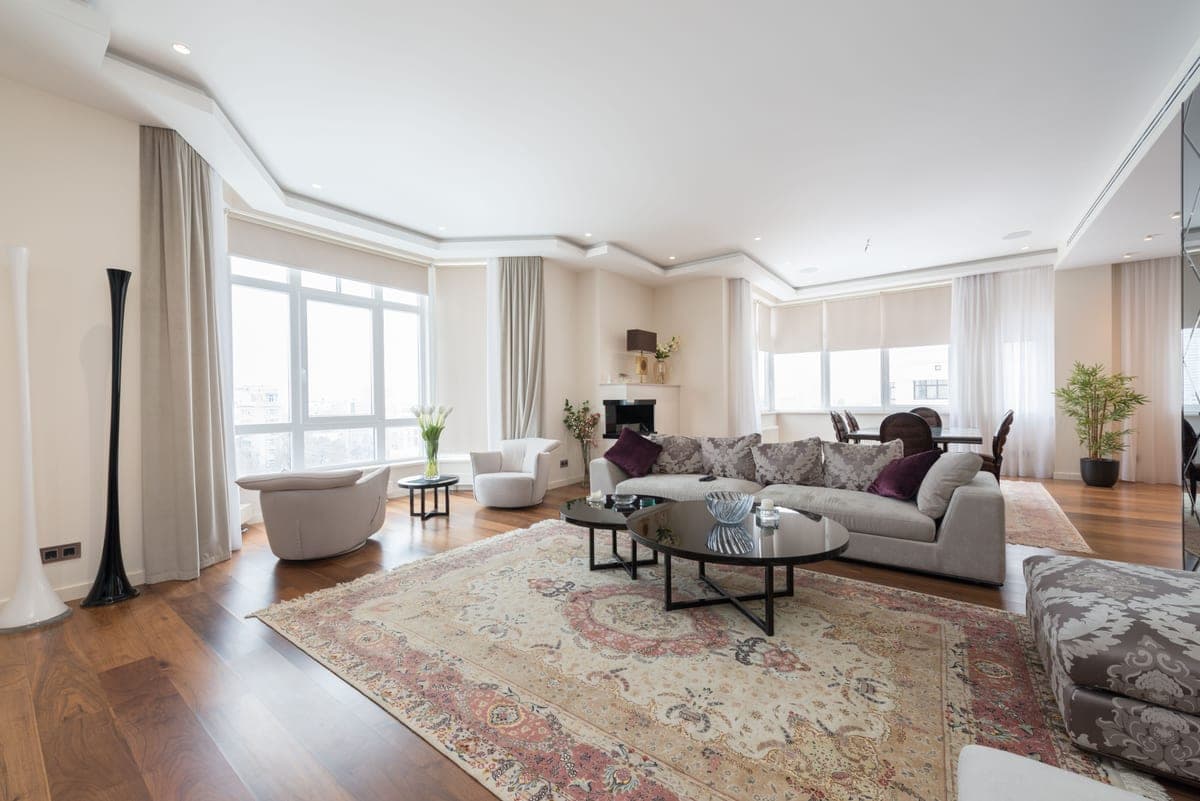
Quick picks
The whole answer, before the detail. Tap any row to jump to that rug's full write-up further down the page.
| # | Rug | Best for | Construction | Price |
|---|---|---|---|---|
| 1 | 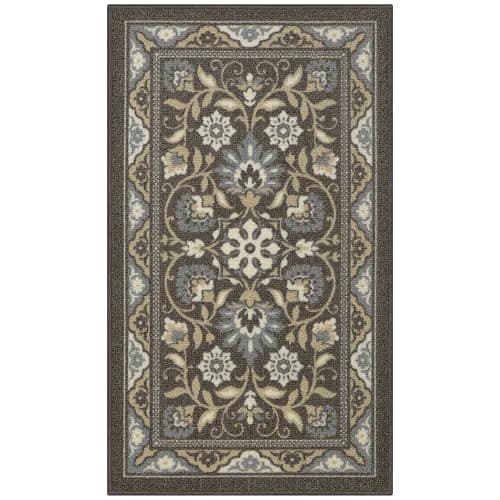 Maples Rugs Florence Accent RugThe accent class, which covers everything from roughly 2x3 up to 3x5. These are the sizes people buy without measuring, and the one specification that matters at this scale is not dimension at all - it is whether the rug stays put. A printed nylon pile bonded to a non-skid backing does, which is why this is the shape of rug that belongs beside a bed, in front of a sink or inside a door. It is small, and buying one in the hope it will anchor a room is the most common size mistake there is. | Accent sizes, 2x3 to 3x5 | Printed nylon pile bonded to a non-skid backing | $26.99View on Amazon #ad We earn a commission · Price as of November 2, 2026 |
| 2 | 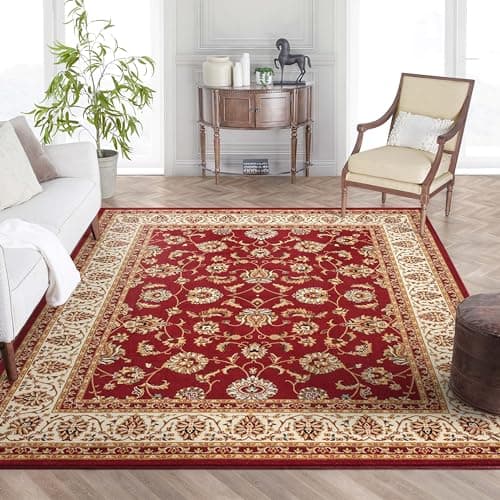 Well Woven Area RugThe 5x7 and 6x9 class, which is where most apartments and most small bedrooms land. A 5x7 is 35 square feet and a 6x9 is 54, and that 19 square feet is the difference between a rug the furniture sits beside and a rug the furniture sits on. Medium-pile machine-woven polypropylene at this size is the value sweet spot of the whole market. The honest limit is that 5x7 is genuinely small for a living room - it reads as a mat in front of a sofa unless the room is tiny. | 5x7 and 6x9 | Machine-woven polypropylene, medium pile | $88.38View on Amazon #ad We earn a commission · Price as of November 2, 2026 |
| 3 | 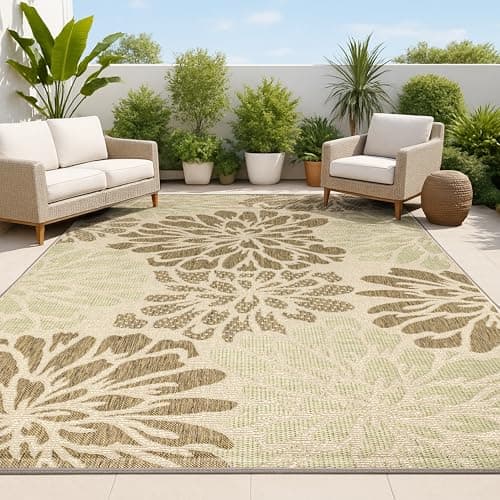 JONATHAN Y Modern Area RugThe room-size class: 8x10, 9x12 and up. This is the bracket where a rug stops being an object in the room and becomes the floor of it, and the two decisions that matter are low pile - because a big rug meets more furniture legs and more traffic - and a pattern that can carry a large area without becoming wallpaper. A rug this size is also the one you cannot easily move alone, so get the dimension right before it arrives rather than after. | 8x10 and 9x12 | Machine-woven polypropylene, low to medium pile | $173.99$183.74View on Amazon #ad We earn a commission · Price as of November 2, 2026 |
| 4 | 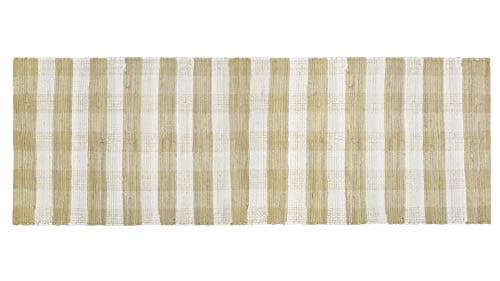 GLAMBURG Cotton Reversible Runner RugThe runner class, where length is standard and width almost never is. Runners come in 2x6, 2x8, 2x10 and 2x12 far more often than they come in anything else, and the width is the number that decides whether the rug looks right - too narrow in a wide hallway reads as a strip of tape. A reversible cotton flatweave is the cheapest honest way to try a runner length in a hallway before committing to an expensive one, and it launders, which a bonded-back runner does not. | Runner lengths | Handwoven cotton flatweave, reversible, no backing | $20.86View on Amazon #ad We earn a commission · Price as of November 2, 2026 |
| 5 | 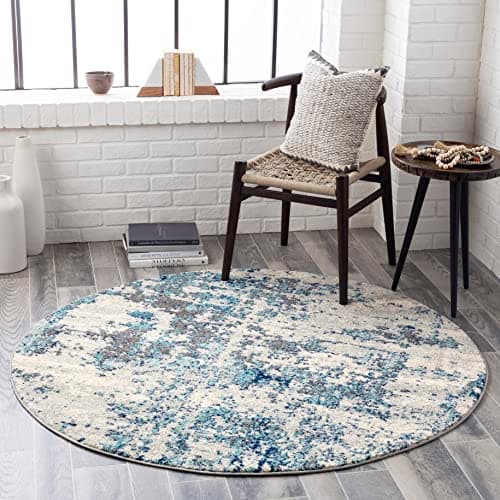 Artistic Weavers Round Area RugThe round class, which is sized by diameter rather than by two numbers: 4, 5, 6 and 8 feet are the sizes that actually exist. Rounds are bought for round dining tables and for landing spots in entries and bay windows, and the arithmetic catches people out - a 6-foot round is 28 square feet, less than a 5x7 rectangle, so it covers much less floor than its diameter suggests. Patterns also distort on a circle in a way they do not on a rectangle; look at the listing photograph rather than the swatch. | Round diameters | Machine-woven synthetic, round format | $126.54View on Amazon #ad We earn a commission · Price as of November 2, 2026 |
The short answer
The standard US rectangles are 2x3, 3x5, 4x6, 5x7, 5x8, 6x9, 8x10, 9x12, 10x14 and 12x15 feet. Runners are 2x6, 2x8, 2x10 and 2x12. Rounds come in 4, 5, 6 and 8-foot diameters. Treat every one of those as nominal - the actual rug is often an inch or two off, and the listing's specification is the number to trust.
There is no standards body for rug sizes. What exists instead is a set of sizes the industry has converged on, which means almost every rug you can buy in the US falls into one of about a dozen rectangles plus a handful of runner lengths, round diameters and squares. That convergence is useful - it means a rug pad, a size guide and a room plan all work from the same numbers - and it is softer than the word standard suggests.
Why the size on the label is not the size of the rug
This is the single most useful thing to know before you buy, and it is the thing listings make least obvious. A rug sold as 5x7 is very often not 60 inches by 84 inches. Loom widths, border finishing and the way a woven rug relaxes after it comes off the roll all mean the finished piece lands near the nominal size rather than on it, and manufacturers round the listing to the familiar number because that is what people search for.
The practical consequence is small but real: if you are fitting a rug to a space with a hard boundary - between two doorways, inside an alcove, under a dining table with a wall behind it - use the exact dimensions from the listing's specification rather than the nominal size in the title, and leave yourself an inch or two of slack. If you are placing a rug in open floor, the nominal number is fine and the difference will never be visible.
The standard rectangles, converted three ways
| Feet | Inches | Centimeters | Square feet | What it is for |
|---|---|---|---|---|
| 2 x 3 | 24 x 36 | 61 x 91 | 6 | Doorways, bedsides, in front of a sink |
| 3 x 5 | 36 x 60 | 91 x 152 | 15 | Entries, small bathrooms, a reading chair |
| 4 x 6 | 48 x 72 | 122 x 183 | 24 | A small bedroom, under a coffee table |
| 5 x 7 | 60 x 84 | 152 x 213 | 35 | Apartment living rooms, under a queen bed's foot |
| 5 x 8 | 60 x 96 | 152 x 244 | 40 | The same job as 5x7 with a foot more reach |
| 6 x 9 | 72 x 108 | 183 x 274 | 54 | Small living rooms, a dining table for four |
| 8 x 10 | 96 x 120 | 244 x 305 | 80 | The default living-room size in US homes |
| 9 x 12 | 108 x 144 | 274 x 366 | 108 | Large living rooms, a dining table for six to eight |
| 10 x 14 | 120 x 168 | 305 x 427 | 140 | Open-plan rooms, a sectional with walkways |
| 12 x 15 | 144 x 180 | 366 x 457 | 180 | Very large rooms; often a special order |
| 12 x 18 | 144 x 216 | 366 x 549 | 216 | Rare outside large homes and commercial spaces |
Two of those jumps matter more than the rest. The step from 5x7 to 6x9 adds 19 square feet and is the difference between a rug beside the furniture and a rug under it - 5x7 vs 6x9 works through where the line falls. The step from 8x10 to 9x12 adds 28 square feet, is the most commonly agonized decision in rug buying, and almost always resolves in favor of the larger one: 8x10 vs 9x12 explains why.
Maples Rugs Florence Accent Rug
Accent sizes, 2x3 to 3x5
Product photo and price from Amazon, refreshed daily.
#ad We earn a commission · Price as of November 2, 2026
The accent class, which covers everything from roughly 2x3 up to 3x5. These are the sizes people buy without measuring, and the one specification that matters at this scale is not dimension at all - it is whether the rug stays put. A printed nylon pile bonded to a non-skid backing does, which is why this is the shape of rug that belongs beside a bed, in front of a sink or inside a door. It is small, and buying one in the hope it will anchor a room is the most common size mistake there is.
What it is
- Nylon pile, printed rather than woven, on a bonded non-skid backing
- Maples lists its accent rugs as machine washable on a gentle cycle
- Sold in the two accent sizes: 1 ft 8 in by 2 ft 10 in, and 2 ft 6 in by 3 ft 10 in
- Made in the USA
What it does well
- The backing is bonded, not a separate pad, so there is nothing to buy or trim before the rug is safe to walk on
- Nylon is the most abrasion-resistant of the common rug fibers, which is what a doorway or a sink mat is up against
- Low profile enough to clear a door that swings over it
Don't buy it if
- The pattern is printed on the surface, so it wears visibly in the one spot you always step on
- Bonded non-skid backings stiffen and eventually crumble with age and heat — keep it out of a hot dryer
- Two sizes only. If you want 3x5 or 4x6, this line does not go there
The small rug to buy when the thing you actually want is grip: the non-skid backing is part of the rug rather than an accessory you might not get around to.
Well Woven Area Rug
5x7 and 6x9
Product photo and price from Amazon, refreshed daily.
#ad We earn a commission · Price as of November 2, 2026
The 5x7 and 6x9 class, which is where most apartments and most small bedrooms land. A 5x7 is 35 square feet and a 6x9 is 54, and that 19 square feet is the difference between a rug the furniture sits beside and a rug the furniture sits on. Medium-pile machine-woven polypropylene at this size is the value sweet spot of the whole market. The honest limit is that 5x7 is genuinely small for a living room - it reads as a mat in front of a sofa unless the room is tiny.
What it is
- Strong coverage of the 5x7 and 5x8 sizes
- Medium pile with a defined pattern
- Jute-blend backing
What it does well
- 5x7 is the size most small living rooms actually need and it is often skipped
- Medium pile is a reasonable compromise between comfort and maintenance
- Patterns busy enough to hide a small room's concentrated traffic
Don't buy it if
- 5x7 is too small to get all the furniture legs on in most rooms — know that before buying
- Medium pile shows vacuum lines
- The backing can shed a little jute dust in the first weeks
The right size for an apartment, with the caveat that a 5x7 is a front-legs-on rug, not an all-legs-on one.
JONATHAN Y Modern Area Rug
8x10 and 9x12
Product photo and price from Amazon, refreshed daily.
#ad We earn a commission · Price as of November 2, 2026
The room-size class: 8x10, 9x12 and up. This is the bracket where a rug stops being an object in the room and becomes the floor of it, and the two decisions that matter are low pile - because a big rug meets more furniture legs and more traffic - and a pattern that can carry a large area without becoming wallpaper. A rug this size is also the one you cannot easily move alone, so get the dimension right before it arrives rather than after.
What it is
- Machine-woven polypropylene in contemporary patterns
- Strong availability at 8x10, 9x12 and larger
- Low to medium pile
What it does well
- Genuinely available in the big sizes an open-plan room needs, which a lot of design-led brands are not
- Contemporary patterns rather than the traditional default
- Pile low enough for a room with dining chairs in it
Don't buy it if
- Large synthetic rugs arrive heavily creased and take weeks to flatten
- The pattern repeat is visible on the very large sizes
- Edges can fray if a vacuum beater bar catches them
A practical answer to the hardest sizing problem in the category: covering a large open room without spending four figures.
GLAMBURG Cotton Reversible Runner Rug
Runner lengths
Product photo and price from Amazon, refreshed daily.
#ad We earn a commission · Price as of November 2, 2026
The runner class, where length is standard and width almost never is. Runners come in 2x6, 2x8, 2x10 and 2x12 far more often than they come in anything else, and the width is the number that decides whether the rug looks right - too narrow in a wide hallway reads as a strip of tape. A reversible cotton flatweave is the cheapest honest way to try a runner length in a hallway before committing to an expensive one, and it launders, which a bonded-back runner does not.
What it is
- Handwoven cotton in a checked or plaid flatweave
- Fully reversible — the maker's own selling point is twice the wear
- Listed at 2 by 6 feet, the standard kitchen and hallway runner footprint
- Listing states vacuum, hand wash or machine wash
What it does well
- A cotton runner at runner size fits a domestic washing machine, which a cotton area rug does not
- Reversible with no backing at all, so both faces wear and both faces wash
- Thin enough to sit under a door and flat enough not to trip a foot in a hallway
Don't buy it if
- No backing means no grip. Without a pad it will travel across a hard floor within a week
- Cotton absorbs, so it is the wrong runner for the strip in front of a sink
- Handwoven cotton shrinks a little on its first hot wash — wash cold
The cotton rug most people should actually buy first: runner size, reversible, and small enough that washing it is a chore rather than a project.
Artistic Weavers Round Area Rug
Round diameters
Product photo and price from Amazon, refreshed daily.
#ad We earn a commission · Price as of November 2, 2026
The round class, which is sized by diameter rather than by two numbers: 4, 5, 6 and 8 feet are the sizes that actually exist. Rounds are bought for round dining tables and for landing spots in entries and bay windows, and the arithmetic catches people out - a 6-foot round is 28 square feet, less than a 5x7 rectangle, so it covers much less floor than its diameter suggests. Patterns also distort on a circle in a way they do not on a rectangle; look at the listing photograph rather than the swatch.
What it is
- Round sizes from four foot up to eight foot
- Medium pile
- Patterns designed to work from every viewing angle
What it does well
- Round patterns that actually resolve in the round, rather than a square design cropped to a circle
- Sizes that line up with standard round table diameters
- Pile height works under a chair without catching
Don't buy it if
- Round rugs are harder to place well and easy to get wrong by a foot
- Fewer sizes than the rectangular equivalents
- A round rug in a square room needs the rest of the furniture to cooperate
Worth it under a round table, where a rectangle always looks like a mistake.
The products above are one per size class rather than a ranked list - a size reference is the wrong page to argue about which 8x10 is best, and the rug sizes hub links the per-size roundups that do. We compared published dimensions, pile construction and backing type across current listings; we do not measure rugs ourselves and make no claim to have done so. How we choose sets out the method and its limits.
Runner sizes, which are the ones people get wrong
A runner is defined by its proportions rather than by a size class, and the number people get wrong is the width. Standard runner widths cluster between 2 feet and 2 feet 6 inches, with 2 feet 7 inches and 3 feet appearing at the wider end, and the lengths are much more standardized than the widths.
| Feet | Inches | Centimeters | Where it goes |
|---|---|---|---|
| 2 x 6 | 24 x 72 | 61 x 183 | A short hallway, a galley kitchen run |
| 2 x 8 | 24 x 96 | 61 x 244 | The commonest hallway runner length |
| 2 x 10 | 24 x 120 | 61 x 305 | A long hallway or a kitchen island run |
| 2 x 12 | 24 x 144 | 61 x 366 | Long hallways; often the largest stocked length |
| 2 ft 6 in x 8 | 30 x 96 | 76 x 244 | A wide hallway, or either side of a bed |
The width rule is the useful one: leave roughly four to five inches of bare floor on each side of a runner in a hallway, so the rug reads as deliberate rather than as something that did not fit. In a 3-foot hallway that means a 2-foot runner. In a 4-foot hallway a 2-foot runner looks like tape down the middle, and you want the wider width. Hallway runners covers the clearance rules properly, and runner rugs covers the other places a runner belongs.
Rounds, squares and the arithmetic trap
| Size | Inches | Centimeters | Square feet | Notes |
|---|---|---|---|---|
| 4 ft round | 48 diameter | 122 | 13 | An entry landing spot; small |
| 5 ft round | 60 diameter | 152 | 20 | A 36 to 42-inch round table for two |
| 6 ft round | 72 diameter | 183 | 28 | A 48-inch round table for four |
| 8 ft round | 96 diameter | 244 | 50 | A 60-inch round table; the largest common round |
| 6 x 6 square | 72 x 72 | 183 x 183 | 36 | Square rooms, bay windows, a reading corner |
| 8 x 8 square | 96 x 96 | 244 x 244 | 64 | A square dining room or a landing |
The trap is that a diameter sounds bigger than it is. A 6-foot round covers 28 square feet; a 5x7 rectangle covers 35. People buy a round rug the same nominal size as the rectangle they were considering and are surprised by how much less floor it covers, because a circle inscribed in a square loses about 21 percent of the area. For a round dining table the rule that matters is not area anyway - it is that the rug needs to extend at least 24 inches past the table edge so a pulled-out chair stays on it. Round rugs and rug size for a dining table have the chair-clearance math.
Which size class fits which room
Size guidance is room by room rather than size by size, because the rug has to relate to the furniture rather than to the walls. The short version, with the detail on the dedicated pages:
- Living room. 8x10 in most US rooms, 9x12 if the seating is deep or there is a sectional. The test is whether the front legs of every seat sit on the rug - rug size for a living room and rug placement in a living room cover the two common layouts.
- Bedroom. 8x10 under a queen and 9x12 under a king if the rug runs under the bed, or a pair of runners either side if it does not. Rug size for a king bed and rug size for a queen bed give the overhang numbers.
- Dining room. Driven entirely by chair pull-out: the rug needs 24 inches of clearance beyond the table on every side, which usually makes a four-seat table a 6x9 and a six-to-eight-seat table a 9x12. Rug size for a dining table has the table-by-table version.
- Hallways and kitchens. Runner widths and lengths as above, chosen for the bare floor you leave at the sides rather than for the length you can fill.
- Outdoors. The same nominal sizes, used differently - furniture clearance outdoors is more generous because people walk around a patio set rather than past it. Outdoor rug sizes covers that.
- Washable rugs. The one case where the size class is decided by your appliance rather than your room. Washable rug sizes maps each size against real washer drum capacities.
Reading a listing: three things to check
- The specification, not the title. The title carries the nominal size; the specification carries the measured one. If the fit is tight, that difference is the whole ball game.
- Whether the quoted size includes a border or fringe. On bordered and fringed rugs it sometimes does and sometimes does not, and a 4-inch fringe at each end is 8 inches of length you either have or do not.
- Pile height, separately from footprint. Two 8x10 rugs can differ by three quarters of an inch in height, which decides whether a door clears it and whether a chair rolls. Rug pile height covers how it is quoted.
Converting without a calculator
Feet to inches is twelve. Inches to centimeters is 2.54, and the shortcut that gets you within a couple of percent is to multiply by 2.5 and add a little. A faster version for whole feet: one foot is about 30 centimeters, so 8x10 is roughly 240 by 300 and the exact answer is 244 by 305. Square footage is just the two numbers multiplied, which is worth doing before you order because it is the number that tells you how much floor you are actually covering - and the one that makes the 8x10 versus 9x12 question answer itself.
One more conversion worth knowing: rug pads are sold to the same nominal sizes but are meant to finish about an inch smaller on each side, so the pad never shows at the edge. If a listing offers an exact-size pad, trim it rather than letting it run to the rug's own edge. Rug pads covers the types and which one suits which floor.
What we would buy at each size
For an accent, the cheapest thing with a non-skid back, because nothing else about a 2x3 matters. For a 5x7 or 6x9, a machine-woven synthetic in a pattern - this is the bracket where the value in the whole market sits. For 8x10 and 9x12, buy the larger of the two sizes you are considering and buy low pile, because a big rug meets more furniture and more traffic than a small one. For a runner, measure the hallway width first and let that choose the runner width. And for a round, check the square footage before you commit, because the diameter will flatter it.
If you are still choosing a fiber rather than a size, the best rug material for high traffic is the place to start for a busy room and the best rug material for kids for a child's. For the per-size roundups - 8x10, 9x12, 5x7, 6x9, large area rugs and throw rugs - the rug sizes hub links all of them.
Questions people actually ask
What are the standard rug sizes?
The standard US rectangles are 2x3, 3x5, 4x6, 5x7, 5x8, 6x9, 8x10, 9x12, 10x14 and 12x15 feet. Runners come in 2x6, 2x8, 2x10 and 2x12, rounds in 4, 5, 6 and 8-foot diameters, and squares usually in 6x6 and 8x8.
What is the most common rug size?
8x10 feet - 96 by 120 inches, 244 by 305 centimeters, 80 square feet - is the default living-room size in US homes, and 5x7 is the commonest size overall because it covers apartments, bedrooms and small living rooms.
How big is a 9x12 rug?
108 by 144 inches, or 274 by 366 centimeters, covering 108 square feet. It is the standard large living-room and dining-room size, and it is 28 square feet more floor than an 8x10.
What is a 5x7 rug in inches and centimeters?
60 by 84 inches, or 152 by 213 centimeters, covering 35 square feet. Check the listing's own specification, though - a rug sold as 5x7 is often an inch or two off those numbers.
Are rug sizes exact?
No. A stated size is nominal. Loom widths, border finishing and the way a woven rug relaxes off the roll mean the finished piece lands near the number rather than on it. For a tight fit, use the measured dimensions in the specification and leave an inch or two of slack.
What are standard runner rug sizes?
Lengths of 6, 8, 10 and 12 feet, at widths between 2 feet and 2 feet 6 inches. The length is the standardized part; the width is the number that decides whether the runner looks right, and it should leave four to five inches of bare floor on each side.
What size rug covers the most floor for the money?
Compare square feet rather than dimensions. A 6x9 covers 54 square feet against a 5x7's 35, and an 8x10 covers 80 against a 6x9's 54 - so the step up is usually a better value per square foot than the step up in price suggests.
Is a 6-foot round rug the same as a 6x6 square?
No, and the gap is larger than it looks. A 6-foot round covers about 28 square feet and a 6x6 square covers 36, because a circle loses roughly 21 percent of the area of the square that contains it.
Sources
- Nazmiyal - standard rug size groupings used by US retailers
- US CPSC - business guidance on the carpet and rug flammability standards, including the small-rug size threshold (16 CFR 1630 and 1631)
- Amazon - Maples Rugs Florence accent rug listing
- Amazon - Well Woven area rug listing
- Amazon - JONATHAN Y modern area rug listing
- Amazon - GLAMBURG cotton reversible runner listing
- Amazon - Artistic Weavers round area rug listing
Read next
- 8x10 vs 9x12The 8x10 versus 9x12 decision settled with measurements rather than instinct.
- 5x7 vs 6x9The 5x7 versus 6x9 decision settled with measurements, including the rooms where neither is big enough.
- Round RugsHow to size a round rug to a round table, and the placements where a circle beats a rectangle.
- Runner RugsRunners for hallways, kitchens, bedsides and stairs — widths, clearance rules and which backing suits which floor.
- What Size Rug for a Living Room?How to measure a living room rug properly — the front-legs-on rule and the three standard layouts.
- Rug Sizes & PadsSize charts by room and bed, the 8x10 vs 9x12 decision, placement rules, and the right pad for hardwood, vinyl or carpet.