Rug Materials
The Best Rug Material for Kids
A child adds three constraints no other room has: it gets spilled on, they lie on it for hours, and what it is made of matters more here than anywhere else in the house.
Heads up: we earn a commission when you buy through links on this page, at no extra cost to you. It never changes which rug we put first — see how we choose and our affiliate disclosure.
Quick picks
The whole answer, before the detail. Tap any row to jump to that rug's full write-up further down the page.
| # | Rug | Best for | Construction | Price |
|---|---|---|---|---|
| 1 | 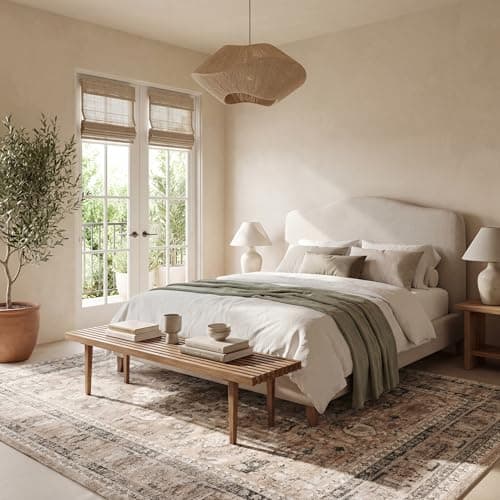 nuLOOM Washable Area RugThe fiber answer for most children's rooms, because the question is not really which fiber feels nicest - it is which fiber survives being cleaned often. Low-pile polyester washes whole in a domestic machine, dries in hours rather than days, and releases water-based spills instead of drinking them. The honest cost of that is thickness: there is very little to this rug underfoot, so if the child in question spends an hour at a time sitting on the floor, budget for a felt pad under it. The integrated non-slip backing grips a hard floor without one, which is the trade you are accepting when you buy a rug this thin. | Polyester, washed often | One-piece low-pile polyester, machine washable | $201.00View on Amazon #ad We earn a commission · Price as of November 2, 2026 |
| 2 | 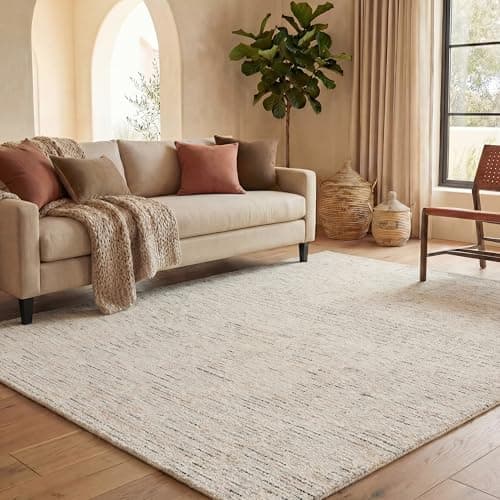 Safavieh Hand-Tufted Wool RugThe fiber you buy once, and the right answer for a school-age child's bedroom rather than a toddler's. Wool is the only common rug fiber with real crush recovery, so the path from the door to the bed does not become a permanent flattened lane, and it is markedly warmer and softer to sit on than any synthetic at the same pile height. Two caveats decide whether it belongs in your house: wool absorbs urine deeply and holds the odor, which rules it out until the accident stage is genuinely over, and it costs several times what a washable polyester rug costs, which changes how you feel about a dropped paint pot. | Wool, if you can spend it | Hand-tufted wool pile on a cotton backing | |
| 3 | 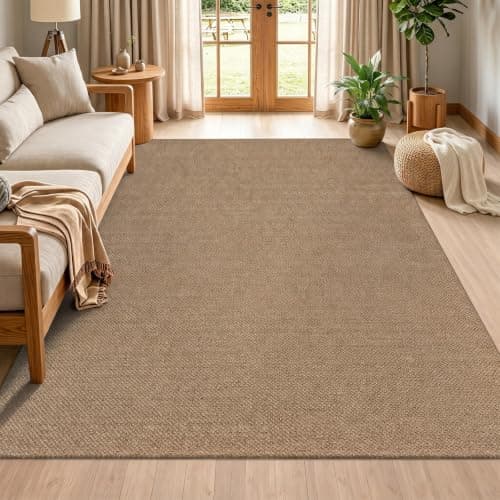 HEBE Cotton Woven Area RugCotton is the fiber people assume is the natural choice for a child, and it is the one most often bought in the wrong size. Cotton is only an advantage if you can actually launder it, and that caps the useful size at whatever your machine takes. This one is a braided cotton-and-polyester weave on a bonded rubber back, which gets you cotton's feel at a room-ish size and adds grip a bare cotton flatweave does not have. It absorbs liquid instantly - a spill is a wash, not a wipe - and the rubber backing means a cool, slow dry rather than a hot one. | Cotton at a size you can wash | Braided cotton-and-polyester weave on a bonded rubber back | $64.99View on Amazon #ad We earn a commission · Price as of November 2, 2026 |
| 4 | 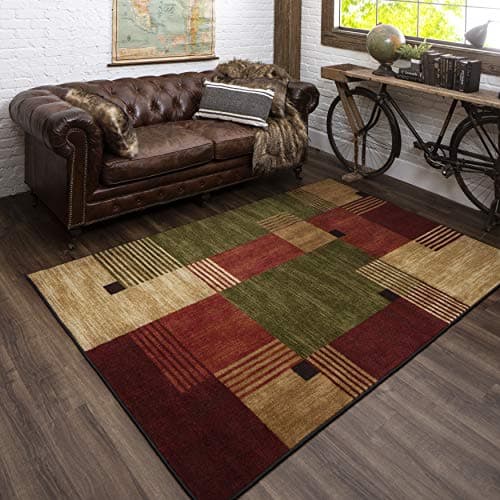 Mohawk Home Alliance Geometric RugThe polypropylene answer, and the pick for an older child's room where hard wear matters more than washability. It is low-profile cut pile - never loop, which is the one construction rule that matters on a floor children play on - and the busy geometric pattern hides both crumbs and the traffic lane that forms in any child's room within a year. It is spot-clean only, so it is the wrong rug for a toddler and the right one for a nine-year-old. Up close it reads as exactly what it is, which no pattern disguises. | Polypropylene and hard wear | Low-profile synthetic cut pile on a textured latex backing | $101.99$109.99View on Amazon #ad We earn a commission · Price as of November 2, 2026 |
The short answer
Washable low-pile polyester for a room that still gets spilled on, wool once the accident stage is over, and cotton for anything small enough to launder. Rule out viscose, jute and sisal. The fiber decision in a child's room is really a cleaning decision, and pile height decides more than fiber does.
Every other room on this site has one dominant constraint. A kitchen is about spills, a hallway is about abrasion, a dining room is about chairs. A child's room has three at once, they pull in different directions, and the fiber that wins depends entirely on which of the three you actually have. That is why so much kids' rug advice is useless: it answers a question about softness when the person asking has a problem with cleaning.
The three things a child adds to the fiber decision
It gets cleaned far more often than a normal rug. Not spot-cleaned - cleaned. Milk, paint, paint water, a nosebleed, a stomach bug at two in the morning. The fiber that wins is the one that survives the twentieth wash, not the one that looks best on the first day. This single fact is why the washable category exists at all, and it is the reason a synthetic usually beats a natural fiber in this room even though the natural fiber is the better rug.
A child is in contact with it for hours, not seconds. Adults stand on rugs. Children lie on them, face down, breathing an inch above the pile, for an hour at a stretch. That shifts two things from footnote to real consideration: what the rug feels like against skin, and what it gives off into the air in the first months after it is unrolled. Neither matters much in a hallway. Both matter here.
Small objects live in the pile. Beads, building bricks, puzzle pieces, the one missing piece of a thirty-piece set. A deep pile is not cozy in a child's room so much as it is a reservoir - things go into it and do not come out, and a vacuum either misses them or eats them. Pile height is the specification that decides this, and it decides it more completely than fiber does. Rug pile height covers how to read it off a listing, which is less obvious than it should be.
The two labels that actually mean something
Most of what a rug listing says about child safety is unregulated adjective. Two things on the subject are real, and they do different jobs.
Surface flammability. The US Consumer Product Safety Commission runs two standards for floor coverings: 16 CFR part 1630 for carpets and rugs, and 16 CFR part 1631 for small carpets and rugs. The split is purely dimensional - a small carpet or rug has no dimension over six feet and an area of no more than 24 square feet, and anything larger falls under part 1630. Both test how the surface behaves when it meets a small ignition source. Read this as a floor rather than a feature: compliance is a legal condition of sale in the US, so a rug meeting it is not making you an offer, it is obeying a rule. Where the standards are genuinely useful is the opposite case - a floor covering bought outside normal retail channels has not necessarily been through either test.
Chemical emissions. This is where a certification earns its place, because there is no legal floor at all. GREENGUARD Gold, run by UL Solutions, sets emission limits for more than 360 volatile organic compounds and additionally requires the product to meet California Section 01350, the CDPH standard test method. UL names nurseries and schools as the settings Gold is aimed at, which is exactly the use case on this page. It says nothing about flammability, durability or fiber content - it is an air-quality certification and nothing else.
Fiber by fiber in a child's room
| Fiber | Can it be washed? | An hour on the floor | The honest problem | Verdict for kids |
|---|---|---|---|---|
| Polyester | Yes, whole, at smaller sizes | Soft, and thin | Mats in a traffic lane faster than polypropylene | The default, because washing is the point |
| Polypropylene | Spot-clean, or hose it outdoors | Firm, slightly plasticky | Looks synthetic up close at any price | The durability answer for an older child |
| Wool | No - professional cleaning | The best surface here by a distance | Absorbs urine and holds odor; expensive | Excellent once accidents are over |
| Cotton | Yes, at sizes a machine takes | Soft, cool, thin | Absorbs everything instantly; wears fast | Good as a small rug, wrong as a room rug |
| Viscose | No | Silky for about a month | Water alone marks it permanently | Never, in any room a child uses |
| Jute | No | Coarse, and it sheds | Stains, mildews, sheds fiber for months | No |
| Sisal | No | Hard, and abrasive on knees | Stains permanently; rough on skin | No |
The table says polyester most of the time and polypropylene when the child is older, which is a less romantic answer than most kids' rug writing gives. It is the right one, and the reason sits in the first column rather than the third: a rug in a child's room is going to be cleaned, and the fiber that can be cleaned without a professional wins almost regardless of how it feels.
nuLOOM Washable Area Rug
Polyester, washed often
Product photo and price from Amazon, refreshed daily.
#ad We earn a commission · Price as of November 2, 2026
The fiber answer for most children's rooms, because the question is not really which fiber feels nicest - it is which fiber survives being cleaned often. Low-pile polyester washes whole in a domestic machine, dries in hours rather than days, and releases water-based spills instead of drinking them. The honest cost of that is thickness: there is very little to this rug underfoot, so if the child in question spends an hour at a time sitting on the floor, budget for a felt pad under it. The integrated non-slip backing grips a hard floor without one, which is the trade you are accepting when you buy a rug this thin.
What it is
- One-piece construction with an integrated non-slip backing; no separate pad included
- Ultra-thin low pile sized to fit a domestic washer
- Wide size range including runners and rounds
- Machine wash cold on gentle; line dry or air-only, never on heat
What it does well
- The cheapest honest route into a washable rug
- One piece, so there is no cover to shift out of alignment
- The non-slip backing means it stays put without buying a pad first
- Sizes go down to accent and runner dimensions the two-piece systems often skip
Don't buy it if
- Ultra-thin, with essentially no cushioning — a felt pad is still worth it for comfort
- The stain repellency is a surface coating, and coatings weaken with every wash
- 100% polyester, which is the wrong answer entirely if you wanted natural fiber
The value pick: it does the one job the category exists for and does not pretend to do anything else.
Safavieh Hand-Tufted Wool Rug
Wool, if you can spend it
The fiber you buy once, and the right answer for a school-age child's bedroom rather than a toddler's. Wool is the only common rug fiber with real crush recovery, so the path from the door to the bed does not become a permanent flattened lane, and it is markedly warmer and softer to sit on than any synthetic at the same pile height. Two caveats decide whether it belongs in your house: wool absorbs urine deeply and holds the odor, which rules it out until the accident stage is genuinely over, and it costs several times what a washable polyester rug costs, which changes how you feel about a dropped paint pot.
What it is
- Wool pile hand-tufted to a cotton backing
- Made in India across a large pattern catalog
- Cut pile, generally medium height
What it does well
- Wool springs back from furniture compression in a way no synthetic does
- Naturally flame-resistant and naturally soil-resistant thanks to the lanolin in the fiber
- With normal care it outlives every synthetic rug on this page several times over
Don't buy it if
- Sheds noticeably for the first few months — normal for a tufted wool rug, not a defect
- Hand-tufted rugs are glued, and the latex adhesive can break down after many years
- Costs several times what a comparable polypropylene rug costs
The long-horizon purchase in this category: expensive once rather than cheap repeatedly.
HEBE Cotton Woven Area Rug
Cotton at a size you can wash
Product photo and price from Amazon, refreshed daily.
#ad We earn a commission · Price as of November 2, 2026
Cotton is the fiber people assume is the natural choice for a child, and it is the one most often bought in the wrong size. Cotton is only an advantage if you can actually launder it, and that caps the useful size at whatever your machine takes. This one is a braided cotton-and-polyester weave on a bonded rubber back, which gets you cotton's feel at a room-ish size and adds grip a bare cotton flatweave does not have. It absorbs liquid instantly - a spill is a wash, not a wipe - and the rubber backing means a cool, slow dry rather than a hot one.
What it is
- Braided weave of cotton blended with polyester, not a 100% cotton rug
- Listing states gentle machine washing, quick drying and vacuuming
- Rubber backing bonded to the rug rather than a separate pad
- Roughly a quarter inch thick, so it clears most interior doors
What it does well
- One of the few cotton-blend rugs sold at full room sizes that the maker still calls machine washable
- The bonded rubber back means it needs no pad to stay put on a hard floor
- The braided texture hides crumbs and lint far better than a flat cotton weave does
Don't buy it if
- It is a blend. The polyester is what makes it survive washing, so a cotton purist should look elsewhere
- Bonded rubber backings stiffen with heat and age, and they rule out a hot dryer entirely
- Neutral colorways only — there is no real pattern range in this line
The practical answer when you want cotton's look at 5x7 or 6x9 and still want to be able to wash the thing.
Mohawk Home Alliance Geometric Rug
Polypropylene and hard wear
Product photo and price from Amazon, refreshed daily.
#ad We earn a commission · Price as of November 2, 2026
The polypropylene answer, and the pick for an older child's room where hard wear matters more than washability. It is low-profile cut pile - never loop, which is the one construction rule that matters on a floor children play on - and the busy geometric pattern hides both crumbs and the traffic lane that forms in any child's room within a year. It is spot-clean only, so it is the wrong rug for a toddler and the right one for a nine-year-old. Up close it reads as exactly what it is, which no pattern disguises.
What it is
- Synthetic cut pile with the maker's soil and stain protection, listed as fade resistant
- Low-profile pile — the 5x8 listing gives an overall height of about 0.4 in
- Textured latex backing for grip on hard floors
- Care line is vacuum, spot clean with mild detergent, or clean professionally
What it does well
- Cut pile rather than loop, which is the single most important thing on a rug a dog walks on
- Low profile means a vacuum head reaches the backing, which is where hair collects
- The latex backing holds it still without a separate pad on tile or laminate
Don't buy it if
- Spot clean only. If your problem is accidents rather than hair, a washable rug beats it outright
- Polyester pile mats down in a traffic lane faster than wool or nylon does
- Individual colorways and sizes go in and out of stock, so the exact variant you see may change
The rug to buy when the dog problem is claws, grit and hair rather than accidents — cut pile, low, and cheap enough to replace.
We compared published fiber content, pile construction, backing type and the maker's own stated care instructions across current listings, and we checked each certification claim against the certifying body rather than the listing. We do not test rugs in children's rooms and make no claim to have done so - how we choose sets out the method and its limits plainly.
Washability is a size decision before it is a fiber decision
This is the step people skip, and it is the one that wastes the money. A rug being described as machine washable tells you about the rug. Whether you can wash it tells you about your washing machine, and those are different facts. A standard US top-loader is roughly 3.5 to 4.5 cubic feet and a front-loader usually 4.0 to 5.0; a one-piece washable rug at 5x7 is fine in almost any of them, and a one-piece 8x10 is not going into a domestic drum whatever the listing implies.
So decide the size first, then find the fiber that washes at that size. In a small bedroom that usually lands on a one-piece washable polyester. In a bigger room it pushes you either to a two-piece cover-and-pad system, where only the thin cover goes in the machine, or to accepting a rug you will spot-clean and replace rather than wash. Washable rug sizes has the size-by-size breakdown against real drum capacities, and how to choose a washable rug works through the whole decision in order.
Pile height, and the bead test
Here is a test worth running mentally before you buy: imagine dropping a single small bead onto the rug. On a quarter-inch pile it sits on the surface and you can see it. On a one-inch shag it is gone, and it is gone in a way a vacuum will either miss entirely or swallow. Almost everything about living with a rug in a child's room follows from that.
Low pile also dries faster, which matters more than it sounds. A rug that takes three days to dry after a wash is a rug that gets washed once. And a flat surface is what lets a toy with wheels roll and a block tower stand up straight, which is the whole argument of the best playroom rugs and applies just as much to a bedroom floor that gets played on.
The obvious objection is comfort, and it is a fair one - a thin rug on a hard floor is not somewhere a child wants to sit. The answer is not a deeper pile. It is a thick felt pad under a low-pile rug, which gets you cushioning from the pad and flatness from the rug, and resolves a contradiction pile height alone cannot. Non-slip rug pads covers which type does which job.
What about wool?
Wool is the best rug fiber by nearly every measure, and in a child's room it is either the obvious choice or the wrong one with very little in between. It is warm, it is soft in a way no synthetic matches at the same pile height, it resists soiling naturally, and it is the only common fiber that recovers from crushing - so the route a child wears across the room does not become permanent. A good wool rug in a child's bedroom will still be a good rug when that child leaves home.
The disqualifier is urine. Wool absorbs it deeply, holds the odor, and a wool rug with a real accident in it needs professional cleaning rather than a wash - which is both expensive and slow in the one room where you need the floor back tonight. So the rule is simple: not until the accident stage is genuinely finished. After that, wool is the fiber to spend on. The best wool rugs covers the category, and do wool rugs shed answers the question parents ask next, because a new wool rug does shed for the first few months.
The three fibers to rule out
- Viscose. This one is not a judgment call. Viscose - also sold as rayon, bamboo silk or art silk - loses strength when wet, and water alone leaves a permanent mark. A single dropped cup makes a stain you cannot remove, and in a child's room that is a question of when rather than whether. Viscose rugs sets out why the fiber exists at all.
- Jute. Soft-looking, genuinely pleasant underfoot, and wrong here. Jute stains readily, mildews if it stays damp, and sheds fiber for months. It also abrades into a rough surface at exactly knee height. Jute rugs covers the rooms where it does belong.
- Sisal. Harder still, and the one people are most surprised by. Sisal is the most durable natural fiber on this site and it is abrasive against skin, stains permanently from anything water-based, and its weave is usually loop - which catches on everything a child owns. Are sisal rugs soft answers the question honestly, and the answer is no.
Match the fiber to the age
Under two
Washable, one-piece, in a size your own machine takes, and nothing else is close. At this age the rug is a surface a child is physically on all day, and the thing most likely to end up on it is bodily. Buy a cheap washable rug you will not mind washing weekly, and if the air-quality question matters to you, this is the age to pay for a GREENGUARD Gold or OEKO-TEX certified rug rather than a listing that merely says it is safe. The best rugs for a nursery or kids' room is the room-level version of this decision.
Two to six
Still washable, but now size matters more than it did - the floor is a play surface, and a rug covering a quarter of it is decoration rather than a floor. This is where the two-piece cover-and-pad systems earn their price, because they are the only way to get a genuinely large rug that still goes in a domestic machine. Low and flat beats soft and deep at this age, every time.
School age
The constraint changes from cleaning to wear, and the fiber answer changes with it. A low cut-pile synthetic in a busy mid-tone pattern, or wool if the budget is there and accidents are a memory. Avoid loop pile whether or not there is a pet in the house: loops catch on toys, zips and claws, and a pulled loop keeps running.
What we would buy
For a toddler's bedroom, washable low-pile polyester in the biggest size the washing machine takes, with a felt pad under it for comfort. For a play space, the same fiber logic at a larger size, which in practice means a two-piece system or an indoor-outdoor weave you can wipe. For a school-age bedroom, either a low cut-pile polypropylene in a pattern that hides a year of wear, or wool if you want the rug to outlast the childhood. For anything small - a bedside strip, a reading corner - cotton, because at that size you can actually launder it, which is cotton's whole argument.
If someone in the house has asthma or a dust-mite allergy the same logic sharpens rather than changes: the best hypoallergenic rugs explains why washability beats every label in that case too. If the floor is shared with a dog, the best rugs for dogs adds the one construction rule that trumps everything here. And if you are still deciding what size to buy before you decide what it is made of, standard rug sizes is the page to read first.
Questions people actually ask
What is the best rug material for a kids' room?
Low-pile washable polyester for most children, because the rug will be cleaned often and that is the fiber that survives it. Wool is the better rug and belongs in a child's room only once the accident stage is over. Cotton works at any size small enough to launder.
Are polypropylene rugs safe for children?
Polypropylene is chemically inert and does not off-gas the way some adhesives and backings can, which is why it is common in children's rooms. The air-quality question is better aimed at the backing and the finishes than at the fiber, and a GREENGUARD Gold certification is the only way to settle it from a listing.
What rug fiber should I avoid in a child's room?
Viscose first - water alone marks it permanently. Then jute, which stains and mildews and sheds, and sisal, which is abrasive against skin and stains for good. All three are good rugs somewhere else in the house.
Is wool a good rug for a nursery?
Wool is wonderful to lie on and wrong for a nursery, for one reason: it absorbs urine deeply and holds the odor, and the fix is professional cleaning rather than a wash. Washable cotton, or one of the washable certified-wool lines, is the natural-fiber answer at that age.
Does a kids' rug need a flammability certification?
It already has one if you bought it through normal US retail. The CPSC runs 16 CFR 1630 for carpets and rugs and 16 CFR 1631 for small ones - no dimension over six feet and no more than 24 square feet - and compliance is a condition of sale rather than a selling point.
What does GREENGUARD Gold actually certify?
Chemical emissions, and only that. UL's Gold level sets limits for more than 360 volatile organic compounds and also requires the product to meet California Section 01350. It is aimed at nurseries, schools and healthcare settings, and it says nothing about durability or flammability.
How thick should a rug in a child's room be?
As low as the room allows, with the comfort added by a pad rather than by pile. Low pile means small objects stay findable, spills do not reach a backing, and the rug dries in hours. A thick felt pad under a thin rug gives you a floor a child can sit on without any of that.
Sources
- US CPSC - business guidance on the federal flammability standards for carpets and rugs (16 CFR 1630 and 1631)
- UL Solutions - GREENGUARD and GREENGUARD Gold certification scope and VOC limits
- Amazon - nuLOOM machine washable area rug listing
- Amazon - Safavieh hand-tufted wool rug listing
- Amazon - HEBE cotton woven area rug listing
- Amazon - Mohawk Home Alliance geometric area rug listing
Read next
- The Best Rugs for a Nursery or Kids' RoomNursery and kids' room rugs chosen for floor play, washability and the snag and slip risks nobody mentions.
- The Best Playroom RugsPlayroom rugs chosen as a floor surface, not decor - how much floor they cover, whether they wash, and whether toys roll and blocks stand up on them.
- How to Choose a Washable RugA buyer's guide to washable rugs in the order the decisions arrive: the room, drum capacity, one-piece or two-piece, pile, backing, drying and the pad.
- The Best Hypoallergenic RugsWhy washability beats the hypoallergenic label, the four rugs that allow it, and the three constructions to avoid if anyone in the house has asthma.
- Rug Pile HeightWhat low, medium and high pile mean in inches, which rooms each suits, and the door-clearance and desk-chair rules that catch people out.
- Rug MaterialsWool, jute, sisal, polypropylene, cotton, viscose and the traditional weaves — compared on wear, feel, water and cost.