Rugs by Room
The Best Rugs for Cats
A dog's claws catch a rug by accident. A cat picks a surface on purpose - and a loop-pile rug is exactly the surface it is looking for.
Heads up: we earn a commission when you buy through links on this page, at no extra cost to you. It never changes which rug we put first — see how we choose and our affiliate disclosure.
Quick picks
The whole answer, before the detail. Tap any row to jump to that rug's full write-up further down the page.
| # | Rug | Best for | Construction | Price |
|---|---|---|---|---|
| 1 | 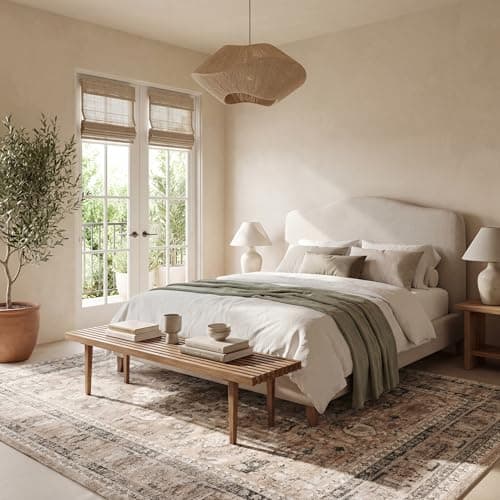 nuLOOM Washable Area RugThe pick for most cat households, and the reason is frequency rather than severity. A cat brings up a hairball on a schedule nobody sets, and the difference between a rug you wash and a rug you scrub is the difference between a five-minute job and a stain you learn to live with. One-piece low-pile polyester washes whole in a domestic machine, dries in hours, and the pile is short enough that nothing soaks through to a backing in the first place. It is very thin - a cat will not mind, but you will want a felt pad under it if the floor is tile - and the larger sizes will outgrow your washer long before they outgrow the room. | Washing the whole rug | One-piece low-pile polyester, machine washable | $201.00View on Amazon #ad We earn a commission · Price as of November 2, 2026 |
| 2 | 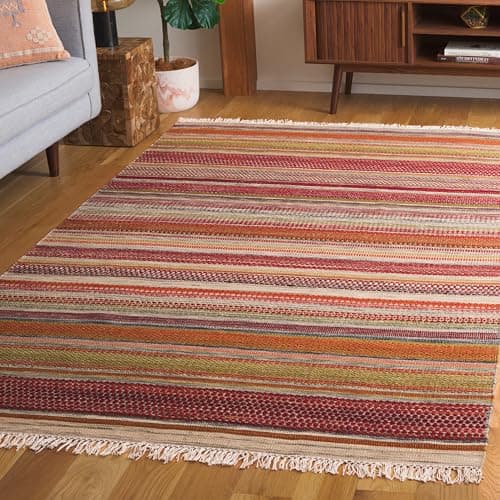 Safavieh Wool Flatweave Kilim RugThe construction answer taken to its logical end: a flatwoven kilim has no pile and no loops at all, so there is nothing standing proud of the backing for a claw to hook and pull. It is also the one rug on this page that will still look good in fifteen years, and wool's crush recovery means the route a cat runs between the window and the food bowl does not become a permanent lane. Two real downsides, and both matter here: wool absorbs urine deeply and holds the odor, so this is the wrong rug for a cat with a marking habit or a litter-box grievance, and it costs several times what the washable options cost. | No loops at all | Flatwoven wool, effectively no pile | $349.34View on Amazon #ad We earn a commission · Price as of November 2, 2026 |
| 3 | 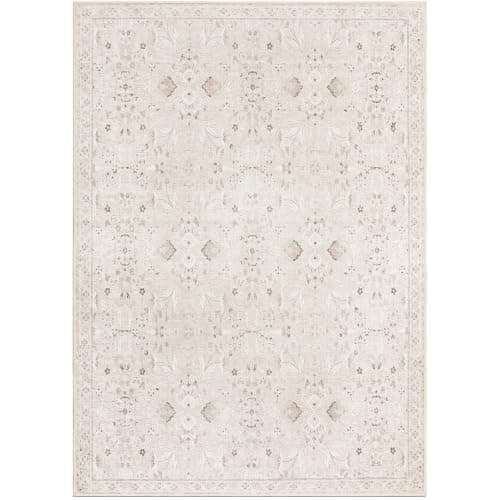 Tumble Washable RugThe two-piece system to buy if the problem is liquid rather than claws. The surface carries a water-based stain-resistant treatment, which does not make the rug waterproof but does buy you the minutes it takes to find a cloth - and with cat vomit, minutes are the whole game, because the pigment in it sets fast. The cover comes off and goes through a full wash cycle, which is the only method that removes what has reached the backing. The design catalog is much narrower than the category leader's, the treatment is a coating that weakens with repeated washing, and the pad never goes in the machine. | Vomit and hairballs | Two-piece with a stain-shedding surface treatment | $199.00View on Amazon #ad We earn a commission · Price as of November 2, 2026 |
| 4 | 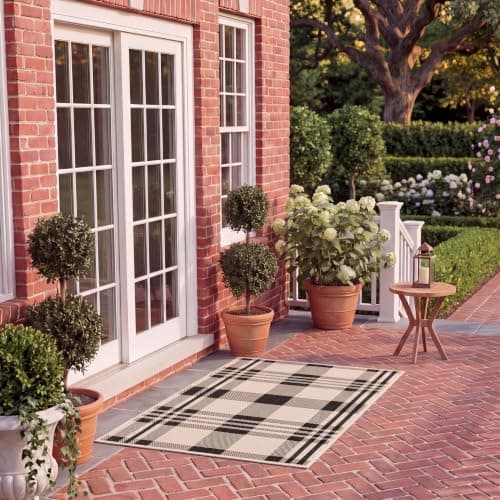 Safavieh Courtyard Indoor/Outdoor RugThe litter-box rug, and the cheapest genuinely useful thing on this page. Litter granules are abrasive grit, and a cat tracks them several feet from the box on its pads - so the rug in that zone is not decor, it is a filter you expect to get dirty. A flatwoven solution-dyed polypropylene weave at a quarter-inch pile catches granules in a surface you can shake out or hose, sheds liquid instead of drinking it, and costs little enough that replacing it annually is a reasonable plan. It is firm, and it reads as synthetic up close. In this spot that is the point. | Beside the litter box | Power-loomed polypropylene, roughly a quarter-inch pile, no backing | $19.78$25.43View on Amazon #ad We earn a commission · Price as of November 2, 2026 |
| 5 | 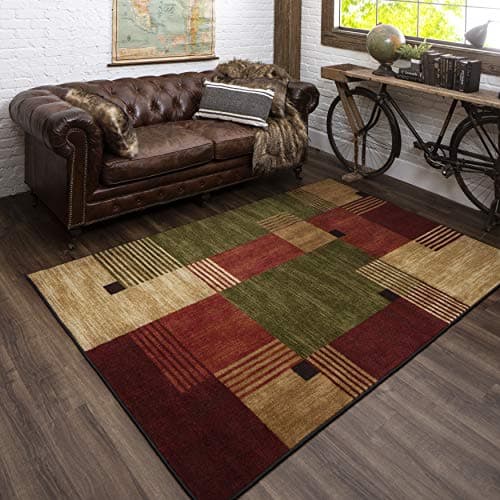 Mohawk Home Alliance Geometric RugThe non-washable pick, for a settled adult cat where hair and wear are the real problem rather than accidents. It is low-profile cut pile - never loop - which keeps the claw risk down, and it is low enough that a vacuum head reaches the backing where cat hair actually accumulates. The busy geometric pattern does work no solid color can: cat hair is fine, light-colored on a dark rug and dark on a light one, and a mid-tone pattern hides both. It is spot-clean only, so pair it with something washable in the room where the cat is actually sick. | Shed hair and wear | Low-profile synthetic cut pile on a textured latex backing | $101.99$109.99View on Amazon #ad We earn a commission · Price as of November 2, 2026 |
| 6 | 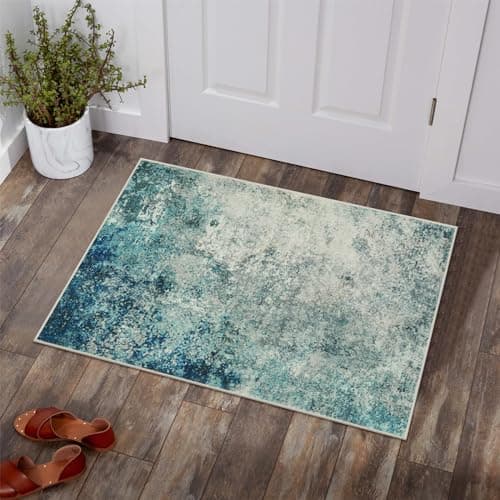 Lahome Washable Accent RugThe answer to the one spot a cat has claimed. Cats are specific - a particular corner, a particular patch of sun, the foot of the bed - and the cheapest correct response is a small washable rug in that exact place rather than a better rug everywhere. This one is ultra-thin printed low pile that machines weekly without complaint, at a price that makes a weekly wash feel reasonable and a replacement feel trivial. It is genuinely thin, it is accent-sized, and it will not anchor a room. That is not what it is for. | The one spot it keeps using | Ultra-thin printed low-pile surface, machine washable | $26.39View on Amazon #ad We earn a commission · Price as of November 2, 2026 |
The short answer
Buy low, dense, cut pile - and rule out loop pile and sisal completely. The difference from a dog is intent: a dog's claw hooks a loop by accident, while a cat is actively looking for a surface with the right resistance, and a loop weave or a sisal rug is that surface. Then buy washable, because hairballs are frequent and vomit sets fast.
Most pet rug advice treats cats and dogs as one problem with different hair. They are not. A dog damages a rug as a side effect of walking on it; a cat damages a rug because the rug is good at being scratched. That single difference reverses one piece of standard rug advice and makes two others matter much more than they do with a dog, and it is why this page exists separately from the best rugs for dogs.
A cat is choosing, not catching
Scratching is not misbehavior and it is not boredom. The ASPCA describes it as doing several jobs at once: cats scratch during play, they scratch to mark territory or as a signal to other cats, and they scratch to remove the frayed, worn outer layer of the claw and expose the new sharp one underneath. That last one is maintenance, and a cat will do it whether or not you provide somewhere appropriate.
What makes this a rug problem is what cats look for in a surface. The ASPCA's own list of materials to offer on a scratching post is cardboard, carpeting, wood, sisal and upholstery - and it notes that cats differ in orientation, with some preferring a vertical grain for raking and others favoring a horizontal grain for picking. A rug is a horizontal grain. A woven sisal rug is a horizontal grain made of the exact fiber sold on scratching posts. If your cat is a picker rather than a raker, a sisal or loop-weave rug is not a rug that happens to be vulnerable; it is a scratching post you paid to install wall to wall.
This is the one place where we give different advice for cats than for any other room on the site. Sisal is the toughest natural fiber we cover and we recommend it freely for hallways and high-traffic rooms - the best rug material for high traffic puts it in the top three. In a house with a cat, take it off the list.
The three problems, in order of how often they happen
Hair, constantly. Cat hair is finer than dog hair and it works deeper into a pile, where it binds around the yarn rather than resting on it. Pile height decides how bad this gets: at a quarter-inch, hair sits where a vacuum head can actually reach it; at an inch, the rug is a hair reservoir and vacuuming is theater. A mid-tone busy pattern also matters more with a cat than with a dog, because most cats shed two colors at once.
Vomit and hairballs, regularly. This is the problem people underestimate and it is the one that decides whether you should buy washable. Hairballs arrive without warning, often in the same favored spot, and cat vomit carries pigment from food that sets into fiber quickly - which makes the first ten minutes worth more than any cleaning product. A rug you can put in a machine turns this into laundry. A rug you cannot turns it into a permanent mark you stop noticing and visitors do not.
Litter, every single day. A cat leaves the box with granules on its pads and distributes them across several feet of floor. Those granules are abrasive - functionally the same as the grit a dog tracks in from a yard - so a rug in the litter zone wears faster than any other rug in the house, and it also traps the dust that comes with clay litter. Treat that rug as a consumable and choose it for shaking out rather than for looks.
Marking is a fourth problem, and it is less common but far worse when it happens. Cat urine is the hardest pet mess to remove from a rug: the residue stays below the surface after the liquid dries, it is exactly what draws the cat back to the same place, and a surface clean reaches none of it. Pet stains and odors sets out what actually works, and the short version is saturation with an enzyme product rather than blotting with anything else.
The six things we judged these on
- Cut pile, never loop. The firm rule, and firmer here than on the dog page. A loop stands proud of the backing and offers the resistance a cat is hunting for. A cut pile offers nothing to hook.
- No sisal, and no sisal-look weave with a real rib. The fiber and the texture are both what scratching posts are made of. A smooth synthetic that merely looks like sisal is a different matter, but a genuinely ribbed weave is not.
- Whether the whole rug washes. Hairballs are frequent and cat vomit sets fast, so the only honest fix is a full wash cycle - and that means checking the size against your own machine before you order.
- Pile height, as low as the room allows. Fine hair, litter dust and granules all collect in depth. A low pile keeps every one of them where a vacuum can reach.
- Pattern, which is not a cosmetic criterion here. A mid-tone busy pattern hides the two hair colors most cats shed and the traffic lane that forms along the cat's favorite route.
- Grip, and it matters for a different reason than with a dog. A cat pushes off hard when it accelerates, and a rug that slides at that moment is both a scratching trigger and something the cat will stop using. A rug with its own backing, or a pad under it.
We compared published fiber content, pile construction and height, backing type and the maker's own stated care instructions across current listings, and we took the behavioral points from the ASPCA's guidance rather than from rug marketing. We do not test rugs with cats and make no claim to have done so - how we choose sets out the method and its limits plainly.
nuLOOM Washable Area Rug
Washing the whole rug
Product photo and price from Amazon, refreshed daily.
#ad We earn a commission · Price as of November 2, 2026
The pick for most cat households, and the reason is frequency rather than severity. A cat brings up a hairball on a schedule nobody sets, and the difference between a rug you wash and a rug you scrub is the difference between a five-minute job and a stain you learn to live with. One-piece low-pile polyester washes whole in a domestic machine, dries in hours, and the pile is short enough that nothing soaks through to a backing in the first place. It is very thin - a cat will not mind, but you will want a felt pad under it if the floor is tile - and the larger sizes will outgrow your washer long before they outgrow the room.
What it is
- One-piece construction with an integrated non-slip backing; no separate pad included
- Ultra-thin low pile sized to fit a domestic washer
- Wide size range including runners and rounds
- Machine wash cold on gentle; line dry or air-only, never on heat
What it does well
- The cheapest honest route into a washable rug
- One piece, so there is no cover to shift out of alignment
- The non-slip backing means it stays put without buying a pad first
- Sizes go down to accent and runner dimensions the two-piece systems often skip
Don't buy it if
- Ultra-thin, with essentially no cushioning — a felt pad is still worth it for comfort
- The stain repellency is a surface coating, and coatings weaken with every wash
- 100% polyester, which is the wrong answer entirely if you wanted natural fiber
The value pick: it does the one job the category exists for and does not pretend to do anything else.
Safavieh Wool Flatweave Kilim Rug
No loops at all
Product photo and price from Amazon, refreshed daily.
#ad We earn a commission · Price as of November 2, 2026
The construction answer taken to its logical end: a flatwoven kilim has no pile and no loops at all, so there is nothing standing proud of the backing for a claw to hook and pull. It is also the one rug on this page that will still look good in fifteen years, and wool's crush recovery means the route a cat runs between the window and the food bowl does not become a permanent lane. Two real downsides, and both matter here: wool absorbs urine deeply and holds the odor, so this is the wrong rug for a cat with a marking habit or a litter-box grievance, and it costs several times what the washable options cost.
What it is
- Flatwoven — effectively no pile at all
- Wool fiber with a handwoven geometric pattern
- Reversible on many of the kilim patterns
What it does well
- Chairs slide over it instead of catching, which is exactly what a dining room needs
- No pile means nothing to crush, so furniture leaves no permanent dents
- Wool's soil resistance without wool's shedding
Don't buy it if
- Thin and firm underfoot — it will not feel luxurious
- Flatweaves need a good pad or they creep across the floor
- Spilled liquid goes straight through to the floor below
The correct rug shape for a dining room, in the correct fiber. Almost nobody buys this and regrets it.
Tumble Washable Rug
Vomit and hairballs
Product photo and price from Amazon, refreshed daily.
#ad We earn a commission · Price as of November 2, 2026
The two-piece system to buy if the problem is liquid rather than claws. The surface carries a water-based stain-resistant treatment, which does not make the rug waterproof but does buy you the minutes it takes to find a cloth - and with cat vomit, minutes are the whole game, because the pigment in it sets fast. The cover comes off and goes through a full wash cycle, which is the only method that removes what has reached the backing. The design catalog is much narrower than the category leader's, the treatment is a coating that weakens with repeated washing, and the pad never goes in the machine.
What it is
- Two-piece system like Ruggable, with a thicker pad included
- Surface carries a water-based stain-resistant treatment
- Sold as a bundle rather than cover and pad priced separately
What it does well
- Liquids bead and sit on the surface longer than on untreated polyester, which buys you time to blot
- The included pad is noticeably thicker than the entry-level competition
- Bundled pricing makes the real cost obvious up front
Don't buy it if
- A much smaller design catalog than Ruggable
- The stain treatment is a coating, not a permanent property of the fiber — it fades with repeated washing
- Fewer size options, especially at the very large end
The one to buy if the rug is going somewhere food and drink actually land — a dining room, a playroom.
Safavieh Courtyard Indoor/Outdoor Rug
Beside the litter box
Product photo and price from Amazon, refreshed daily.
#ad We earn a commission · Price as of November 2, 2026
The litter-box rug, and the cheapest genuinely useful thing on this page. Litter granules are abrasive grit, and a cat tracks them several feet from the box on its pads - so the rug in that zone is not decor, it is a filter you expect to get dirty. A flatwoven solution-dyed polypropylene weave at a quarter-inch pile catches granules in a surface you can shake out or hose, sheds liquid instead of drinking it, and costs little enough that replacing it annually is a reasonable plan. It is firm, and it reads as synthetic up close. In this spot that is the point.
What it is
- 100 percent polypropylene, power loomed in Turkey
- Pile around a quarter of an inch, with no applied backing
- Rated for indoor or outdoor use and listed as cleanable with a garden hose
What it does well
- A far deeper pattern catalog than the stripe-and-solid outdoor norm - borders, geometrics and traditional medallions
- Polypropylene absorbs no water, so nothing in the rug can feed mildew
- The quarter-inch pile hoses clean and dries far faster than any cut-pile rug
Don't buy it if
- Fade resistant is not fade proof - a quarter-inch pigmented pile in unshaded afternoon sun will still lighten over a few summers
- No backing at all, so it slides and creeps without an outdoor pad
- A quarter-inch pile is firm underfoot; comfort is not what this line is for
The outdoor rug for people who want a pattern rather than a stripe, bought with clear eyes about what a south-facing summer does to any synthetic.
Mohawk Home Alliance Geometric Rug
Shed hair and wear
Product photo and price from Amazon, refreshed daily.
#ad We earn a commission · Price as of November 2, 2026
The non-washable pick, for a settled adult cat where hair and wear are the real problem rather than accidents. It is low-profile cut pile - never loop - which keeps the claw risk down, and it is low enough that a vacuum head reaches the backing where cat hair actually accumulates. The busy geometric pattern does work no solid color can: cat hair is fine, light-colored on a dark rug and dark on a light one, and a mid-tone pattern hides both. It is spot-clean only, so pair it with something washable in the room where the cat is actually sick.
What it is
- Synthetic cut pile with the maker's soil and stain protection, listed as fade resistant
- Low-profile pile — the 5x8 listing gives an overall height of about 0.4 in
- Textured latex backing for grip on hard floors
- Care line is vacuum, spot clean with mild detergent, or clean professionally
What it does well
- Cut pile rather than loop, which is the single most important thing on a rug a dog walks on
- Low profile means a vacuum head reaches the backing, which is where hair collects
- The latex backing holds it still without a separate pad on tile or laminate
Don't buy it if
- Spot clean only. If your problem is accidents rather than hair, a washable rug beats it outright
- Polyester pile mats down in a traffic lane faster than wool or nylon does
- Individual colorways and sizes go in and out of stock, so the exact variant you see may change
The rug to buy when the dog problem is claws, grit and hair rather than accidents — cut pile, low, and cheap enough to replace.
Lahome Washable Accent Rug
The one spot it keeps using
Product photo and price from Amazon, refreshed daily.
#ad We earn a commission · Price as of November 2, 2026
The answer to the one spot a cat has claimed. Cats are specific - a particular corner, a particular patch of sun, the foot of the bed - and the cheapest correct response is a small washable rug in that exact place rather than a better rug everywhere. This one is ultra-thin printed low pile that machines weekly without complaint, at a price that makes a weekly wash feel reasonable and a replacement feel trivial. It is genuinely thin, it is accent-sized, and it will not anchor a room. That is not what it is for.
What it is
- Listed at roughly 0.3 in thick — thin enough to sit under a door or a furniture leg
- Machine washable, and light enough to carry to the machine one-handed
- Widely stocked at 2x3 and 3x5
- Backing varies by variant: some are non-slip coated, the woven cotton versions have no backing at all
What it does well
- The thinness is the feature — no lip to catch a toe, no door that has to be lifted over it
- Cheap enough per rug that you can keep a second one in rotation while the first is in the wash
- Prints and colorways turn over quickly, so it does not look like the rug everyone else has
Don't buy it if
- There is nothing underfoot. Thin is comfortable to nobody
- The non-slip coating is a surface treatment and it gets less grippy with each wash
- Backing and construction differ between listings under the same brand — read the specific variant, not the brand
The right answer where a small rug gets dirty faster than it gets admired: a kitchen sink, a back door, a laundry floor.
Fiber by fiber in a cat household
| Fiber | Scratch appeal | Vomit and liquid | Hair | Verdict for cats |
|---|---|---|---|---|
| Polypropylene | Low as cut pile, high as loop | Sheds it; wipes or hoses clean | Releases hair readily | The default. Cheap, tough, often washable |
| Polyester | Low as cut pile | Holds it briefly; treated lines buy time | Good at low pile | Softer, and the washable category lives here |
| Wool | Low as flatweave, moderate as pile | Resists, then absorbs and holds odor | Grips fine hair harder than synthetics | Excellent as a flatweave, risky with a marker |
| Cotton | Low | Absorbs instantly; launders at small sizes | Fine at flatweave thickness | Good as a washable mat, wrong as a room rug |
| Sisal | Very high - this is post material | Stains permanently | Traps hair in the weave | No, in any room a cat uses |
| Jute | High - a loose, coarse grain | Stains and mildews | Traps hair | No |
| Viscose | Moderate | Water alone marks it for good | Poor | Never, in any room at all |
The table lands on synthetics for the same reason the dog page does, with one addition: wool is genuinely excellent here provided it is flatwoven and provided the cat does not mark. A wool kilim is the least scratch-attractive construction we cover and the longest-lived rug on this page, and those two facts together make it the one premium rug worth the risk. Wool rugs and the best flatweave rugs cover both halves of that.
Match the rug to your actual cat
A cat that scratches the floor
Buy cut pile and nothing else, and solve the behavior at the same time rather than instead. A rug change alone moves the problem rather than ending it: a cat denied the resistance it wants on the rug will find it on a sofa arm or a door frame. Put a sturdy sisal post immediately beside the spot the cat has chosen, keep the claws trimmed, and buy the rug on the assumption the post works.
A cat with frequent hairballs
Buy washable and buy it in a size your machine takes - that constraint does more to decide this purchase than any other. Measure the drum first: a one-piece washable at 5x7 fits almost any domestic machine and a one-piece 8x10 fits none of them, which is why the two-piece cover systems exist. How to choose a washable rug works through the decision in order, and the best washable rugs for pets is the deeper list.
A heavy shedder, or a long-haired cat
Low pile and a mid-tone pattern, then vacuum in two directions rather than one. Fine hair binds around the yarn, and a single pass in one direction lifts perhaps half of it - vacuuming rugs covers why crossing the pile at right angles roughly doubles what you pick up. Nothing about fiber choice beats those two habits in a long-haired household.
A cat that marks
This is a veterinary and behavioral question before it is a rug question, and a cat that has started marking indoors should be seen by a vet - it is frequently a medical signal rather than a preference. On the rug side, the rule is absolute: nothing absorbent, nothing you cannot wash whole, and nothing expensive until the behavior has stopped. A cheap washable rug in the affected area, washed properly with an enzyme product, is the only approach that removes the residue the cat is navigating by.
The litter zone deserves its own rug
The highest-value rug in a cat household is usually the cheapest one: a flat, wipeable mat in front of the litter box. It catches granules at the point of exit, which protects every other rug in the house from the grit that actually wears them out, and it concentrates the daily mess in one place you can pick up and shake outside.
Two specifics make the difference. Give it enough length that the cat takes at least two full steps on it before reaching bare floor - one step does not clear the pads. And choose something with a surface texture coarse enough to knock granules loose but not ribbed enough to read as a scratching surface, which in practice means a flat indoor-outdoor weave rather than a sisal mat. Entryway rugs covers the same catch-it-at-the-door logic for the front of the house.
Living with it: four things that matter
- Keep the claws trimmed. It is the cheapest rug protection available and it reduces damage on any construction. It does not reduce the urge to scratch, which is why the post still matters.
- Treat vomit within minutes, not hours. The pigment sets into fiber as it dries. Lift the solids, flush the area with cool water, and blot from the outside in - heat and scrubbing both drive it deeper.
- Vacuum the litter zone separately and often. Granules ground into a rug by foot traffic do the same abrasive damage as sand, and once they are in the backing a vacuum will not get them out.
- Watch the sunny patch. A cat picks the brightest spot in the room and lies in it for hours, which concentrates both hair and UV exposure in one place. Rotating the rug twice a year spreads both - and fade is real on anything that is not solution-dyed. Fade-resistant outdoor rugs explains why solution dyeing is what matters.
What we would buy
For most cat households, the one-piece washable low-pile rug in the largest size the washing machine takes, with a felt pad under it for warmth on a hard floor. For a living room where the cat is settled and accidents are not the issue, a wool flatweave - no loops, no pile, and a rug that outlives several synthetic ones. For the room where hairballs actually land, a two-piece washable with a stain-shedding surface. For the litter zone, the cheapest flat indoor-outdoor weave that fits, replaced annually without sentiment. And for the one corner your cat has decided is its own, a small washable accent rug rather than a better rug everywhere.
If the floor is shared with a dog, the best rugs for dogs covers the differences - and where the two conflict, follow the cat page, because the cat is the one actively looking for something to scratch. If wear and traffic are as much of a problem as the animals, the best rugs for pets and high traffic takes the same question from the durability end. And if you have not settled on a size yet, standard rug sizes has every size a US retailer stocks with the square footage that decides it.
Questions people actually ask
What is the best type of rug for cats?
A low, dense, cut-pile rug in a synthetic fiber, in a mid-tone pattern, and washable if you can get it at the size you need. Cut pile gives a claw nothing to hook, low pile keeps fine hair where a vacuum reaches it, and washability is what handles hairballs.
Why do cats scratch rugs?
The ASPCA describes scratching as play, as territory marking, and as claw maintenance - removing the frayed outer layer to expose the new claw underneath. Cats also differ in preference, with some favoring a horizontal grain for picking, and a rug is a horizontal grain.
Are sisal rugs bad for cats?
Sisal is one of the materials the ASPCA lists for scratching posts, so a sisal rug is made of the fiber your cat is already looking for, in a ribbed horizontal weave. It is an excellent rug everywhere else in the house and the wrong one in a room a cat uses.
Is loop pile bad with a cat?
Yes, and more so than with a dog. A loop stands proud of the backing and gives a claw exactly the resistance a cat is hunting for, so it is an invitation rather than a risk. Berber-style rugs, woven sisal and many indoor-outdoor loop weaves all fall into this group.
What rug hides cat hair best?
A mid-tone busy pattern at low pile. Most cats shed light and dark hair at once, so a dark solid shows one and a light solid shows the other, while a mid-tone pattern hides both. Deep pile hides hair only in the sense that it swallows it.
How do you get cat vomit out of a rug?
Speed first: lift the solids, flush with cool water and blot from the outside in within minutes, because the food pigment sets as it dries. Avoid heat and avoid scrubbing, both of which drive it deeper. On a washable rug, a full machine wash is far more effective than any surface method.
What should go in front of a litter box?
A flat, wipeable mat long enough for the cat to take two full steps on it before reaching bare floor. A flat indoor-outdoor weave works better than a sisal mat, both because it does not read as a scratching surface and because granules shake out of it.
Is wool a bad choice with a cat?
Not as a flatweave, which has no loops at all and is the least scratch-attractive construction there is. Wool is a bad choice if the cat marks, because it absorbs urine deeply and holds the odor, and the fix is professional cleaning rather than a wash.
Sources
- ASPCA - destructive scratching: why cats scratch, preferred materials and post placement
- Amazon - nuLOOM machine washable area rug listing
- Amazon - Safavieh wool flatweave kilim rug listing
- Amazon - Tumble washable rug listing
- Amazon - Safavieh Courtyard indoor/outdoor rug listing
- Amazon - Mohawk Home Alliance geometric area rug listing
- Amazon - Lahome washable accent rug listing
Read next
- The Best Rugs for DogsRugs that survive a dog - claws, hair and accidents are three different problems, and the right rug depends on which one you actually have.
- The Best Rugs for Pets and High TrafficRugs that survive dogs, cats and constant footfall — the fibers, the pile, and the one construction to avoid.
- The Best Washable Rugs for PetsWashable rugs that survive claws, accidents and hair — plus why loop pile is the one construction to avoid entirely.
- Pet Stains and OdorsWhy old pet stains keep smelling, how enzyme cleaners work, and the one mistake that makes them permanent.
- The Best Flatweave RugsFlatweave rugs across cotton, wool, sisal and polypropylene, judged on what each fiber does when there is no pile to hide behind.
- Rugs by RoomLiving room, bedroom, kitchen, bathroom, entryway, stairs and runners — the fiber, size and pile each room actually needs.