Rugs by Room
The Best Rugs for Dogs
A dog does three separate things to a rug, and no single rug is best at all three. Work out which one is your problem first.
Heads up: we earn a commission when you buy through links on this page, at no extra cost to you. It never changes which rug we put first — see how we choose and our affiliate disclosure.
Quick picks
The whole answer, before the detail. Tap any row to jump to that rug's full write-up further down the page.
| # | Rug | Best for | Construction | Price |
|---|---|---|---|---|
| 1 | 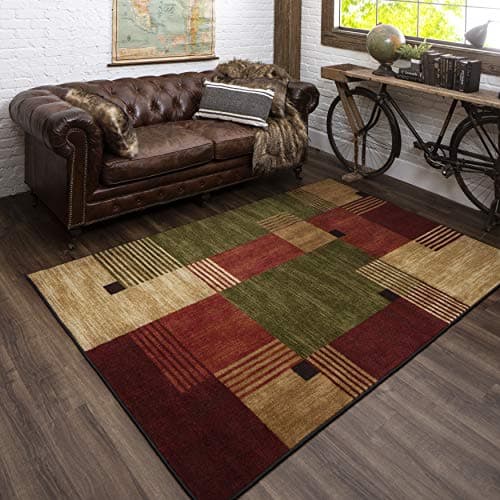 Mohawk Home Alliance Geometric RugThe default answer when the problem is claws, grit and hair rather than accidents. It is cut pile rather than loop, which is the one construction rule that matters on a rug a dog uses, and it is low enough that a vacuum head reaches the backing where hair actually collects. The busy geometric pattern does the work a solid color cannot, hiding both shed hair and the traffic lane a dog wears along its favorite route. It is spot-clean only, so if your real problem is a puppy who has not finished house-training, buy something from further down this list instead. | Claws, grit and hair | Low-profile synthetic cut pile on a textured latex backing | $109.99View on Amazon #ad We earn a commission · Price as of October 19, 2026 |
| 2 | No image Ruggable Classic CollectionThe accident answer, and the reason is residue rather than appearance. Surface-cleaning a soiled rug lifts the stain and leaves the part that causes the smell sitting in the backing, which is why a dog returns to the same spot. A cover that comes off and goes through a full wash cycle removes all of it. The cover is thin and wrinkles at the corners for a week after each wash, and cover and pad are priced separately, so the real cost is higher than the headline. Worth it anyway in the room where accidents happen. | Accidents and odor | Two-piece: printed cover over a separate grip pad | |
| 3 | 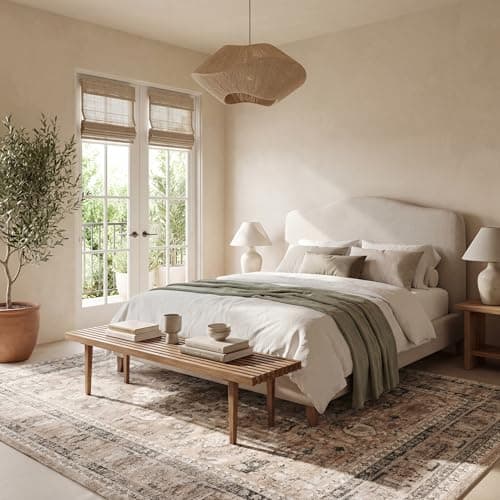 nuLOOM Washable Area RugThe same washing logic in one piece rather than two, which suits people who do not want to re-seat a cover on a pad every time. It washes whole, it comes in sizes small enough to fit a domestic drum, and there is nothing to separate or mis-align. The integrated non-slip backing grips without a pad, but it is ultra-thin, and larger sizes will outgrow your washing machine long before they outgrow the room. | Washing the whole rug | One-piece low-pile polyester, machine washable | $123.97$179.84View on Amazon #ad We earn a commission · Price as of October 19, 2026 |
| 4 | 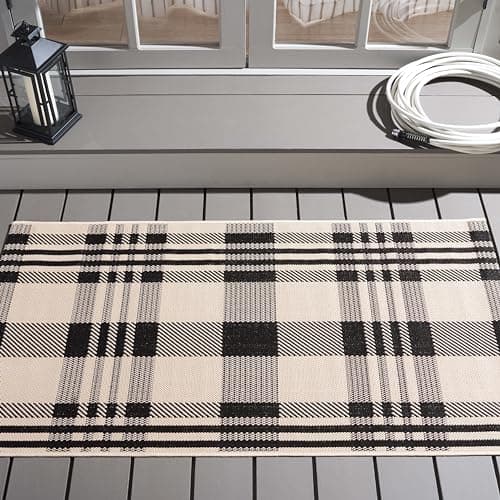 Safavieh Courtyard Indoor/Outdoor RugThe muddy-paw rug, and the one to put by the door the dog actually comes in through. Solution-dyed polypropylene woven flat sheds water instead of absorbing it, so wet paws leave marks that wipe rather than stains that set, and in warm weather the whole rug can go outside and be hosed. It is firm underfoot and reads as synthetic up close - this is a working rug for a working doorway, not a living room centerpiece. | Muddy paws and doorways | Power-loomed polypropylene, roughly a quarter-inch pile, no backing | $19.78$25.43View on Amazon #ad We earn a commission · Price as of October 19, 2026 |
| 5 | 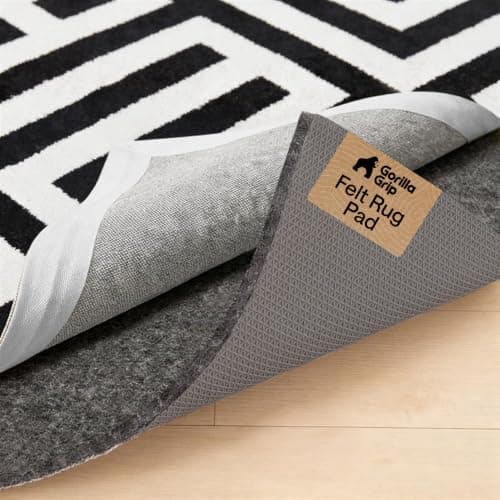 Gorilla Grip Felt and Rubber Rug PadNot a rug, and on this page the pick that changes the most for the most dogs. An older or arthritic dog slipping on a hard floor is the commonest reason people buy a rug in the first place, and a rug that slides under a dog's push-off is worse than no rug at all. A felt-and-rubber pad stops the movement and adds the cushioning that a thin washable rug does not have. Check the backing rules before you put one on a finished hardwood floor. | An older dog's footing | Felt top layer over a textured rubber grip layer | $48.99$51.99View on Amazon #ad We earn a commission · Price as of October 19, 2026 |
The short answer
Buy low, dense, cut pile in a synthetic fiber. Loop pile is the one construction to rule out, because a claw goes through a loop and pulls it. If accidents are the problem rather than wear, buy a washable rug instead and wash it whole - surface cleaning leaves the residue that causes the smell.
A dog does three separate things to a rug, and people shopping for one usually have only one of the three. Claws abrade and snag. Hair works its way into the pile and stays. Accidents soak through to the backing. Those three problems want three different rugs, and the single biggest mistake in this category is buying a rug that solves someone else's dog problem rather than yours.
What a dog actually does to a rug
Start with the claws, because they do the damage that cannot be undone. A dog's nails are blunt and they do not cut the way a cat's do, but they catch. On a cut-pile rug a claw passes over the tufts. On a loop-pile rug - a Berber, most sisal weaves, a lot of indoor-outdoor loop constructions - a claw goes into the loop, and the dog's next step pulls a run through the weave that spreads a little further every week. That is not wear. That is a defect you installed yourself at purchase.
Hair is the second problem and the one people underestimate. Shed hair does not sit on top of a rug; it works down into the pile and binds around the yarn, and once it is there a normal vacuum pass will not lift it. Pile height decides how bad this gets. A quarter-inch pile gives hair nowhere to go and a vacuum head can actually reach the backing. A one-inch shag is a hair reservoir, and no amount of vacuuming fixes it.
Accidents are the third, and they are a chemistry problem rather than a cleaning problem. Urine carries salts that stay behind after the liquid dries, and those salts hold moisture and feed bacteria, which is where the smell comes from. Blotting the surface removes the part you can see and leaves the part that smells, sitting in the backing where the dog can still find it. That is why a dog goes back to the same spot after you have cleaned it. Pet stains and odors covers what actually works, and the short version is that full saturation and an enzyme product beat any surface method.
There is a fourth thing, and it only applies to some households: grit. A dog that goes outside brings in sand, road salt and small stones, and grit is abrasive under foot traffic in a way that hair never is. In a house with a yard, the rug by the back door wears out three times faster than the one in the middle of the living room, and that is the rug to buy cheap and replace rather than the rug to spend on.
The one hard rule: no loop pile
Everything else on this page is a judgment call. This one is not. If the yarn forms a loop that stands proud of the backing, a dog's claw will eventually hook it, and the resulting pull will not stop. It is the single most common way a rug dies in a dog household, and it is entirely avoidable at the point of purchase: look at the listing photograph closely enough to see whether the surface is made of cut tufts or of loops.
This rules out more rugs than people expect. Most Berber-style rugs are loop. Woven sisal and most jute constructions are loop or near enough that a claw treats them the same way. Several popular indoor-outdoor lines are loop because loops survive weather better. None of those are bad rugs; they are bad rugs for this room. Do sisal rugs shed and the best rug material for high traffic go further into where those fibers do belong.
The six things we judged these on
- Cut pile, never loop. The rule above. Everything else is secondary to it, because every other kind of damage is gradual and a pulled loop is not.
- Pile height, as low as the room allows. Low pile means hair sits where a vacuum can reach it, grit does not disappear into the backing, and the rug dries in hours rather than days after a wash or a wet-paw afternoon.
- What happens to liquid. Polypropylene sheds it, polyester holds it briefly, wool resists it then absorbs, cotton takes it instantly. This decides whether an accident is a wipe, a wash or a professional clean.
- Whether the whole thing can be washed. Not spot-cleaned - washed. This is the only criterion that addresses odor at its source, and it is the one that separates a rug you keep from a rug you throw out.
- Grip, for the dog rather than for you. A rug that slides under a dog's push-off is actively worse than a bare floor for an older animal, because it moves at exactly the moment the dog is committing weight to it.
- Pattern, which is not a cosmetic criterion here. A mid-tone, busy pattern hides shed hair and a developing traffic lane. A dark solid shows every light hair and a light solid shows every dark one.
We compared published fiber content, pile construction and height, backing type and the maker's own stated care instructions across current listings. We do not test rugs with dogs and make no claim to have done so - how we choose sets out the method and its limits plainly.
Mohawk Home Alliance Geometric Rug
Claws, grit and hair
Product photo and price from Amazon, refreshed daily.
#ad We earn a commission · Price as of October 19, 2026
The default answer when the problem is claws, grit and hair rather than accidents. It is cut pile rather than loop, which is the one construction rule that matters on a rug a dog uses, and it is low enough that a vacuum head reaches the backing where hair actually collects. The busy geometric pattern does the work a solid color cannot, hiding both shed hair and the traffic lane a dog wears along its favorite route. It is spot-clean only, so if your real problem is a puppy who has not finished house-training, buy something from further down this list instead.
What it is
- Synthetic cut pile with the maker's soil and stain protection, listed as fade resistant
- Low-profile pile — the 5x8 listing gives an overall height of about 0.4 in
- Textured latex backing for grip on hard floors
- Care line is vacuum, spot clean with mild detergent, or clean professionally
What it does well
- Cut pile rather than loop, which is the single most important thing on a rug a dog walks on
- Low profile means a vacuum head reaches the backing, which is where hair collects
- The latex backing holds it still without a separate pad on tile or laminate
Don't buy it if
- Spot clean only. If your problem is accidents rather than hair, a washable rug beats it outright
- Polyester pile mats down in a traffic lane faster than wool or nylon does
- Individual colorways and sizes go in and out of stock, so the exact variant you see may change
The rug to buy when the dog problem is claws, grit and hair rather than accidents — cut pile, low, and cheap enough to replace.
Ruggable Classic Collection
Accidents and odor
No licensed photo of this exact rug yet — see it on the Amazon listing.
The accident answer, and the reason is residue rather than appearance. Surface-cleaning a soiled rug lifts the stain and leaves the part that causes the smell sitting in the backing, which is why a dog returns to the same spot. A cover that comes off and goes through a full wash cycle removes all of it. The cover is thin and wrinkles at the corners for a week after each wash, and cover and pad are priced separately, so the real cost is higher than the headline. Worth it anyway in the room where accidents happen.
What it is
- Two-piece system — a thin printed cover plus a separate cushioned pad
- Cover is machine washable in a standard home washer up to the 8x10 size
- Pile is very low, roughly an eighth of an inch on the Classic line
What it does well
- The largest catalog of designs in the washable category by a wide margin
- The cover packs down small, so shipping damage and storage are non-issues
- Replacement covers let you change the look without rebuying the pad
Don't buy it if
- The cover can wrinkle at the corners for a week or two after a wash
- It is thin. If you want something plush underfoot, this is the wrong system
- Cover and pad are priced separately, which makes the real cost easy to underestimate
The default washable rug for most rooms, because the design range means you rarely trade looks for washability.
nuLOOM Washable Area Rug
Washing the whole rug
Product photo and price from Amazon, refreshed daily.
#ad We earn a commission · Price as of October 19, 2026
The same washing logic in one piece rather than two, which suits people who do not want to re-seat a cover on a pad every time. It washes whole, it comes in sizes small enough to fit a domestic drum, and there is nothing to separate or mis-align. The integrated non-slip backing grips without a pad, but it is ultra-thin, and larger sizes will outgrow your washing machine long before they outgrow the room.
What it is
- One-piece construction with an integrated non-slip backing; no separate pad included
- Ultra-thin low pile sized to fit a domestic washer
- Wide size range including runners and rounds
- Machine wash cold on gentle; line dry or air-only, never on heat
What it does well
- The cheapest honest route into a washable rug
- One piece, so there is no cover to shift out of alignment
- The non-slip backing means it stays put without buying a pad first
- Sizes go down to accent and runner dimensions the two-piece systems often skip
Don't buy it if
- Ultra-thin, with essentially no cushioning — a felt pad is still worth it for comfort
- The stain repellency is a surface coating, and coatings weaken with every wash
- 100% polyester, which is the wrong answer entirely if you wanted natural fiber
The value pick: it does the one job the category exists for and does not pretend to do anything else.
Safavieh Courtyard Indoor/Outdoor Rug
Muddy paws and doorways
Product photo and price from Amazon, refreshed daily.
#ad We earn a commission · Price as of October 19, 2026
The muddy-paw rug, and the one to put by the door the dog actually comes in through. Solution-dyed polypropylene woven flat sheds water instead of absorbing it, so wet paws leave marks that wipe rather than stains that set, and in warm weather the whole rug can go outside and be hosed. It is firm underfoot and reads as synthetic up close - this is a working rug for a working doorway, not a living room centerpiece.
What it is
- 100 percent polypropylene, power loomed in Turkey
- Pile around a quarter of an inch, with no applied backing
- Rated for indoor or outdoor use and listed as cleanable with a garden hose
What it does well
- A far deeper pattern catalog than the stripe-and-solid outdoor norm - borders, geometrics and traditional medallions
- Polypropylene absorbs no water, so nothing in the rug can feed mildew
- The quarter-inch pile hoses clean and dries far faster than any cut-pile rug
Don't buy it if
- Fade resistant is not fade proof - a quarter-inch pigmented pile in unshaded afternoon sun will still lighten over a few summers
- No backing at all, so it slides and creeps without an outdoor pad
- A quarter-inch pile is firm underfoot; comfort is not what this line is for
The outdoor rug for people who want a pattern rather than a stripe, bought with clear eyes about what a south-facing summer does to any synthetic.
Gorilla Grip Felt and Rubber Rug Pad
An older dog's footing
Product photo and price from Amazon, refreshed daily.
#ad We earn a commission · Price as of October 19, 2026
Not a rug, and on this page the pick that changes the most for the most dogs. An older or arthritic dog slipping on a hard floor is the commonest reason people buy a rug in the first place, and a rug that slides under a dog's push-off is worse than no rug at all. A felt-and-rubber pad stops the movement and adds the cushioning that a thin washable rug does not have. Check the backing rules before you put one on a finished hardwood floor.
What it is
- Felt-over-rubber construction at a lower price point
- Multiple thicknesses
- Trimmable
What it does well
- Close to the premium pad's performance for meaningfully less money
- Thick enough to make a thin flatweave feel like a real rug
- Widely available in odd sizes
Don't buy it if
- The rubber layer is less dense than the premium option and compresses sooner
- Can leave a faint residue on some sealed floors in hot rooms
- The felt sheds a little when first cut
The value pad. Right under a synthetic rug, and the wrong economy under an expensive rug on an expensive floor.
Fiber by fiber in a dog household
| Fiber | Claws | Accidents | Hair | Verdict for dogs |
|---|---|---|---|---|
| Polypropylene | Fine as cut pile, bad as loop | Sheds liquid, cleans easily | Releases hair readily | The default. Cheap, tough, washable in small sizes |
| Polyester | Fine as cut pile | Holds liquid briefly, stain-treated lines buy time | Good, especially at low pile | Softer than polypropylene, mats faster in a traffic lane |
| Wool | Fine, and it recovers from crushing | Resists at first, then absorbs and holds odor | Grips hair more than synthetics do | Beautiful and expensive to risk with a young dog |
| Cotton | Fine, but it wears fast | Absorbs instantly, washes well at small sizes | Good at flatweave thickness | Only as a small washable mat, never as a room rug |
| Sisal and jute | Usually loop - the claw risk is real | Stains and mildews | Traps hair in the weave | Avoid in a dog room, whatever the room looks like |
The table says polypropylene most of the time, and it is right. Polypropylene rugs explains the fiber in full, including the one honest downside: it looks like what it is up close, and no amount of pattern disguises that. Are polypropylene rugs toxic addresses the question people ask next, which matters when a dog sleeps on the thing.
Match the rug to your dog's actual problem
A puppy, or a dog that is still having accidents
Buy washable, and buy it in a size your own machine can take. Nothing else matters as much, and a rug that merely says stain-resistant is not the same thing - a coating buys you time to blot, it does not remove what soaked through. Measure your washer drum before you order, because the gap between the size that fits and the size the room wants is where most of the disappointment in this category lives. How to choose a washable rug works through that decision properly, and the best washable rugs for pets is the deeper list.
A heavy shedder
Buy low pile and buy a pattern. Those two choices do more for a shedding household than any fiber decision, because the problem is not that hair lands on the rug - it is that hair disappears into it and then reappears on your clothes. A quarter-inch cut pile in a mid-tone pattern gives hair nowhere to hide and nowhere to show. Then vacuum in two directions rather than one; vacuuming rugs covers why that doubles what you actually pick up.
An older dog slipping on a hard floor
This is a traction problem, not a rug problem, and the pad matters more than the rug. What an arthritic dog needs is a surface that does not move when weight lands on it at an angle, and a rug without a pad on hardwood or tile moves exactly then. A felt-and-rubber pad under a low-pile rug gives both grip and a little cushioning. Run the rug as a continuous path rather than as islands, because a dog that has to cross bare floor between rugs will still slip at the crossing. Non-slip rug pads covers the types, and rug pads for hardwood covers which backings will not mark a finish.
What about wool?
Wool is the best rug fiber by almost every measure and it is a genuinely defensible choice in a dog house - with conditions. It is resilient, it recovers from the crushing that a dog bed or a sleeping dog causes, and its natural lanolin resists soil in a way no synthetic matches. A good wool rug under an adult, house-trained, light-shedding dog will outlast three synthetic rugs.
The conditions are where it falls apart. Wool absorbs urine deeply and holds the odor, and a wool rug with a real accident in it needs professional cleaning rather than a wash. It also grips hair harder than a smooth synthetic does, so a heavy shedder makes more work on wool than on polypropylene. And it costs several times what the alternatives cost, which makes the risk calculus different: nobody minds replacing a hundred-dollar rug. Do wool rugs shed and the best wool rugs cover the fiber in full if you are leaning that way.
Size, placement and the parts people get wrong
Buy one size larger than the room strictly needs. A dog does not walk down the middle of a rug; it cuts corners, and a rug that stops short of the furniture leaves the dog's actual route on bare floor - which defeats the point if traction was the reason you bought it, and concentrates wear on the rug's edge if it was not. The edge is where rugs fail anyway, so moving traffic off it buys real years.
Think about where the dog comes in, not just where the dog lies down. The highest-value rug in a dog household is usually a cheap, washable, wipeable one at the back door, because it stops grit and wet at the point of entry and protects everything further in. Spend the money on the living room rug if you like, but buy the door rug first. Entryway rugs covers that spot specifically, and the best rugs for hardwood floors covers what a wet rug can do to the floor underneath it.
Living with it: four things that actually matter
- Vacuum more often than you think, and in two directions. Hair binds around yarn and a single pass in one direction lifts perhaps half of it. Two passes at right angles is not a trick, it is how the pile releases what is caught in it.
- Treat an accident the same day, and saturate rather than blot. The residue sits below the surface, so a surface treatment reaches none of it. An enzyme product applied generously enough to reach the backing is the only method that stops a dog returning to the spot.
- Keep the nails trimmed. It is the cheapest rug-protection measure available and it halves the snag risk on any construction. A dog whose nails click on a hard floor is a dog whose nails are long enough to catch.
- Rotate the rug twice a year. A dog has one favorite route and one favorite sleeping spot, and both wear visibly within a year. Turning the rug 180 degrees spreads that across the whole surface rather than concentrating it in two patches.
What we would buy
For a settled adult dog in a living room, the low-pile patterned synthetic: cut pile, cheap enough to replace, and the pattern does more work than the price. For a puppy or any dog still having accidents, the two-piece washable system, because removing the residue is the only thing that actually solves odor. For somebody who wants one washable rug with nothing to re-seat, the one-piece washable in a size your machine can take. For the door the dog comes in through, the flat indoor-outdoor weave that can be hosed. And for an older dog on a hard floor, the pad - which is the cheapest item on this page and the one that changes the most. If your problem is traffic and wear as much as it is the dog, the best rugs for pets and high traffic takes the same question from the durability end, and the rugs by room hub has the room-by-room versions. If children share that floor with the dog, the best playroom rugs covers the washability and pile-height trade a play space adds.
Questions people actually ask
What is the best type of rug for dogs?
A low-pile, cut-pile rug in a synthetic fiber, in a mid-tone pattern. Cut pile means a claw cannot hook a loop and pull it, low pile means hair stays where a vacuum can reach it, and synthetic fibers shed liquid rather than absorbing it.
Are loop pile rugs bad for dogs?
Yes, and this is the one firm rule on the subject. A claw goes into a loop and the next step pulls a run through the weave that keeps spreading. Berber-style rugs, woven sisal and many indoor-outdoor loop constructions all carry that risk.
What rug hides dog hair best?
A mid-tone, busy pattern at low pile. Dark solids show light hair, light solids show dark hair, and a deep pile hides hair in the sense that it swallows it - which means it is still there and your vacuum is not reaching it.
Are washable rugs worth it for dogs?
If accidents are your problem, yes, because washing the whole rug is the only method that removes the residue below the surface that causes the smell. If your problem is wear and hair rather than accidents, a tougher non-washable rug may last longer.
Will a rug stop my older dog slipping on hardwood?
Only with a pad under it. A rug that slides when weight lands on it at an angle is worse than bare floor for an arthritic dog. Use a felt-and-rubber pad and run the rugs as a continuous path rather than as separate islands.
Is wool a bad choice with a dog?
Not bad, but conditional. Wool is resilient and resists soil naturally, and it suits an adult house-trained dog well. It absorbs urine deeply and holds odor, it grips hair more than synthetics do, and it costs enough that the risk matters.
How often should I vacuum a rug if I have a dog?
More often than a rug in a dog-free room, and in two directions each time. Hair binds around the yarn, so a single pass in one direction lifts only part of it. Low pile makes this far quicker and far more effective.
Sources
- Amazon - Mohawk Home Alliance modern geometric area rug listing
- Amazon - Safavieh Courtyard indoor/outdoor rug listing
- Amazon - nuLOOM machine washable area rug listing
- Amazon - Gorilla Grip felt and rubber rug pad listing
- Mohawk Home - area rug construction and care guidance
- Ruggable - how the two-piece washable system works
Read next
- The Best Rugs for Pets and High TrafficRugs that survive dogs, cats and constant footfall — the fibers, the pile, and the one construction to avoid.
- The Best Washable Rugs for PetsWashable rugs that survive claws, accidents and hair — plus why loop pile is the one construction to avoid entirely.
- Pet Stains and OdorsWhy old pet stains keep smelling, how enzyme cleaners work, and the one mistake that makes them permanent.
- Polypropylene RugsWhy solution-dyeing and water repellency make polypropylene the default budget and outdoor fiber — and its real limits.
- Non-Slip Rug PadsWhy rugs slide, which pad constructions genuinely hold, and the thin options for tight door clearances.
- Rugs by RoomLiving room, bedroom, kitchen, bathroom, entryway, stairs and runners — the fiber, size and pile each room actually needs.